
Reach out to us for an assessment of your project and to receive a personalized quote tailored to your needs.
GP-Probe TGE2
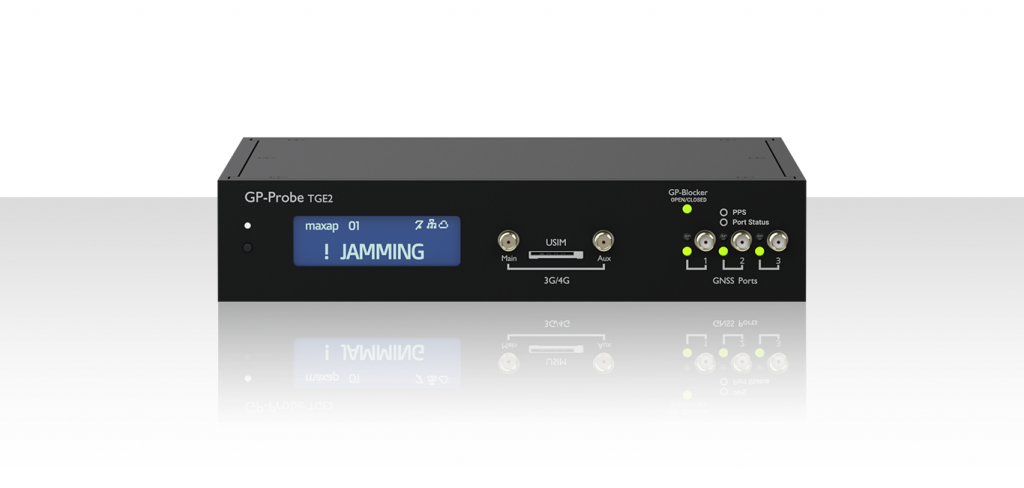
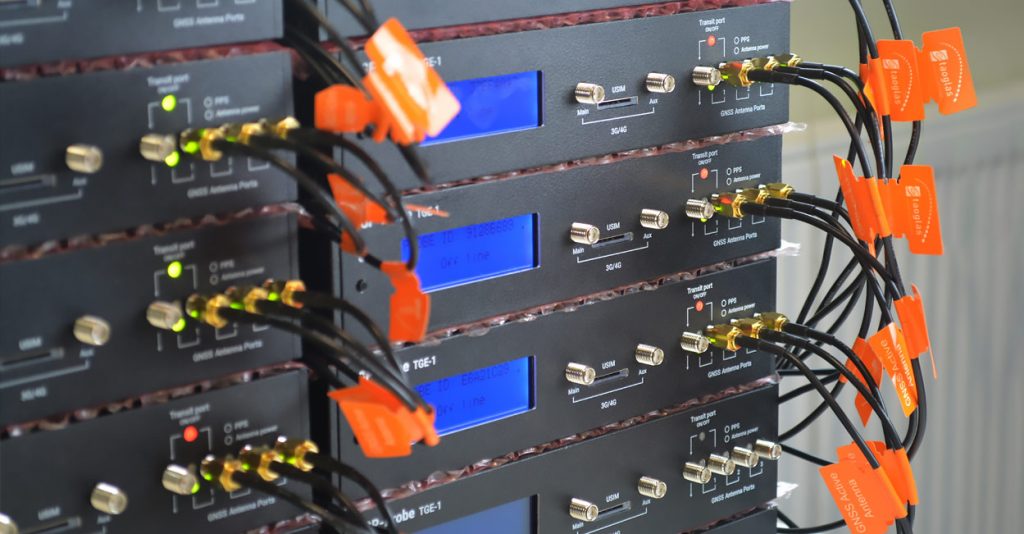
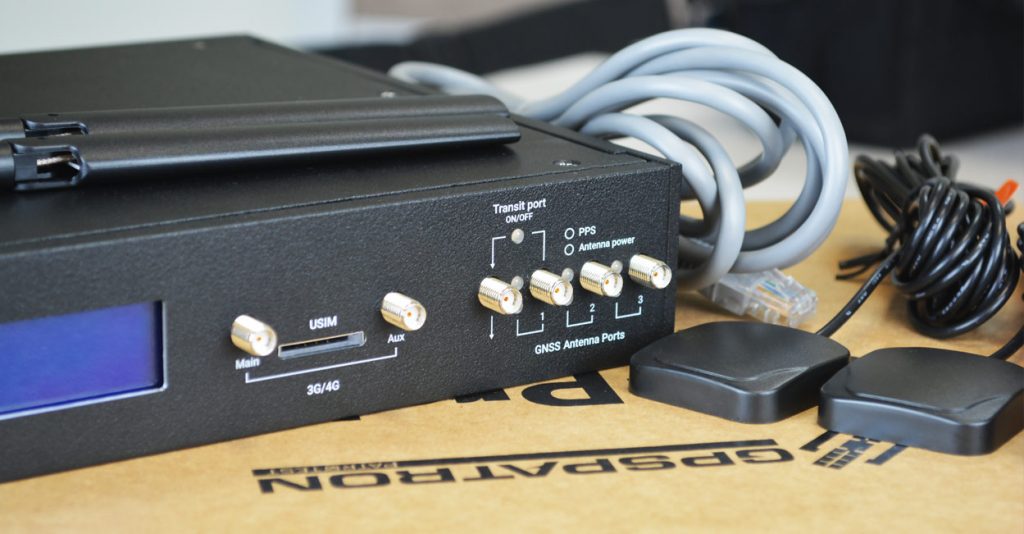
High-performance three-channel GNSS probe with built-in RF signal analyzer. Designed to detect, classify and localize GNSS spoofing/jamming. Three RF channels enable spatial signal analysis, ensuring identification of sophisticated GNSS spoofing attacks.
Contact Us for Project Evaluation
Reseller Directory
Choose from our trusted distributors to enjoy personalized service, expert advice, and compliance with regional standards for a seamless buying experience.
Specification
Supported GNSS
GPS/QZSS L1 C/A
GLONASS L10F
BeiDou B1
SBAS L1 C/A: WAAS, EGNOS, MSAS,GAGAN
Galileo E1B/C
Traceable GNSS
GPS/Galileo/GLONASS
GPS/Galileo/BeiDou
GLONASS/BeiDou
GPS/GLONASS
GPS
GLONASS
Galileo
BeiDou
GNSS Channels
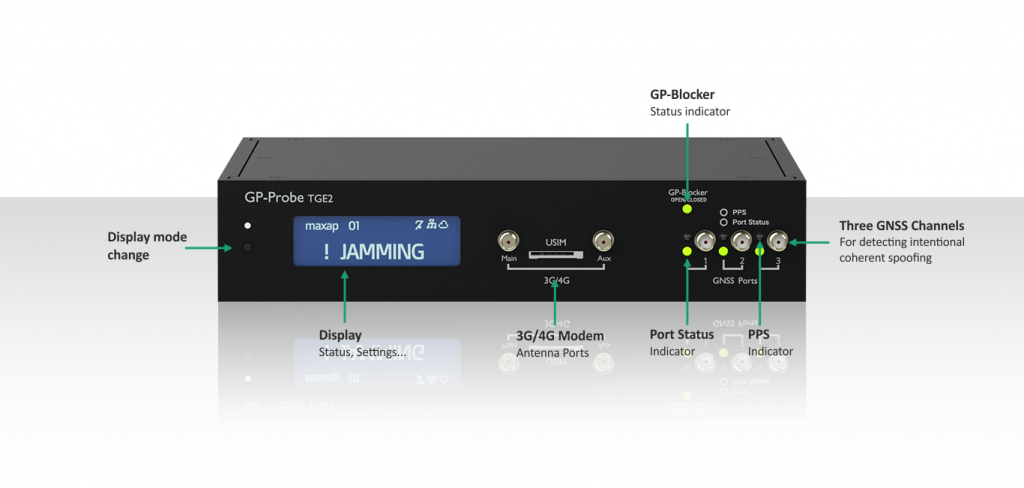
Three GNSS RF channels for assured detection of intentional sophisticated synchronous spoofing attacks
Recommended Horizontal GNSS Antenna Spacing
Min – 0.25 m
Max – 5 m
Detected Threat Types
All types of jamming
1 ch. – asynchronous spoofing
2 ch. – synchronous spoofing
3 ch. – synchronous multiple-TX spoofing
RF Signal Analyzer
| ADC: | 12 bit, 60 MSPS |
| Frequency Range: | 1555 MHz – 1615 MHz |
| Noise Figure: | 6 dB, Max |
| AGC Dynamic Range: | 122 dB, from -31 to +91 dB gain |
| IIP3: | -29 dBm, typical (@ max Rx gain) |
| IIP2: | 28 dBm, typical (@ max Rx gain) |
| Local Oscillator Leakage: | -120 dBm, typical |
| EVM: | -42 dB, typical |
| Local Oscillator: | OCXO, 50 ppb Phase Noise: -154 dBc/Hz @ 10 kHz |
| Input Filter Out of Band Rejection: | 65 dB |
| Measuring Parameters: |
|
| Data Transfer: | The following data is sent to the GP-Cloud every second:
The following data is sent to the GP-Cloud when an incident is detected:
|
GP-Probe Configuration
Browser-based configuration and monitoring, GP-Cloud
Display
GP-Probe status
Server connection settings and status
GNSS channels status: satellites in view, RMS CN0
LEDs
GP-Blocker Status: enabled, disabled, error, closed, open.
GNSS Port Status: enabled, disabled, error, normal.
PPS
Mechanical
| Housing: | Aluminum, IP20 |
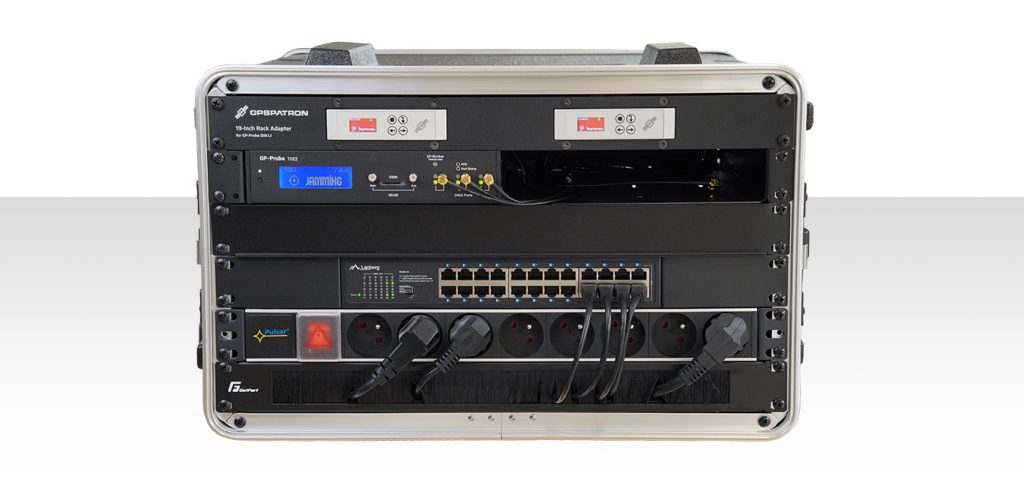
| Size: | 1 U half-size, rack mount, 211.0 x 203.0 x 44.0 mm |
| Weight: | 1.5 kg |
Environmental
| Operational Temperature: | 0°C to +50°C |
| Storage Temperature: | -20°C ~ +70°C |
| Humidity: | 0% – 90% RH non-condensing @ 40°C |
GNSS Antenna Inputs
| Connector: | SMA(F) |
| Max Input Power Level: |
10 dBm |
| Impedance: | 50 Ω |
| Antenna bias voltage: | 3.3 VDC |
| ESD protection: | ±15-kV Air discharge mode IEC 61000-4-2 |
PPS Input
| Connector: | SMA(F) |
| Impedance: | 50 Ω, TTL compliant |
| High-Voltage Level (50 Ω): |
1.3 Min 5.5 Max |
| ESD protection: |
±15-kV Air discharge mode IEC 61000-4-2 |
PPS Output
| Connector: | SMA(F) |
| Impedance: | TTL into 50Ω |
| Typical Accuracy (clear sky): |
±20 ns RMS to UTC (USNO), typical |
| ESD protection: | ±15-kV Air discharge mode IEC 61000-4-2 |
I/O Connections
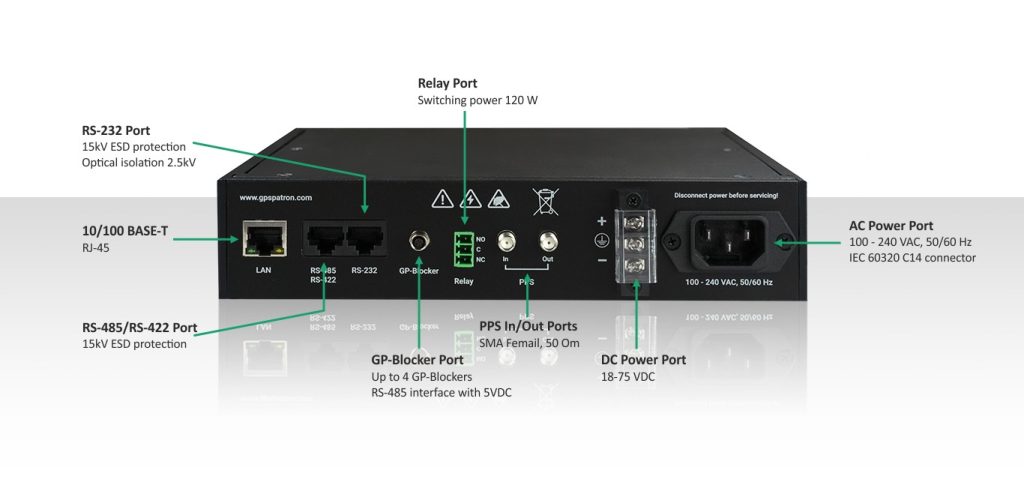
| Network Interface: | 10/100BASE-T RJ45 |
| RS-232 interface: | HOST port for remote control of external equipment. ESD Protection: ±15-kV IEC 61000-4-2, Air-Gap Discharge. Optical isolation. |
| RS-485/RS-422 interface: | HOST port for remote control of external equipment. ESD Protection: ±15-kV IEC 61000-4-2, Air-Gap Discharge. Optical isolation. |
Relay Output
| Relay Type: | 1 Form C (SPDT); NO-C-NC |
| Contact Material: | Silver Alloy with Gold Alloy Overlay |
| Switching Power: | 60 W, 125 VA |
| Switching Voltage DC: | 220 V |
| Switching Voltage AC: | 250 VAC |
| Switching Current: | 2 A |
| Contact Resistance: | 75 mOhms |
GP-Blocker Port
| Interface: | RS-485 |
| Bit Rate: | 9600 bps |
| Power Supply: | 5 VDC, 1 A |
| Max Number of Connected GP-Blockers: | 4 |
Power Supply
| AC: | 100 – 240 VAC, 50/60 Hz IEC 60320 C14 connector |
| DC: | 18 – 75 VDC |
| Power Consumption: | < 20 W |
Supported Protocols
| GP-Cloud interaction: | HTTPS |
| Firmware Upgrade Server: | SFTP |
| Ethernet Protocol: | IPv4, DHCP (RFC 2131) |
4G Modem
| Data transfer: |
|
| Available bands: |
|
| (U)SIM: | Mini-SIM (2FF) ISO/IEC 7810:2003, ID-000 Standard 3V/1.8V user card interface. ESD Protection: ±15-kV IEC 61000-4-2, Air-Gap Discharge |
| Antenna connectors: | Main, Aux. SMA (f) |
Regulatory Compliance
Complies with the requirements: CE | FCC | ROHS
Contains FCC ID: 2AJYU-8PYA008
| EMC: | ETSI EN 301 489-1 ETSI EN 301 489-19 ETSI EN 301 489-52 FCC Part 15B |
| RF: | ETSI EN 303 413 ETSI EN 301 511 ETSI EN 301 908-1 ETSI EN 301 908-2 ETSI EN 301 908-13 |
| Safety: | EN 62368-1 |
Warranty & Support
| Warranty: | 1 year Extended warranty is available |
| Support: | 1 year of complimentary technical support |
Package Content
| GP-Probe: | 1 pc. Rack mount hardware included (assembly required) |
| 3G/4G antenna: | 2 pcs. Multiband antennas: 700 MHz, 800 MHz, 850 MHz, 900 MHz, 1.8 GHz, 1.9 GHz, 2.1 GHz, 2.3 GHz, 2.5 GHz, 2.6 GHz |
| Manuals: | Quick start guide |
| Power Lead: | 1 pc. |
Ordering Information
GP-Probe model number definition

Number of channes
CH1 – asynchronous spoofing detection
CH2 – synchronous spoofing detection
CH3 – detection of synchronous multiple-TX spoofing.
Uncompromising protection against all types of attacks
4G modem
Built-in 3G/4G modem option for connecting to GP-Cloud via UMTS, LTE networks
RFSA
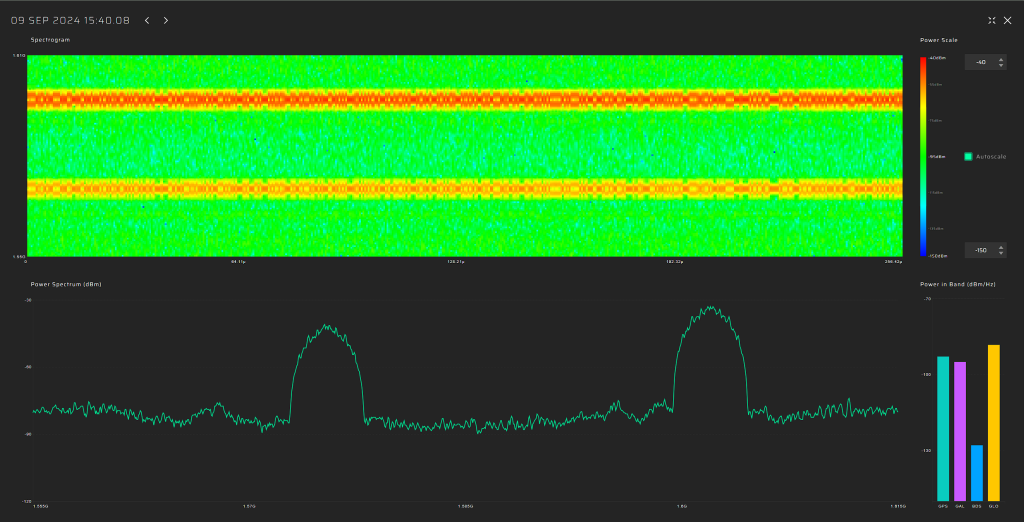
Embedded 60 MHz real-time RF signal analyzer for spectrum monitoring, interference classification and localization with TDOA
Software Options
GP-Probe TGE2 opt.: TDOA
Option for sending raw IQ data to GP-Cloud for interference localization by TDOA method.
GP-Probe TGE2 opt.: LUA
Develop custom scenarios for external equipment remote control via RS232/Telnet/SNMP with the embedded LUA scripting engine.
Optional Accessories
IP67 rated waterproof protective case for GP-Probe outdoor usage with built-in 36v 17.6Ah Lipo batteries.
IP66 Rated Protective Box for Outdoor Use of GP-Probe TGE2 with Embedded Antenna System. Designed for Wall or Pole Mounting
An optional GNSS threat blocker. High isolation RF switch and an embedded noise generator can suppress the most powerful counterfeit RF signals. The ideal solution for protecting time servers against spoofing.
GNSS power divider with GNSS antenna preamplifier current simulation. It allows you to use one GNSS antenna for two receivers at once.
GP-Probe TGE2 Unboxing Video
Delivery set. Integration options. How to setup the probe. Why we use three GNSS antennas and what’s inside the device.
Learn more on our YouTube Channel
ACCESSORIES
Enhance the performance and versatility of your GP-Probe TGE2 GNSS interference detector with our specially designed accessories,
suitable for both mobile and permanent outdoor applications.
GP-Probe Case for TGE2
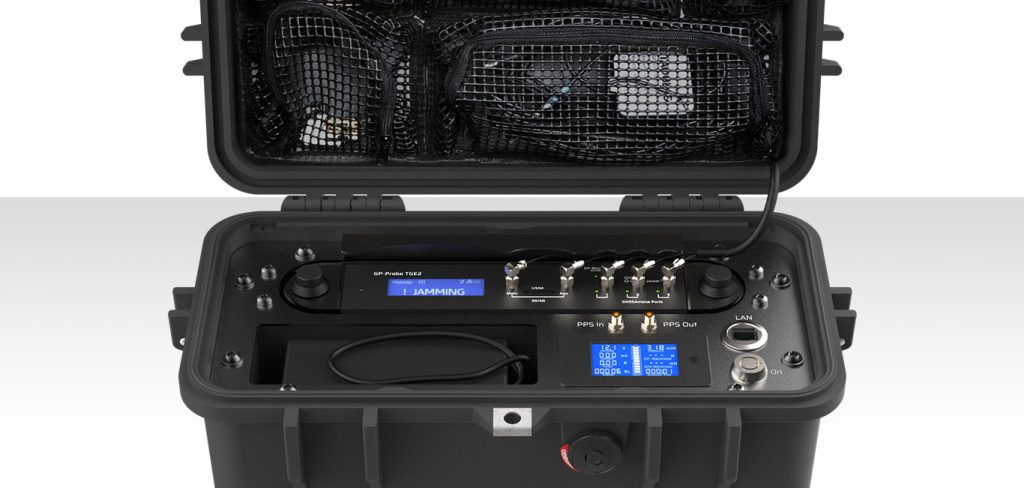
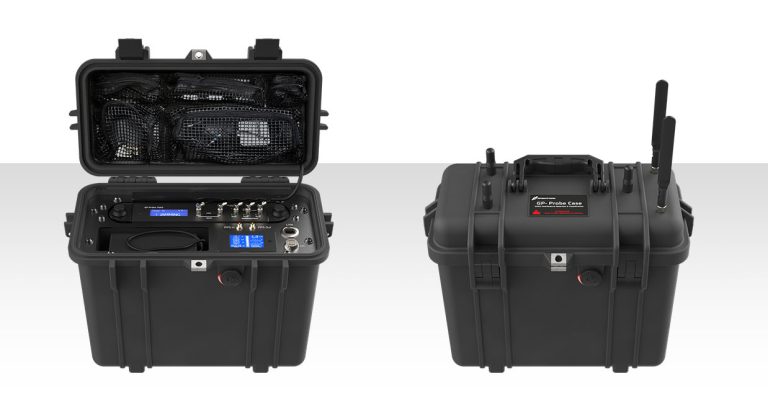
IP67-rated protective case for outdoor use of the GP-Probe TGE2, features a built-in LiPo battery, water and dust resistance, true shock protection, and a wide operational temperature range.
GP-Probe BOX for TGE2
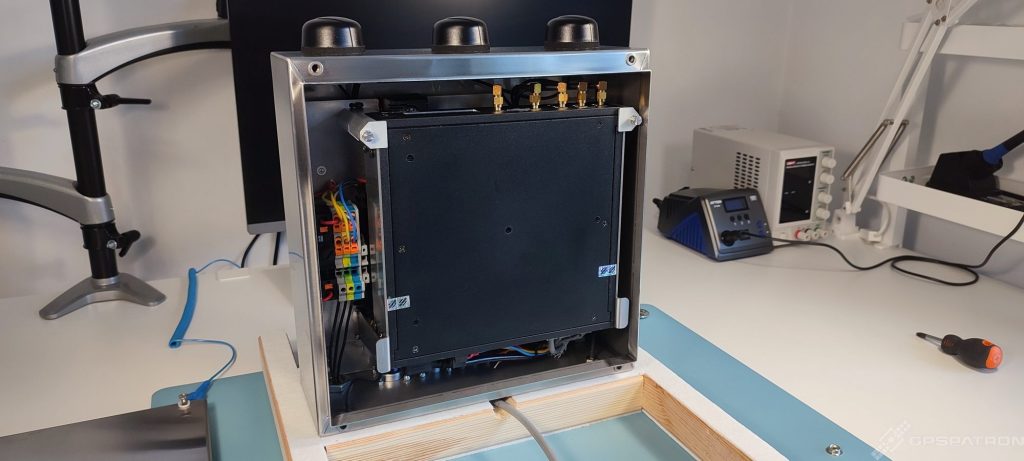
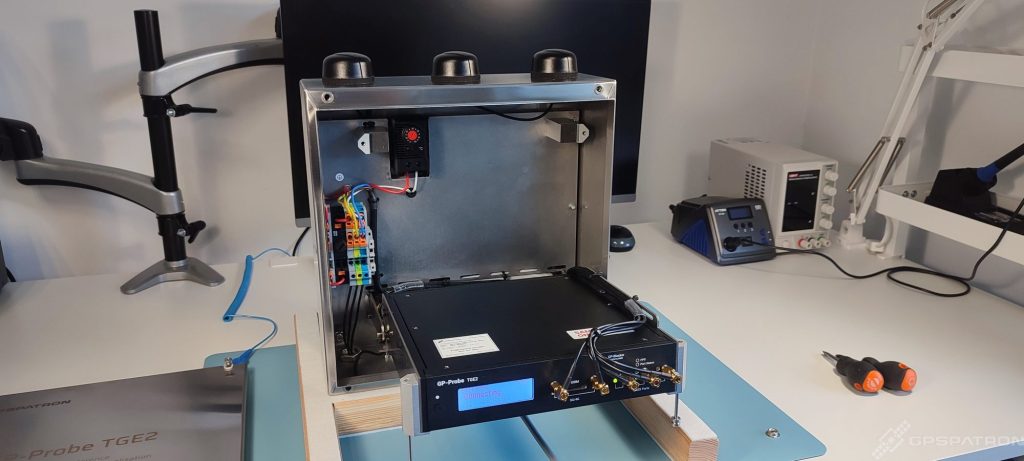
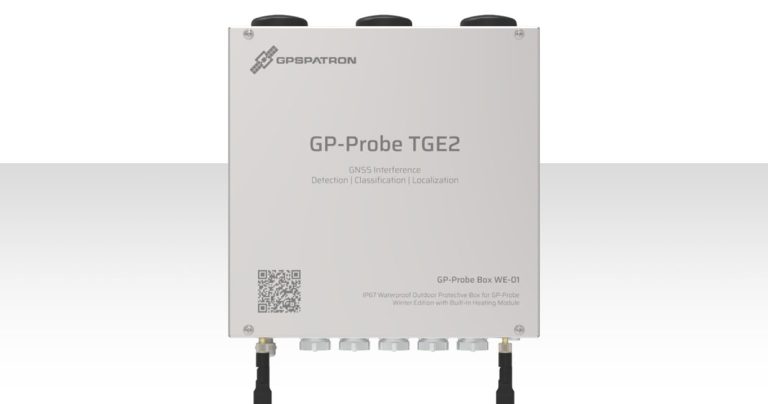
IP66 rated protective enclosure designed for outdoor use of the GP-Probe TGE2 GNSS interference detector. It ensures reliable operation in extreme conditions with a high-quality stainless steel body and a built-in automated heating module. Easy to mount on walls or poles.
F.A.Q.
GP-Probe TGE2 is designed to detect jamming, RF interference, asynchronous spoofing, sophisticated synchronous/coherent spoofing, and synchronous multi-transmitter spoofing. Its three GNSS channels enable progressively more advanced spoofing detection: one channel supports asynchronous attack detection, two channels enable synchronous spoofing detection, and three channels provide spatial analysis for multi-TX scenarios.
In a non-coherent, or asynchronous, attack, counterfeit GNSS signals are not precisely synchronized with the authentic signals, so the attack typically creates abrupt changes in signal parameters. In a coherent, or synchronous, attack, the counterfeit signal can initially closely match the authentic GNSS signal and then gradually manipulate position or time, making the attack significantly harder to detect.
The three antennas allow TGE2 to compare the same GNSS signals at different spatial points. This spatial information is essential for detecting sophisticated coherent spoofing, where counterfeit signals arriving from a common source behave differently from genuine satellite signals. For full three-channel operation, the recommended horizontal antenna spacing is approximately 0.25 to 5 meters.
Yes. A GP-Divider can split one GNSS antenna signal between a TGE2 input and another receiver or time server. Any TGE2 GNSS channel can be connected this way; the remaining channels can use their own antennas when full multi-channel spoofing detection is required. GP-Divider also provides a DC-pass output and a DC-blocked output with a load suitable for time servers that monitor antenna current.
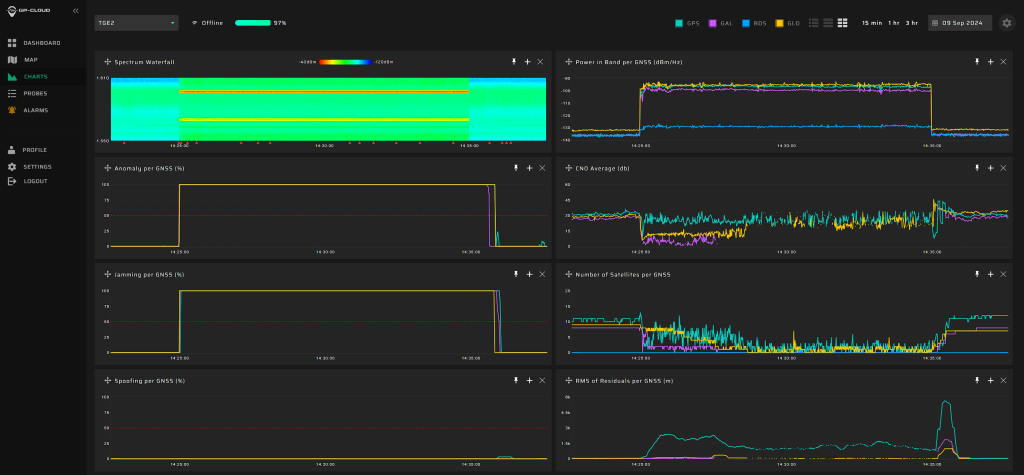
TGE2 combines three GNSS measurement channels with a built-in 60 MHz real-time RF signal analyzer. The system can evaluate GNSS observables and signal-quality parameters together with spatial and phase relationships between channels, correlation behavior, RF power, spectrum, and spectrogram data. Combining these independent indicators provides much more information than using either a GNSS receiver or a spectrum analyzer alone.
TGE2 continuously provides RF power and spectrum measurements to GP-Cloud. When an incident is detected, the system can also provide higher-resolution spectrum data, spectrograms, and raw IQ samples for detailed post-analysis. GP-Cloud combines this RF information with GNSS parameters such as C/N0, pseudorange, carrier phase, Doppler, residuals, position accuracy, and other measurements.
Yes. With the TDOA option, multiple TGE2 detectors can provide synchronized raw RF data for Time Difference of Arrival localization. This allows a distributed sensor network to estimate the position of a jammer or other interference source rather than only detecting that interference is present.
TGE2 is the higher-performance detector for advanced spoofing analysis, interference classification, and localization. It uses three GNSS channels, a high-end real-time RF analyzer, and supports TDOA localization. DIN L1 is a compact single-channel DIN-rail detector designed for cost-effective distributed monitoring, synchronization applications, and anomaly/interference detection, with an integrated GNSS blocker and optional standalone processing.