
Reach out to us for an assessment of your project and to receive a personalized quote tailored to your needs.
GP-Probe Nano
Wearable GNSS Jamming Detector/Logger
Designed to detect and log GNSS interference in the L1 band for both standalone and smartphone-assisted operation
Contact Us for Project Evaluation
Reseller Directory
Choose from our trusted distributors to enjoy personalized service, expert advice, and compliance with regional standards for a seamless buying experience.
Key Features
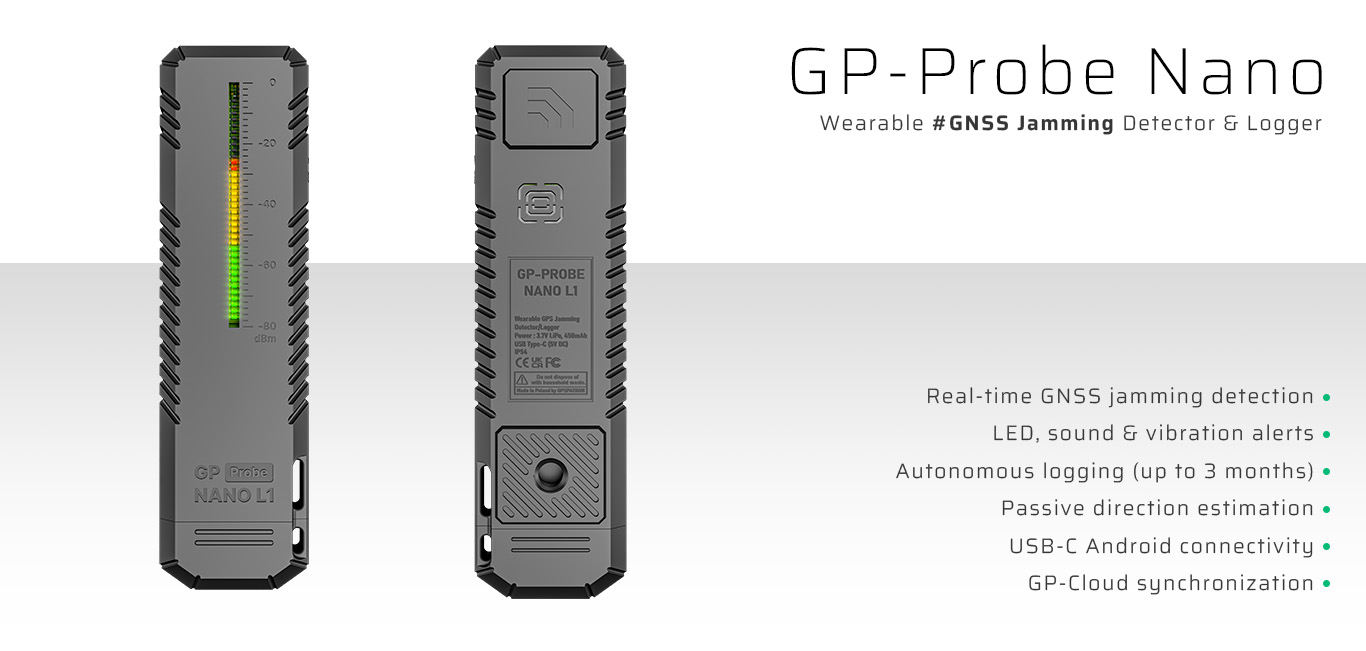
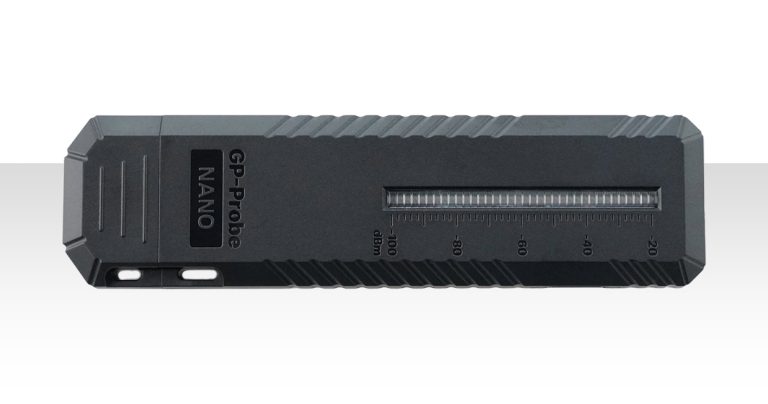
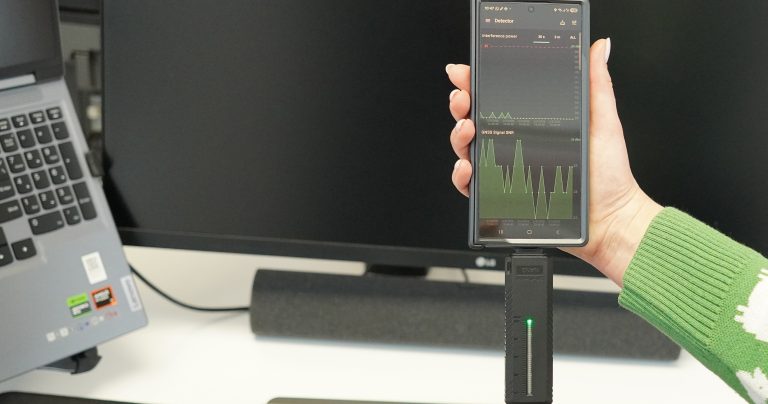
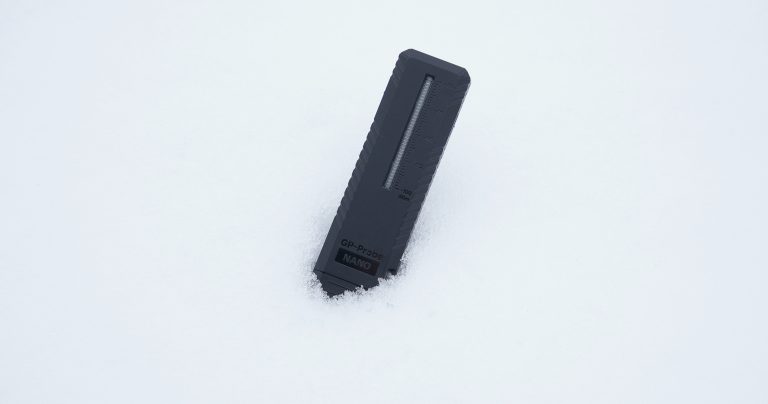
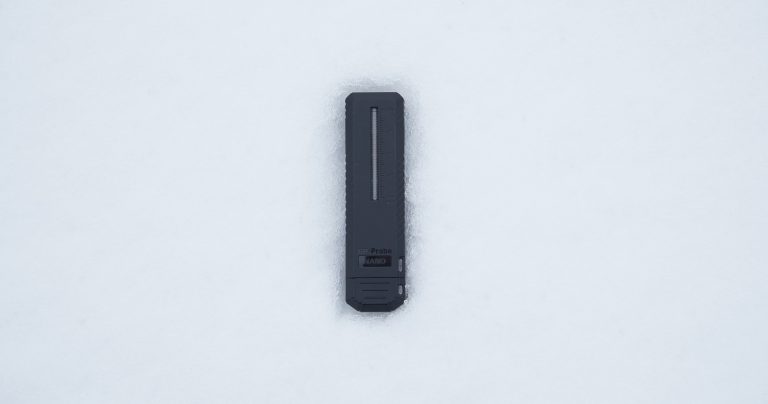
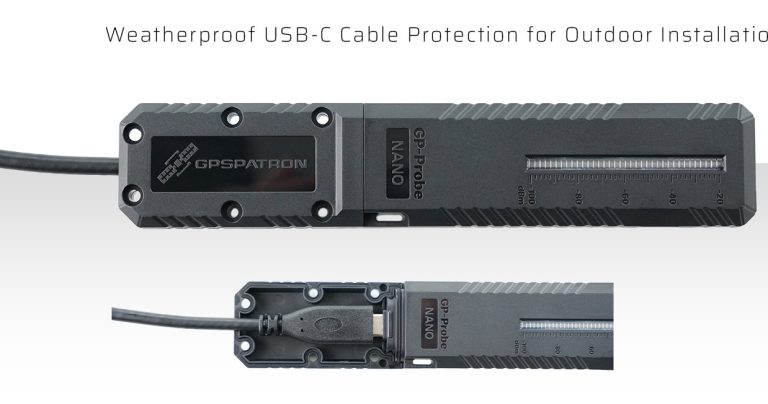
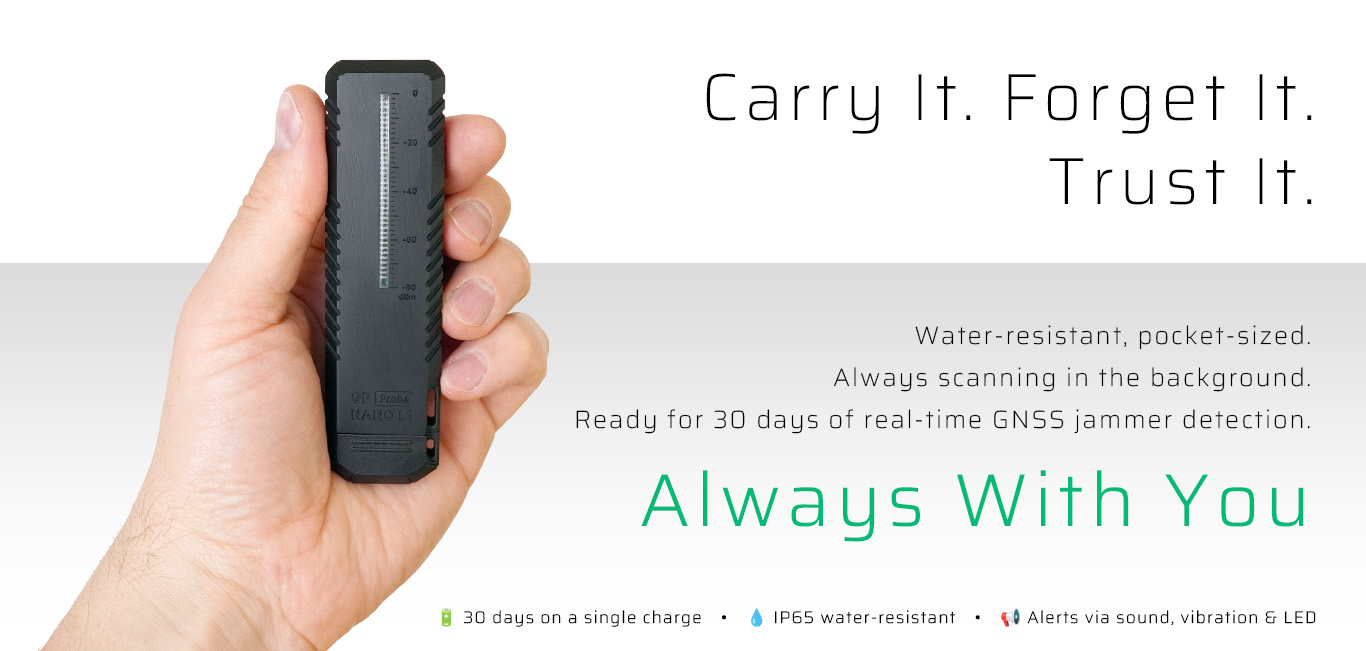
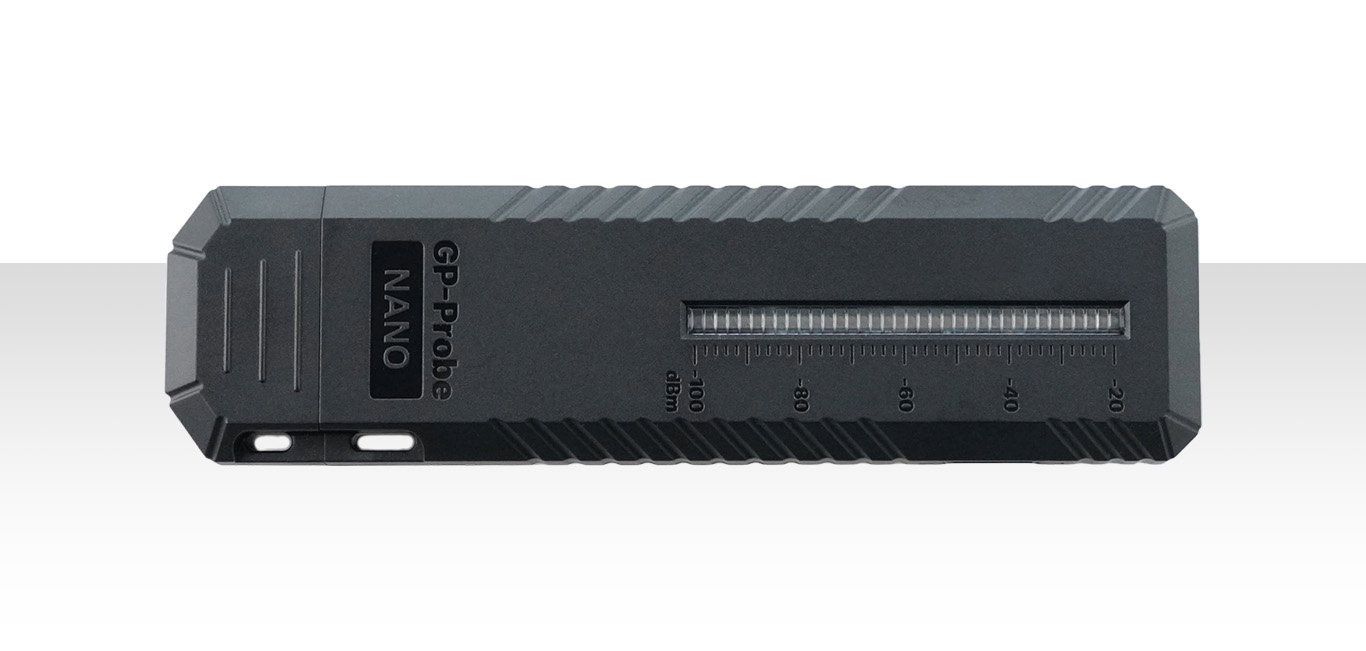
The GP-Probe Nano L1 is an ultra-compact, wearable GNSS interference detector for detecting and logging jamming activity in the GNSS L1 band. It operates standalone with instant alerts or connects to an Android smartphone for real-time visualization and optional GP-Cloud integration.
Use Case
Early GNSS Jamming Detection as a Convoy Attack Warning
85% of convoy attacks today involve radio jammers used to disable navigation and communications before the assault begins.
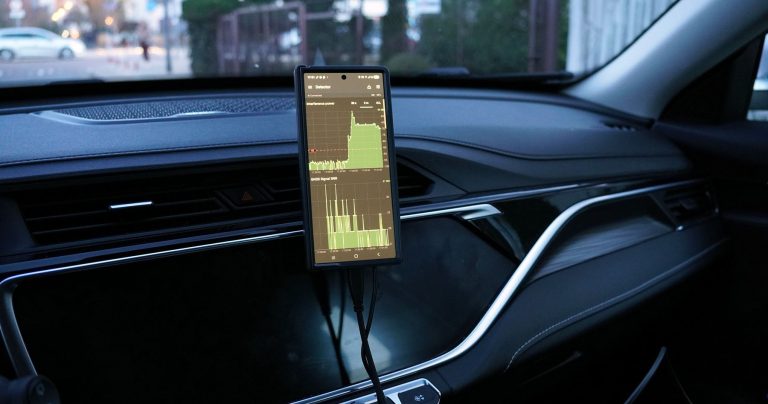
This video demonstrates a real-world use case of GP-Probe Nano L1 as an early warning tool. By detecting GNSS jamming at the very first moment it appears, security teams gain critical seconds to react, prepare, and adjust their actions before an attack unfolds.

GP-Probe Nano Intro Video
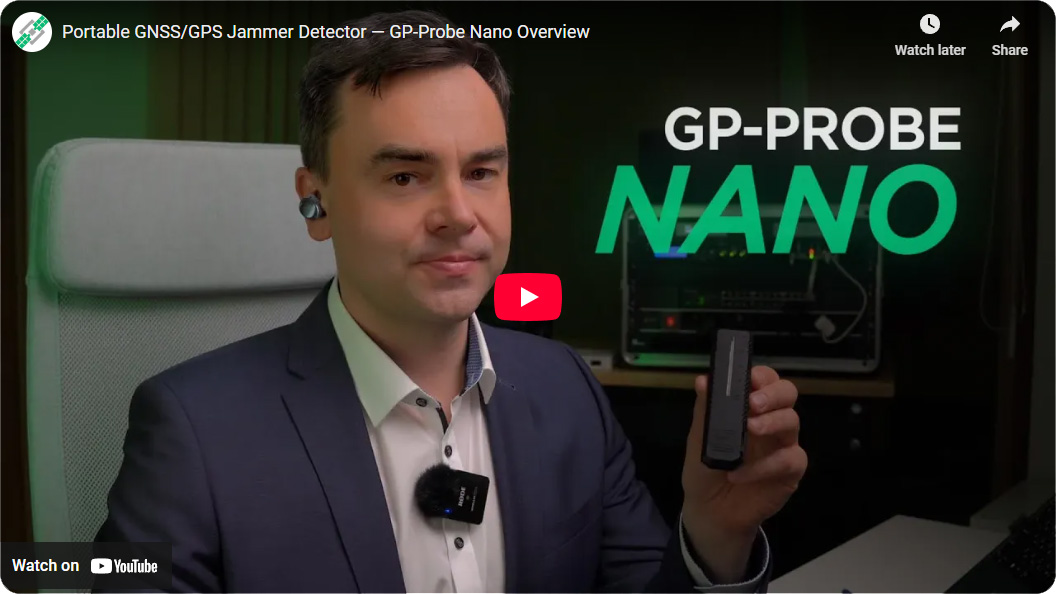
Overview of GP-Probe Nano L1: features, operation modes, and Android app integration.
Learn more on our YouTube Channel


Use Cases & Applications
GP-Probe Nano L1 is a portable GNSS interference detector designed for real-world, ground-level use. It helps identify the presence and physical source of GNSS jamming—both intentional and unintentional. The following use cases show how the device is applied in law enforcement, security operations, and critical infrastructure protection.
🚓 Law Enforcement — Search for Stolen Vehicles & Bicycles
🧩 The Operational Challenge
Today, almost all modern cars, motorcycles, and high-value bicycles are equipped with GNSS/GPS tracking devices. For law enforcement, this tracking data is often the primary and fastest way to locate stolen property.
Criminal groups are fully aware of this. As a result, in approximately 80–85% of professional theft cases, offenders immediately activate GPS/GNSS jammers after the theft.
From the police perspective, the situation looks simple but critical:
the tracking signal suddenly disappears, and the stolen vehicle or bicycle becomes invisible to all monitoring systems.
This method is used not only for cars, but also for:
- Electric bicycles and scooters
- Motorcycles
- Commercial vehicles and vans
- Construction and agricultural machinery
- Once jamming is active, classic tracking-based search methods become ineffective.
🧭 How GP-Probe Nano L1 Is Used in Practice
GP-Probe Nano L1 is designed to restore situational awareness after GNSS tracking is blocked.
The device works in Detector Mode and can operate up to one month in a pocket without recharging. During this time, it continuously monitors the GNSS signal band and automatically notifies the officer using vibration and sound when a jammer is detected.
Key operational principle:
If a jammer is active, it creates a detectable RF “bubble” around it. GP-Probe Nano L1 alerts the officer when entering this area and shows the interference strength in real time.
Typical usage scenarios:
- Patrol car operation
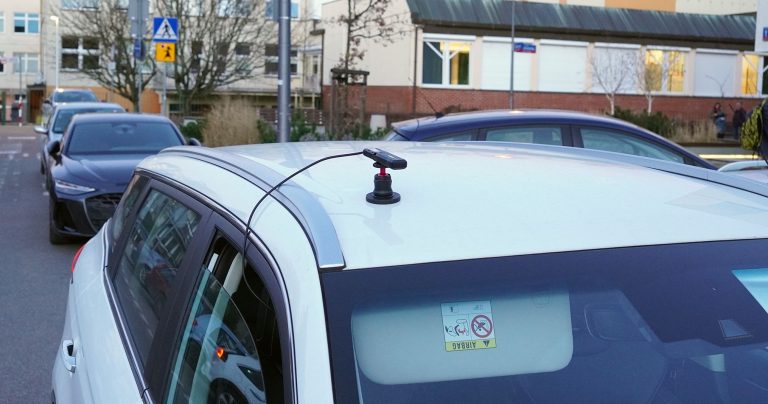
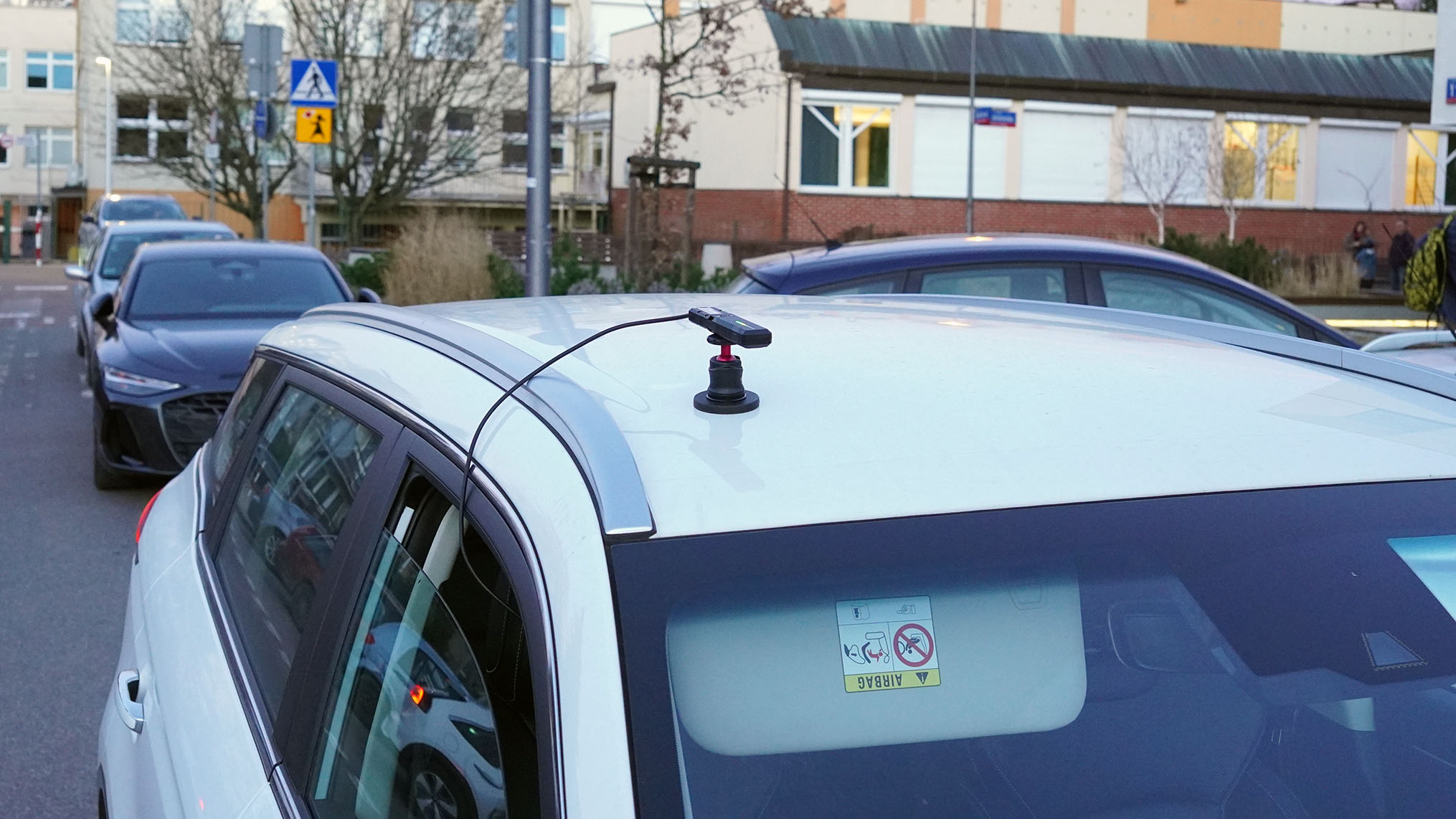
The detector can be placed inside a patrol vehicle. When a car with an active jammer passes nearby, the device immediately alerts the crew. - Stationary roadside monitoring
The detector can remain inside a parked patrol car, passively waiting for vehicles using jammers to pass through the area. - Mobile patrols in high-risk zones
Officers can drive through districts where stolen vehicles or bicycles are suspected to be stored, watching for jammer detections. - Foot patrols and inspections
The detector can be carried in a pocket during foot patrols, garage inspections, parking facilities, warehouses, or residential areas.
As officers move closer to the jammer:
- Alert intensity increases
- Interference power level rises
- The source can be narrowed down step by step
This allows officers to physically approach the interference source, identify the vehicle or location, recover stolen property, and detain suspects.
What this gives to law enforcement:
- Ability to find stolen assets even when GPS tracking is completely disabled
- Simple operation — no RF expertise required
- Continuous protection and detection during routine patrols
- Effective countermeasure against organized theft groups using jammers
In practice, GP-Probe Nano L1 turns GNSS jamming from a criminal advantage into a detectable operational signal that leads officers directly to the stolen property.
🛡️ Early Attack Warning in Protected Operations
⚠️ The Pre-Attack Indicator
In many violent crimes and organized attacks, GNSS/GSM jammers are activated before the actual assault begins.
This is done deliberately to:
- Disable vehicle tracking systems
- Block panic buttons and telematics
- Prevent alarm transmission and location sharing
- Isolate the target from external monitoring and response systems
This pattern is well known in attacks involving:
- Cash-in-transit vehicles detecting jammers before ambush
- Escort teams protecting high-risk individuals
- Security personnel guarding sensitive sites or perimeters
- Convoy operations transporting dangerous goods
- Kidnapping prevention, where jammers are used to isolate the victim
- Attacks on armored vehicles, logistics hubs, or checkpoints
From an operational point of view, jammer activation is often the very first technical action taken by attackers — seconds or minutes before the physical attack starts.
Without a dedicated jammer detector, this early phase goes completely unnoticed.
⏱️ How GP-Probe Nano L1 Provides Early Warning
GP-Probe Nano L1 acts as a personal and vehicle-level early warning sensor.
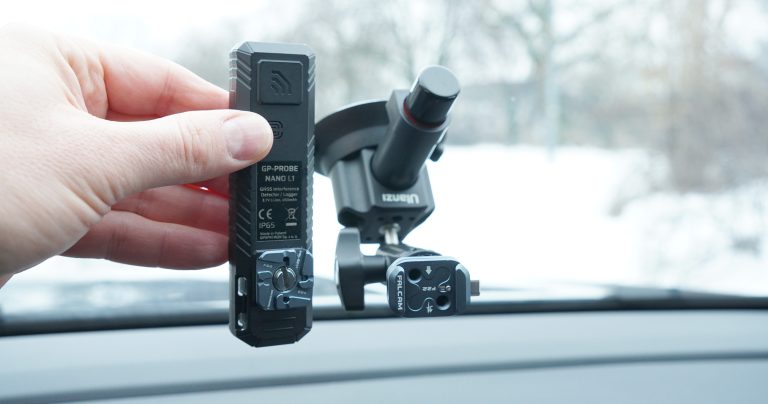
The device can operate for up to one month in Detector Mode, carried in a pocket, worn on a belt, or placed inside a vehicle. It continuously monitors the GNSS L1 band and immediately alerts the user when jamming appears in the surrounding area (up to ~500 m).
Operational effect:
The moment attackers activate a jammer, the detector:
- Triggers vibration and audible alerts
- Signals abnormal RF activity before the attack begins
- Gives the protected team critical seconds of advance warning
These seconds matter!
They allow personnel to:
- Increase situational awareness
- Prepare defensive actions
- Change vehicle behavior or route
- Trigger internal security procedures
- Alert colleagues or command centers (before communication is lost)
In real operations, GP-Probe Nano L1 does not stop the attack — it gives something just as important:
⏱️ Time
And in high-risk security scenarios, time is often the difference between control and chaos.
🏭 Critical Infrastructure Protection — GNSS Interference Detection & Source Identification
⚙️ The Hidden Dependency on GNSS
Modern critical infrastructure depends on GNSS not only for positioning, but first of all for precise time synchronization. Today GNSS is a primary time source for:
- Data centers (time-stamping, databases, distributed systems)
- Airports (IT systems, surveillance, navigation, ground operations)
- Seaports (vessel traffic systems, logistics, port automation)
- Mobile network base stations (4G/5G synchronization)
- Communication systems (telecom, dispatch, control networks)
Loss or degradation of GNSS timing can lead to:
- Network desynchronization
- Service degradation or outages
- Incorrect event timestamps
- Loss of redundancy in backup timing chains
Sources of GNSS interference can be:
- Intentional
- Sabotage
- Targeted disruption
- Criminal activity near infrastructure
- Unintentional
- Vehicle-mounted jammers used by taxi drivers
- Drivers trying to disable fleet or GPS tracking
- Consumer-grade “GPS blockers”
- Faulty or misconfigured RF equipment
In many real cases, interference originates very close to the facility:
- Parking areas
- Access roads
- Service zones
- Adjacent public streets
Without portable detection tools, the root cause often remains unknown.
🔍 How GP-Probe Nano L1 Is Used on Critical Sites
GP-Probe Nano L1 is used as a mobile GNSS interference detector to quickly identify where interference is coming from, not just that it exists.
Typical operational workflow:
- GNSS-related anomaly is observed (timing alarms, sync warnings, degraded performance)
- Fixed systems cannot clearly identify the source
- Security or technical staff deploy GP-Probe Nano L1
- Personnel patrol:
- Parking areas
- Access roads
- Fence lines
- Equipment shelters
- Detector indicates presence and strength of interference
- Source is narrowed down by movement and signal level
This allows staff to:
- Identify vehicles using jammers near the site
- Detect accidental interference sources
- Distinguish between internal and external causes
- Take action before service impact escalates
Applicable infrastructure scenarios:
- Data centers — protection of time synchronization and redundancy chains
- Airports — detection of ground-level jammers near terminals and service roads
- Seaports — monitoring interference affecting navigation and logistics systems
- Cellular base stations — rapid localization of GNSS timing disruption
- Telecom & communication sites — verification of GNSS as timing reference
What this gives in practice:
- Fast localization of GNSS interference sources
- Reduced downtime and troubleshooting time
- Clear differentiation between sabotage and accidental interference
- Simple operation for non-RF specialists
- A practical tool for both security and technical teams
In critical infrastructure, GNSS interference is often not an abstract RF problem, but a local, physical source nearby.
GP-Probe Nano L1 gives teams the ability to find it quickly and act, before timing loss turns into operational failure.
Operating Modes
The GP-Probe Nano L1 offers three levels of operation depending on how the device is used — standalone, connected to a smartphone, or integrated with GP-Cloud. Each mode unlocks specific capabilities tailored to your mission.
🧭 1. Standalone Operation
Operate the device completely independently — no phone, no app, no distractions. Ideal for covert or rapid-response scenarios.
🔍 Detector Mode
Instant alerts when jamming is nearby.
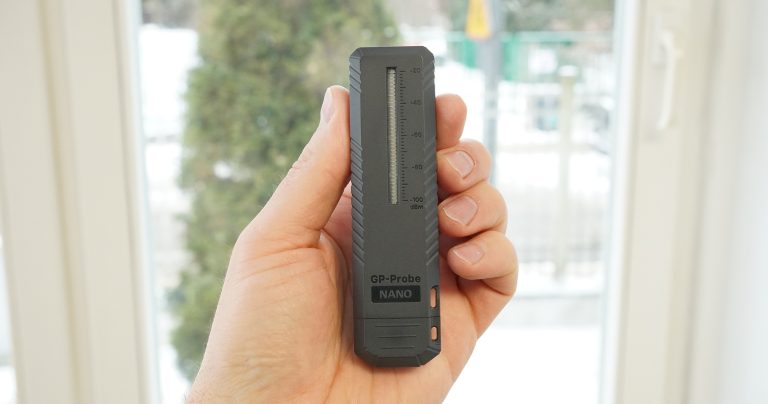
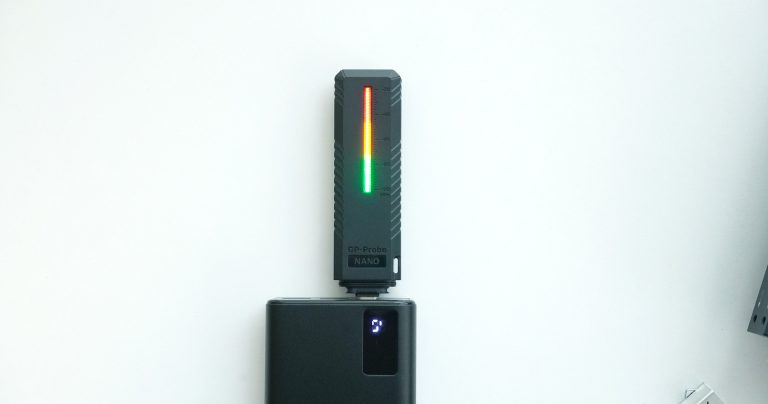
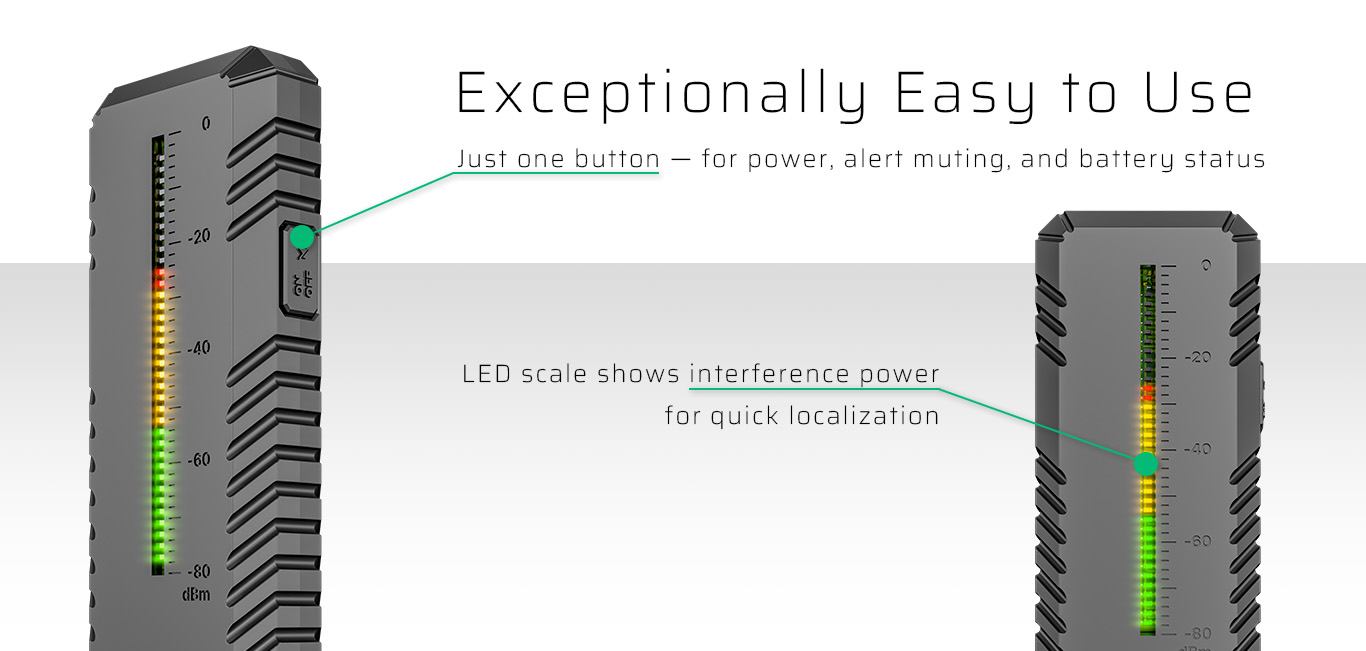
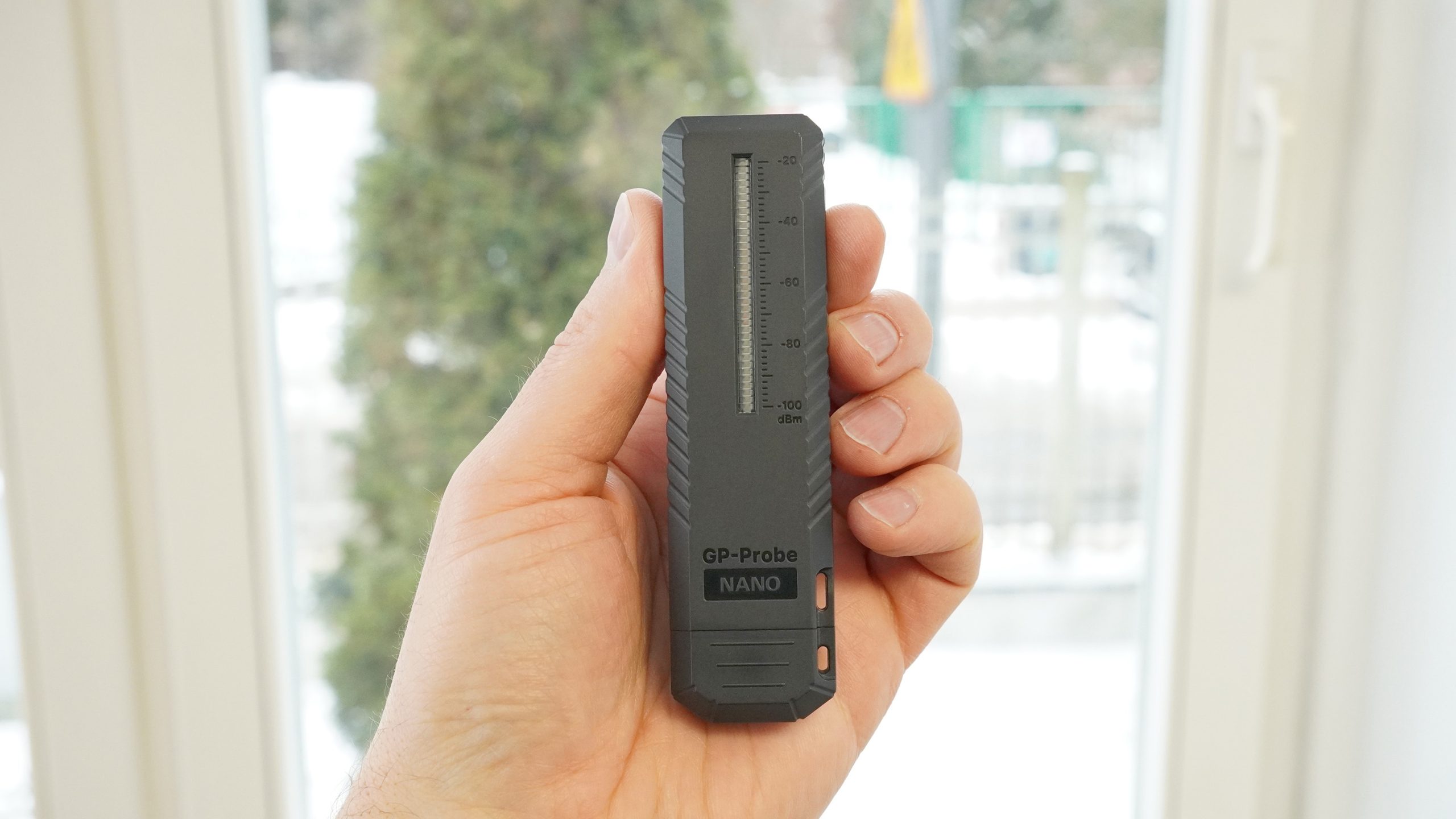
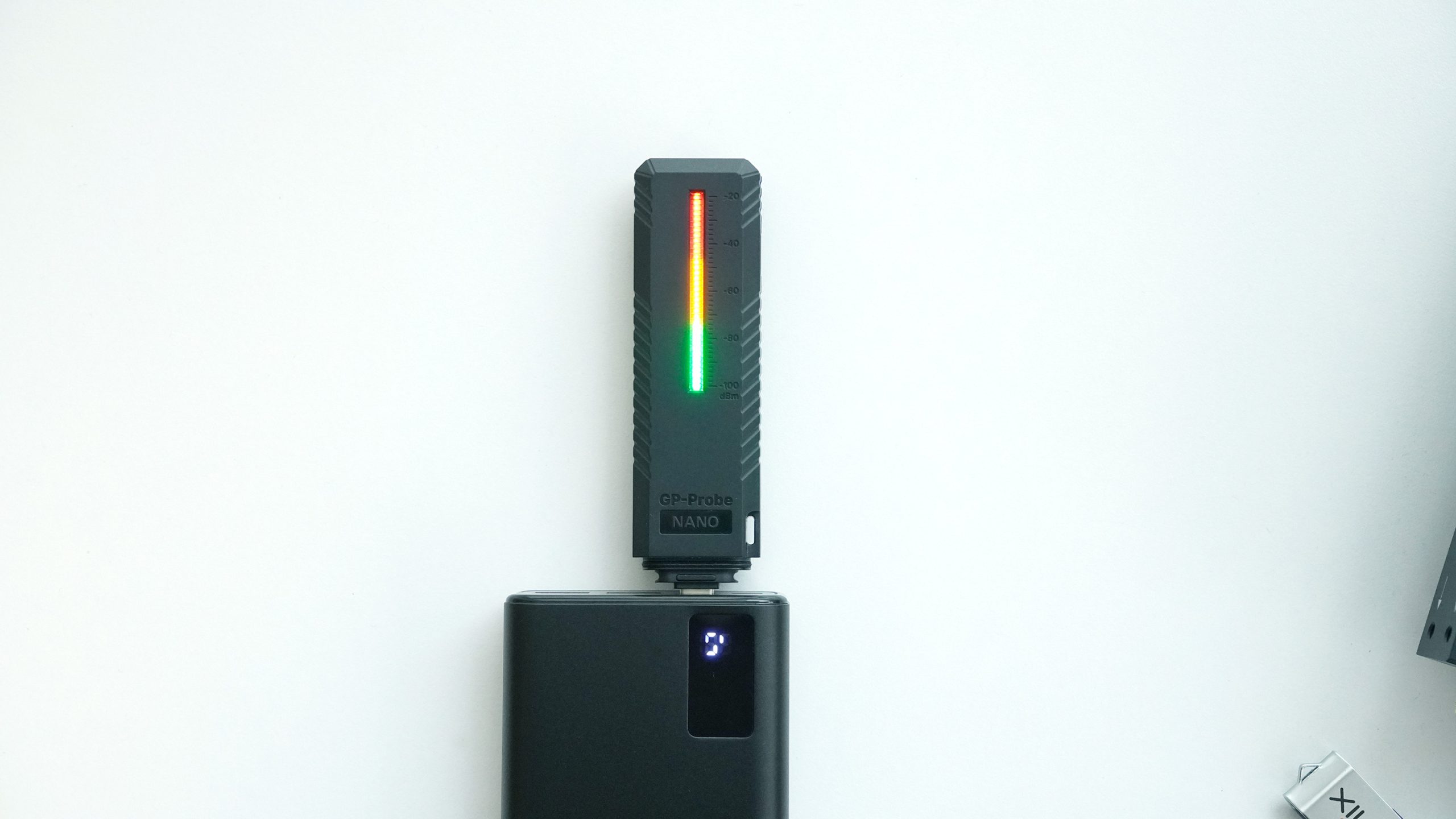
In this mode, the device continuously scans for RF interference in the GNSS L1 band and immediately notifies you using sound, vibration, and an LED scale. It’s perfect for walk-around inspections or personal GNSS protection — giving you real-time situational awareness with zero setup.
📊 Logger Mode
Unattended monitoring and detailed post-analysis.
This silent mode records interference power once per second, running autonomously for up to 3 months. Ideal for long-term or covert deployments, you can later retrieve all logs to analyze when and where jamming occurred — even if you weren’t present during the event.
📱 2. Operation with Smartphone
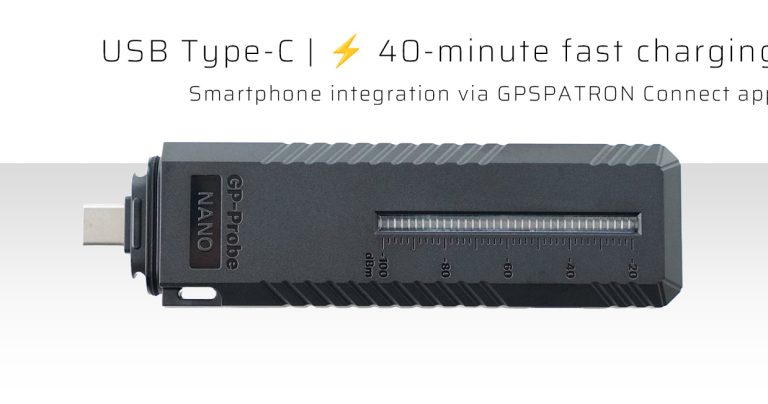
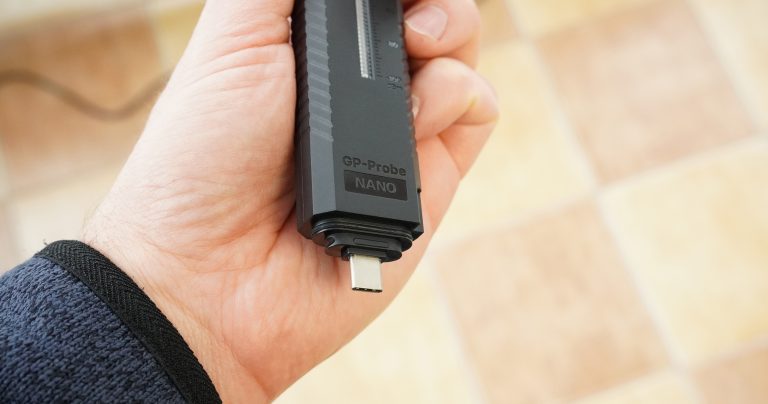
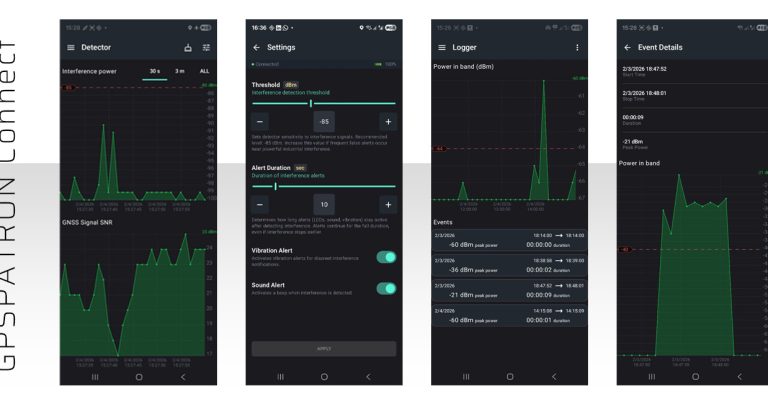
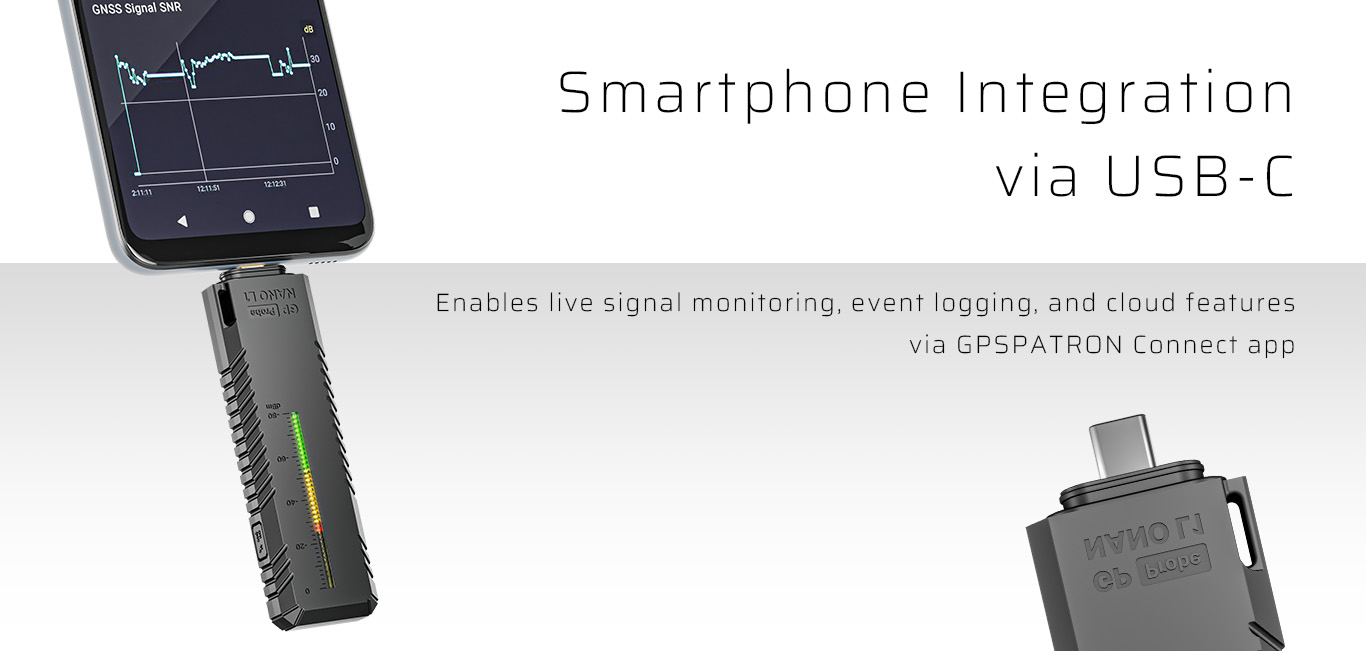
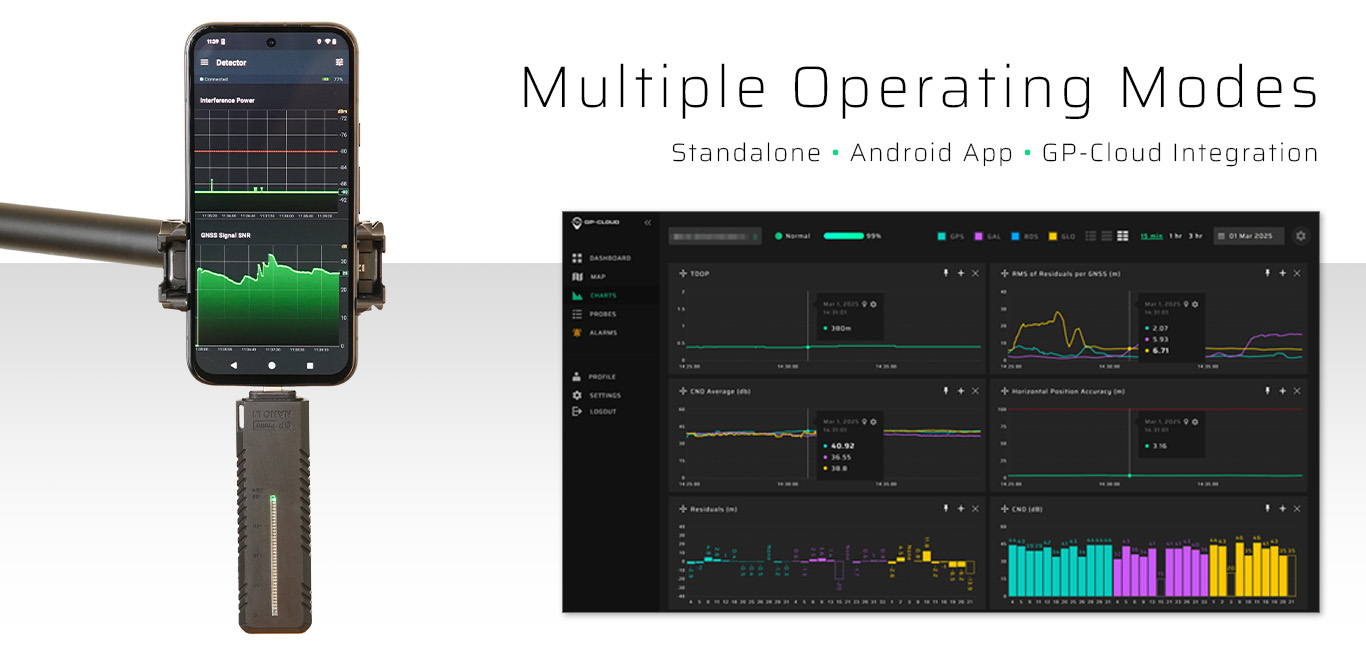
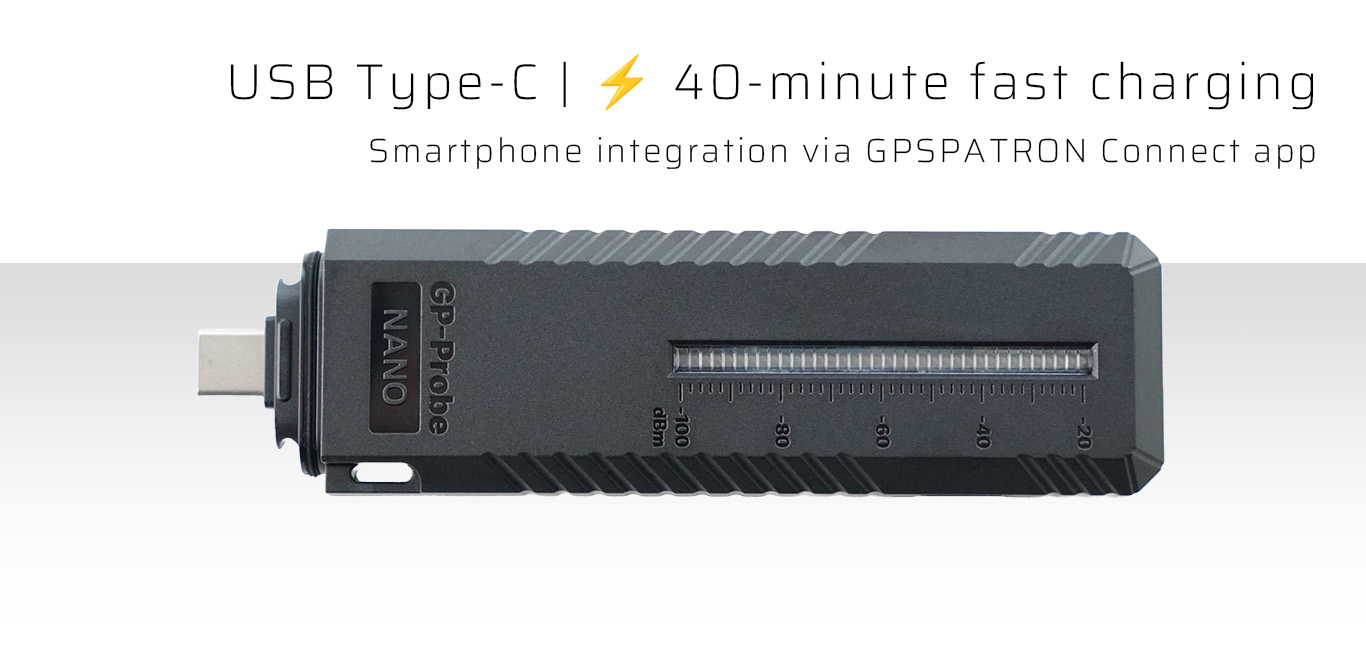
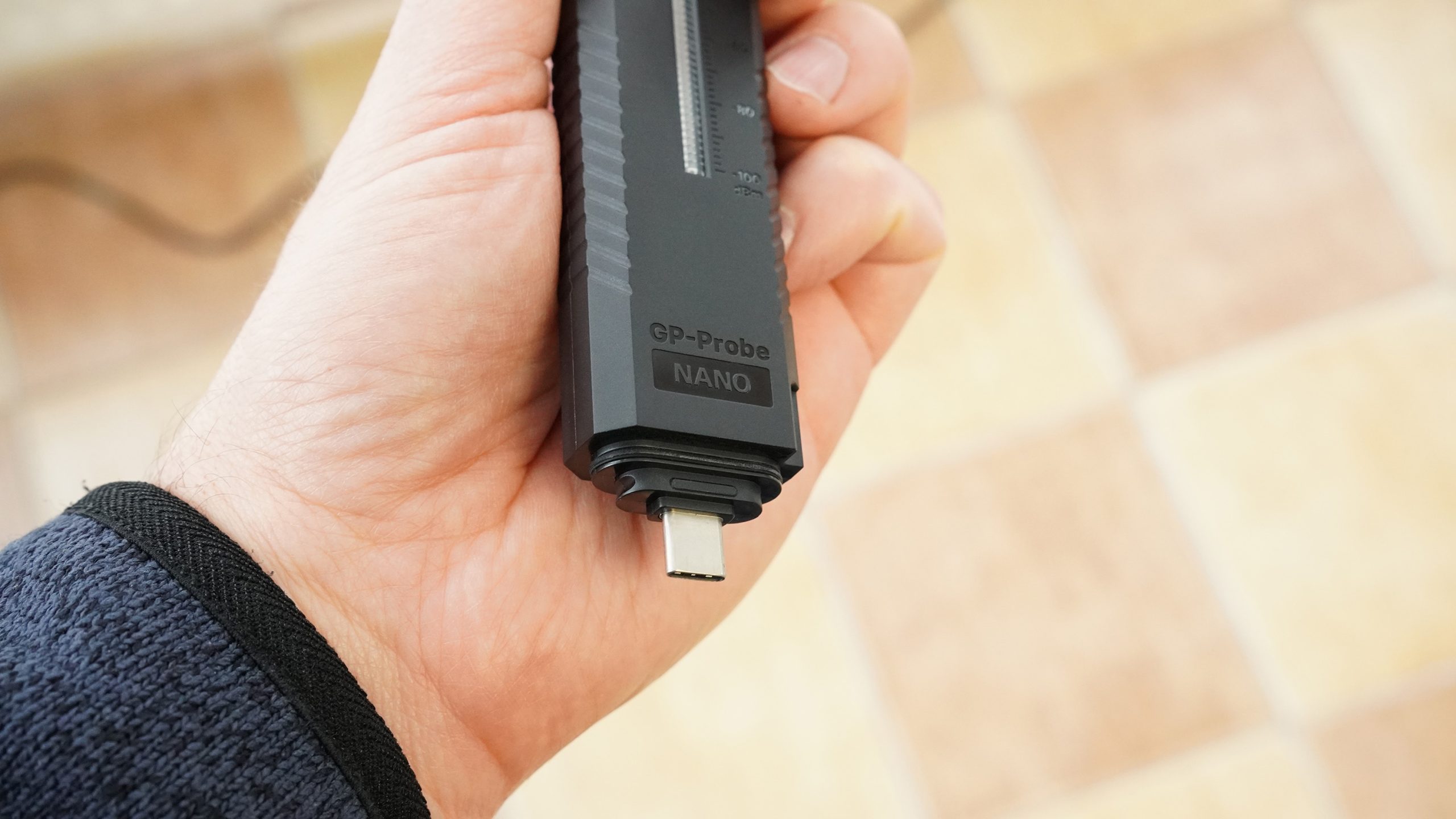
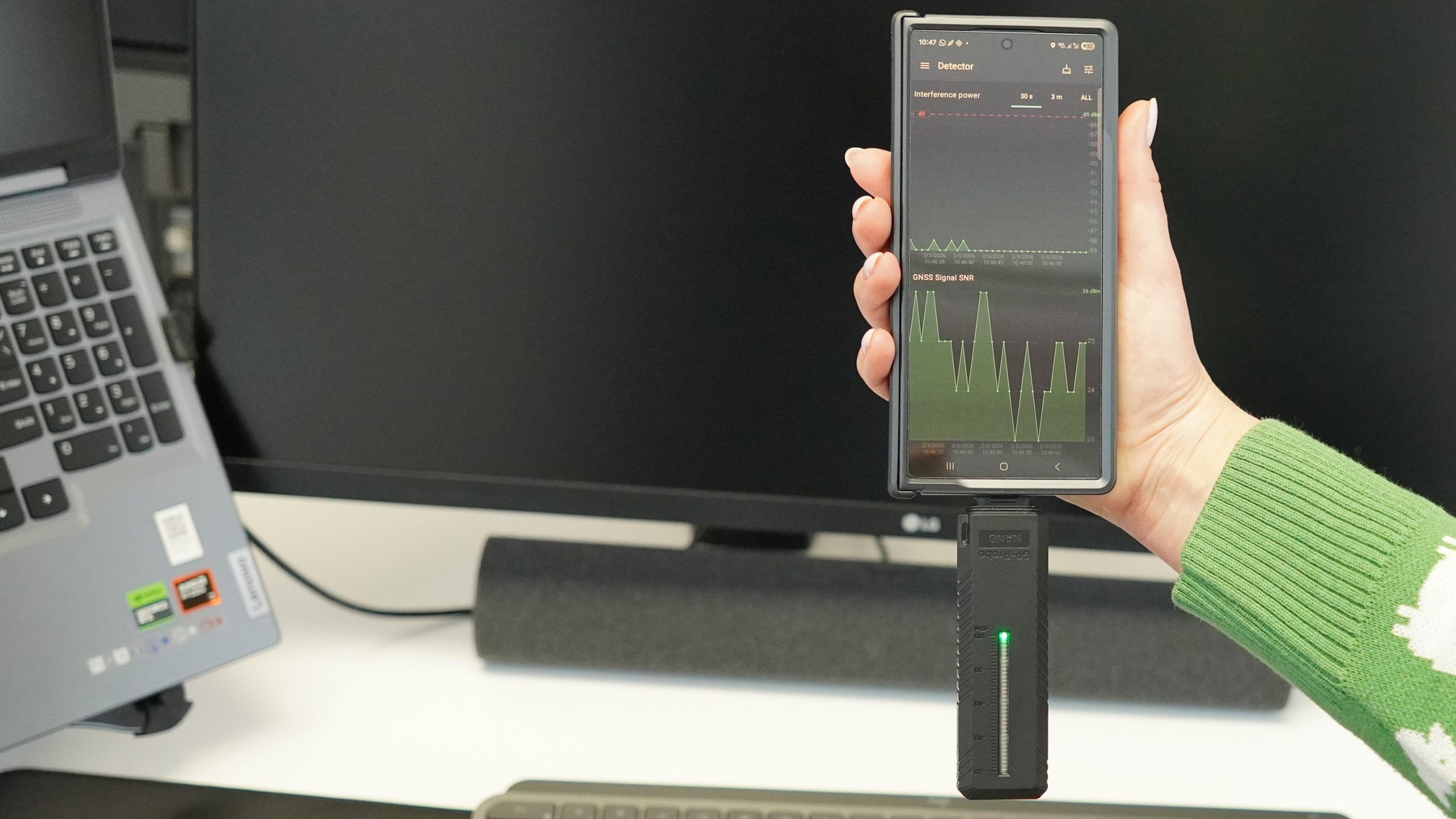
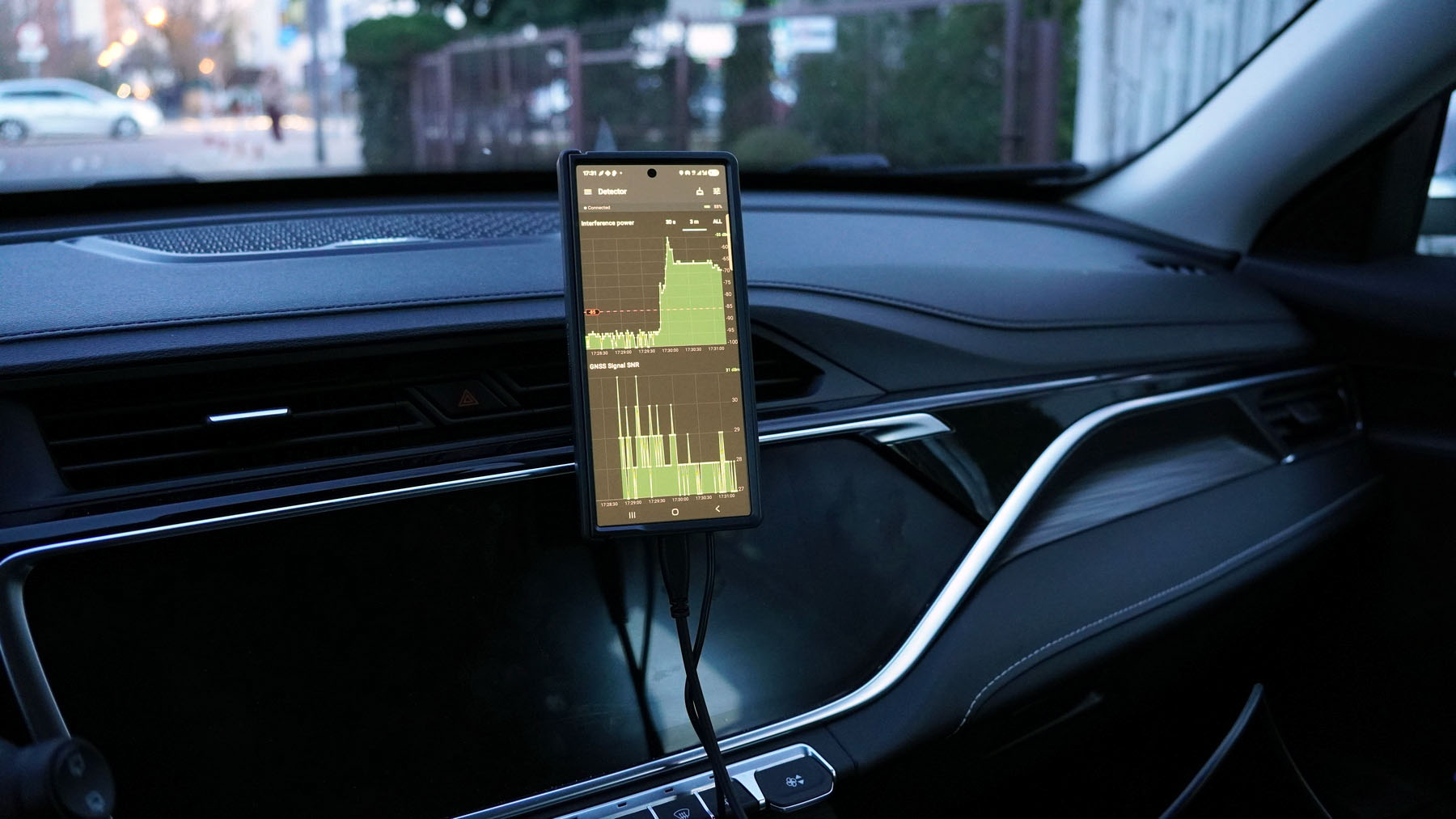
When connected to an Android phone via USB-C, the device becomes a smart GNSS interference workstation — offering live data visualization and interactive tools.
📡 Detection Mode
Detect interference in real time.
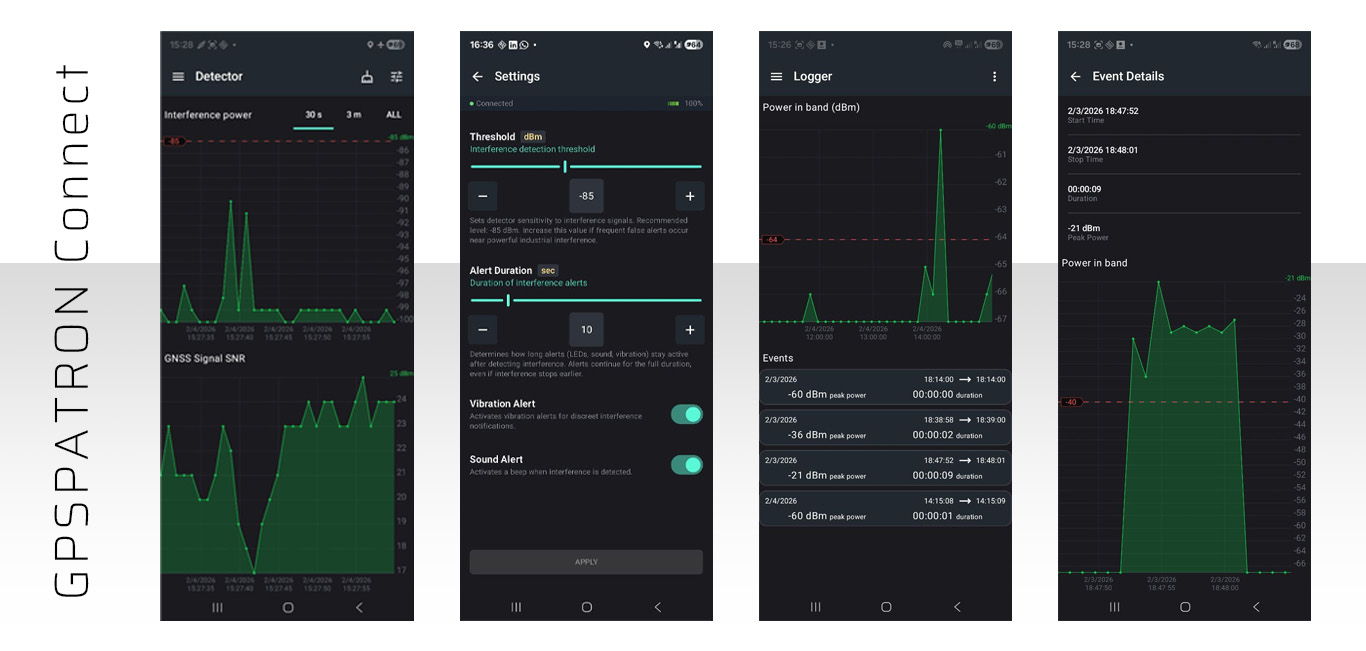
Mirrors the detector behavior on your smartphone, showing live power levels and triggering instant visual, audio, and vibration alerts when jamming is detected.
📈 Signal Analysis Mode
Analyze interference and signal behavior in real time.
Visualizes RF power levels, signal profile, and modulation characteristics to help distinguish intentional jamming from industrial noise and support basic jammer classification.
🧭 Localization Mode
(coming soon)
Quickly estimate the direction of a jammer — without extra gear.
By using your own body as a passive shield, you can rotate with the device and let the app detect where the interference is coming from. Direction vectors are shown on the map to help you pinpoint the source quickly and easily — even without a directional antenna.
🚔 Patrol Mode
(coming soon)
Detect and classify jammers while driving.
Mounted in a vehicle, the system automatically detects jamming signals on the move, classifies them, and logs where they occur. You get a geotagged timeline of events — perfect for route analysis or tracking moving threats.
📸 Sentinel Mode
(coming soon)
Monitor a fixed location for passing interference.
Place the device roadside or at a facility perimeter, and it will watch for jamming from nearby vehicles. Events are automatically recorded and can include a photo — providing visual evidence alongside RF data for investigations.
☁️ 3. Operation with GP-Cloud
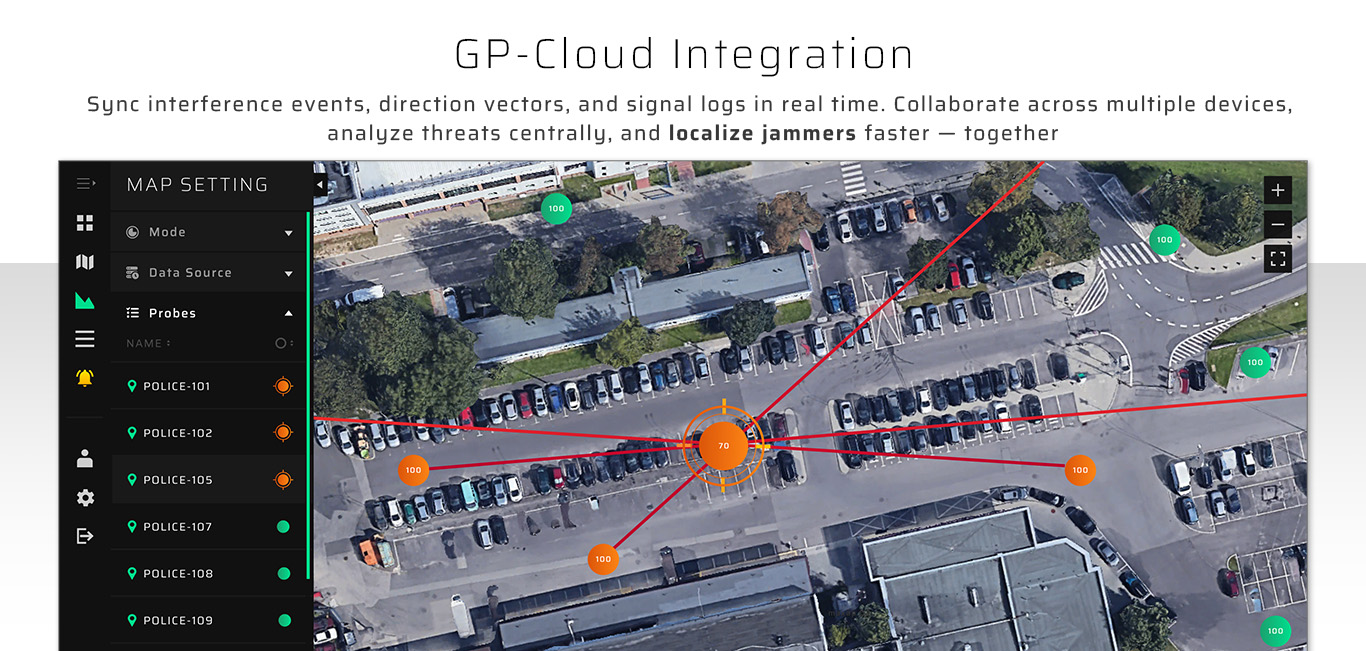
When connected to the GP-Cloud, GP-Probe Nano becomes part of a collaborative detection network — perfect for large teams, infrastructure protection, and remote missions.
Collaborative Localization Mode
(coming soon)
Find the jammer faster with multiple users.
Multiple devices submit their direction estimates to the cloud, where the system calculates the source location by intersecting vectors — dramatically speeding up localization and improving accuracy.
Collaborative Patrol Mode
(coming soon)
Build a shared threat map across your fleet.
As your vehicles detect interference, all data is synced to the cloud in real time. Your team gets a live view of jamming activity across a wide area — helping you spot trends, repeat offenders, and movement patterns.
Collaborative Sentinel Mode
(coming soon)
Centralized surveillance with optional images.
All stationary events are logged and uploaded, including optional photos. From a central dashboard, your team can analyze multiple monitoring points, correlate data, and respond faster to threats.
Specification
Monitored GNSS Signals
- GPS L1
- Galileo E1B/C
- GLONASS G1
- Beidou B1
Operational Modes
Standalone Operation:
(without connection to a smartphone)
- Detector Mode
- Logger Mode
Smartphone-Assisted Operation:
(via GPSPATRON Connect app)
- Detection Mode
- Signal Analysis Mode
- Localization Mode – Coming soon
- Patrol Mode – Coming soon
- Sentinel Mode – Coming soon
GP-Cloud Enhanced Operation:
- Collaborative Localization Mode – Coming soon
- Collaborative Patrol Mode – Coming soon
- Collaborative Sentinel Mode – Coming soon
RF Power Measurement Dynamic Range
+5 dBm to -100 dBm
Jammer Detection Range:
For usb-style low-power (5 dBm) jammer:
- Up to 200m in line-of-sight conditions
- 50m when jammer is inside a vehicle
GNSS Measurement
GPSPATRON Connect app:
- Power
- SNR
GP-Cloud:
- Signal quality
- Anomaly detection caused by spoofing or jamming
- Interference detection
- SNR
- Numbers of visible satellites
- DOP
- Position accuracy
- + much more
Angle-of-Arrival Estivation
Passive localization
Notification
Configurable in app:
- Speaker
- Vibration
- 36 LEDs
Power
| Battery: | 3.7V LiPo, 450mAh |
| Charging: | USB Type-C 90 minutes for a full charge |
| Operating time: | Up to 1 month in Detector mode (2 measurements per second). Up to 3 months in Logger mode (1 measurement per second). |
Mechanical
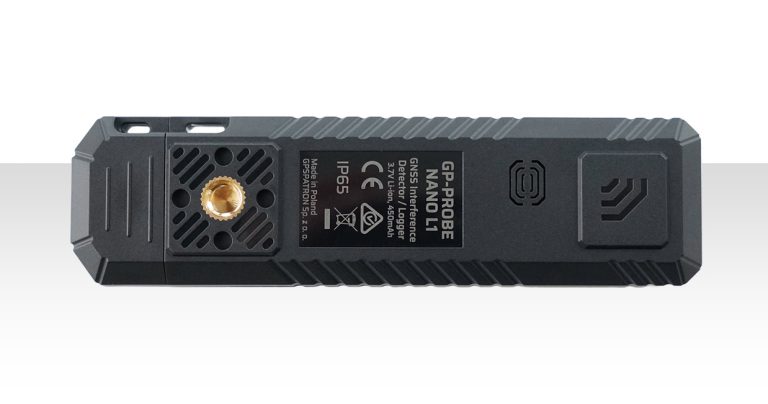
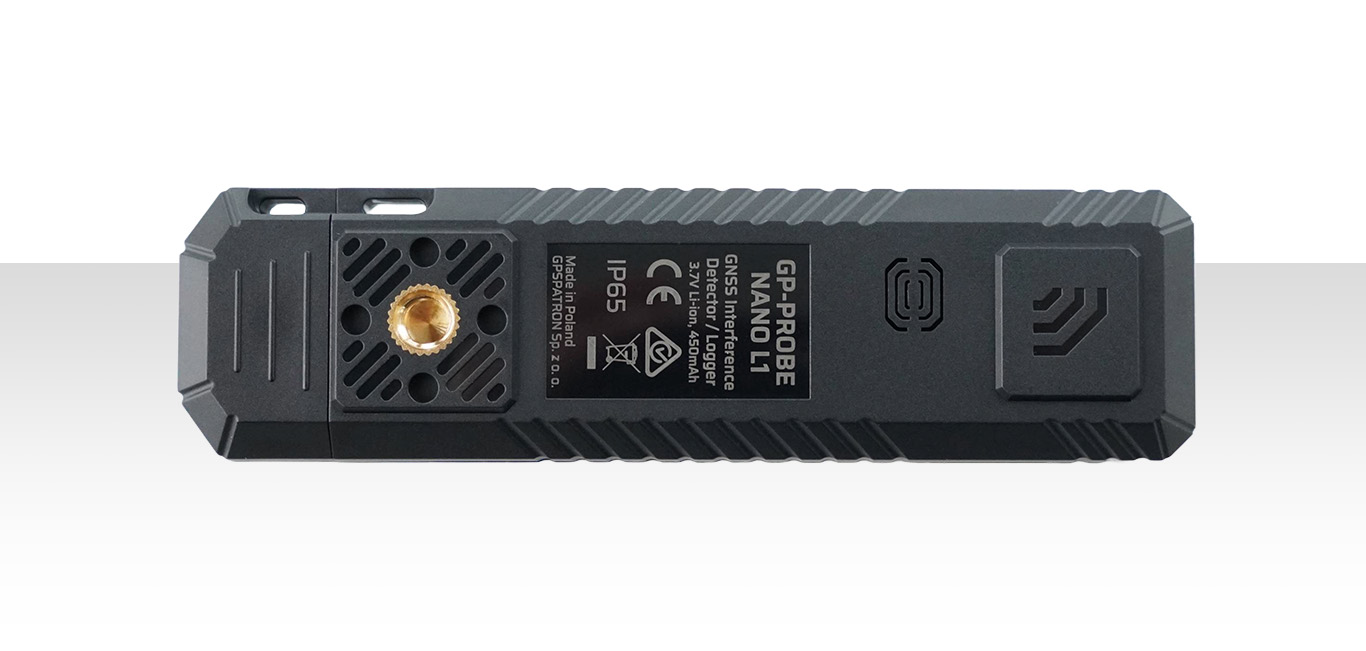
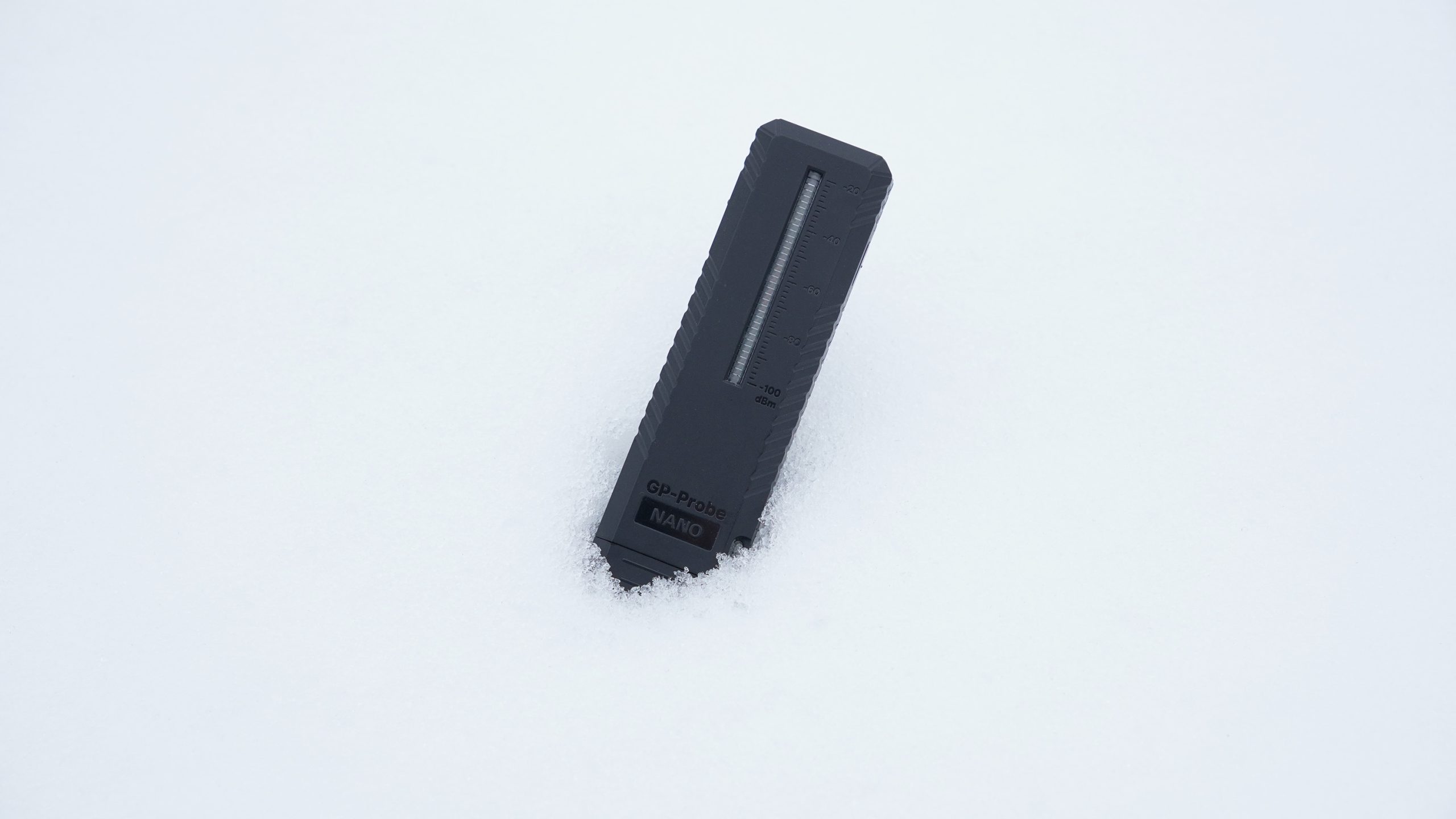
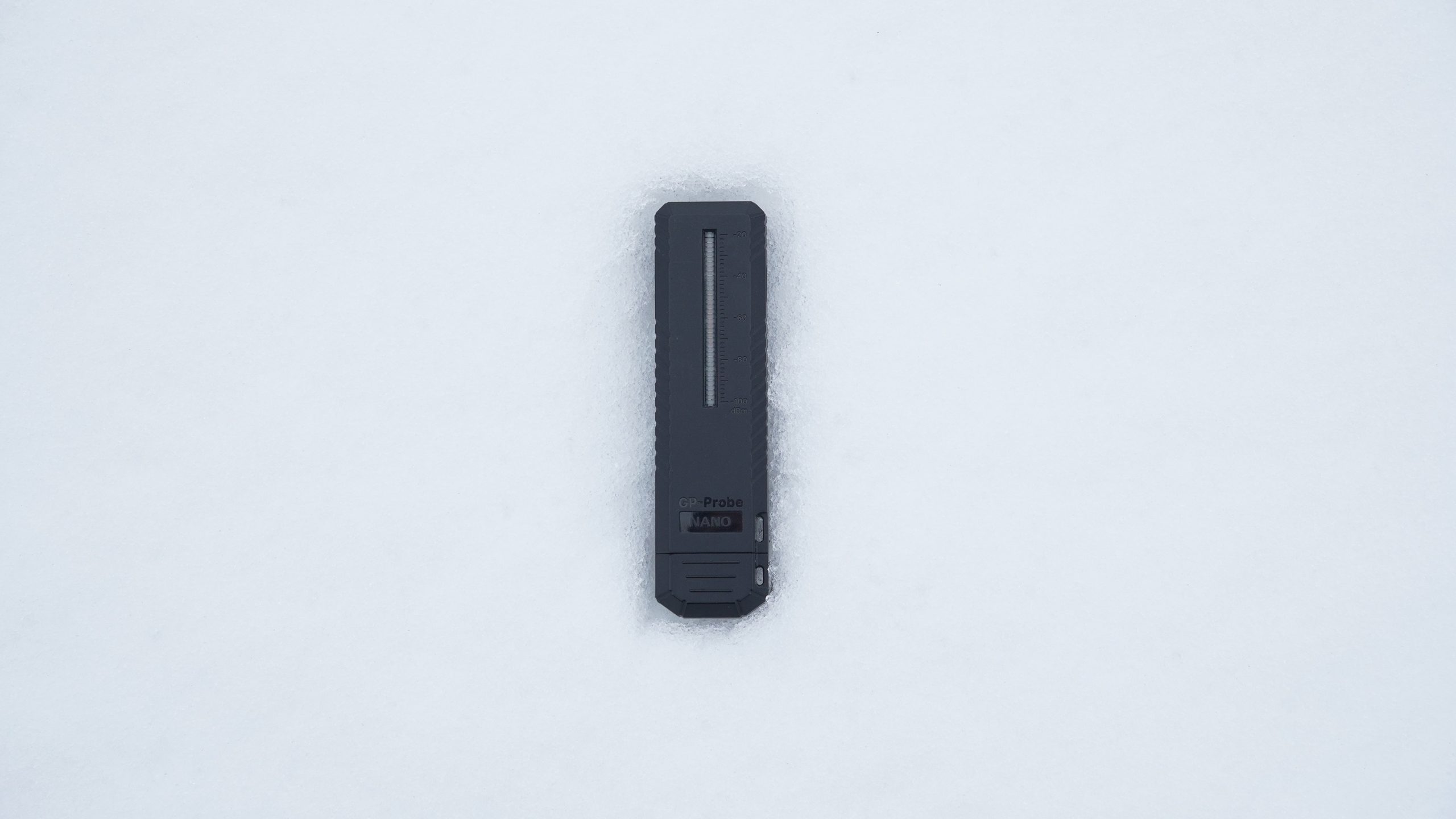
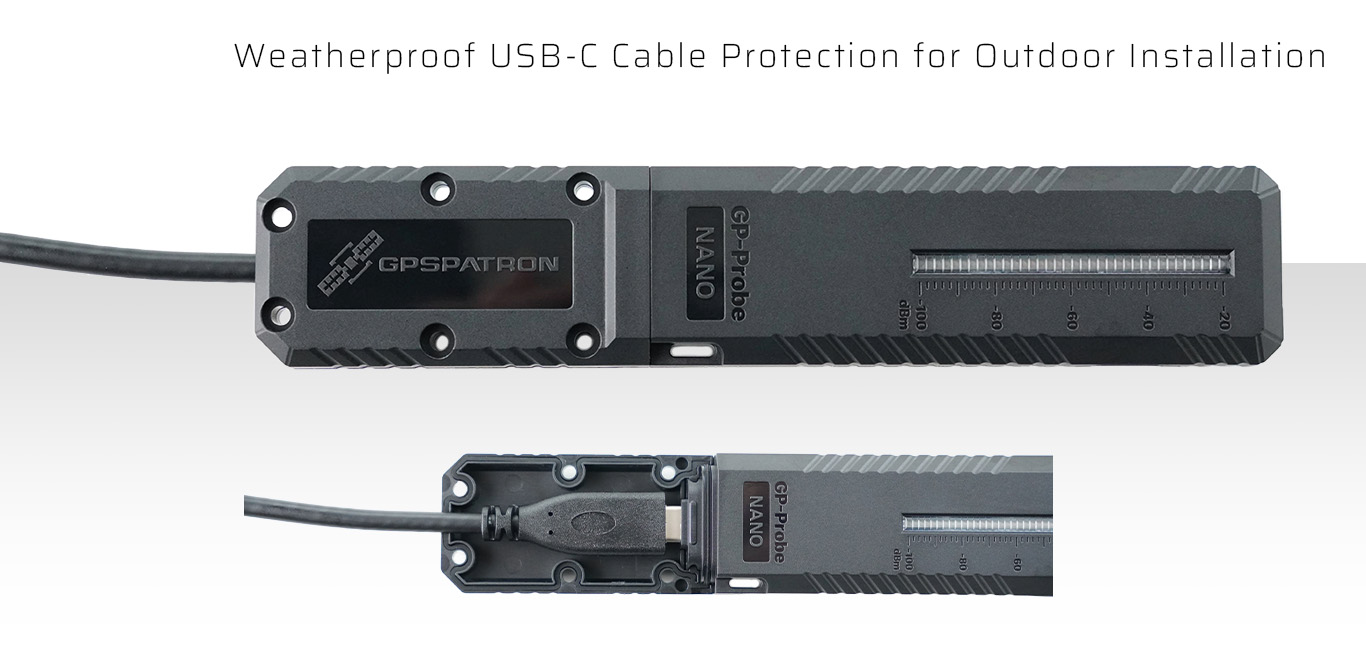
| Enclosure: | Ruggedized, IP65-rated for dust and water resistance |
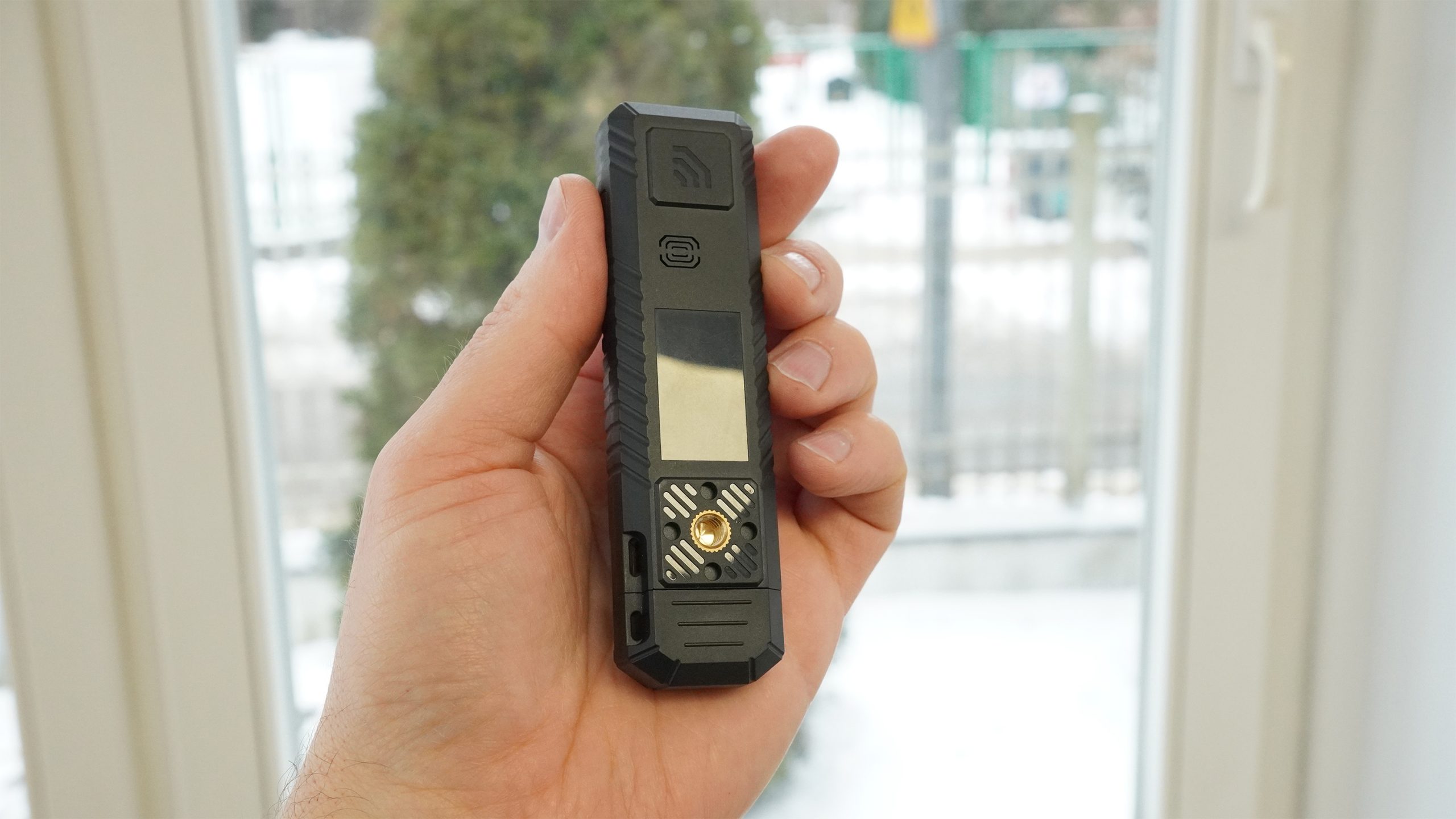
| Size: | 113 × 31 × 15 mm |
| Weight: | ~50 g |
Environmental
| Operational Temperature: | -20°C to +60°C |
| Storage Temperature: | -20°C ~ +70°C |
| Humidity: | 0% – 90% RH non-condensing @ 40°C |
Regulatory Compliance
Complies with the requirements: CE | FCC | RCM | ROHS
| EMC: | EN 55032:2015+A1:2020 EN 55035:2017+A11:2020 ETSI EN 301 489-1 V2.2.3 (2019-11) ETSI EN 301 489-19 V2.2.1 (2022-09) AS/NZS Cispr 32 FCC Part15B |
| Safety: | ETSI EN 303 413 V1.2.1 (2021-04) |
Warranty & Support
| Warranty: | 1 year Extended warranty is available |
| Support: | 1 year of complimentary technical support |
Package Content
| GP-Probe Nano L1: | 1 pc. |
| Cables: | USB Type C – Type C. 1 meter cable |
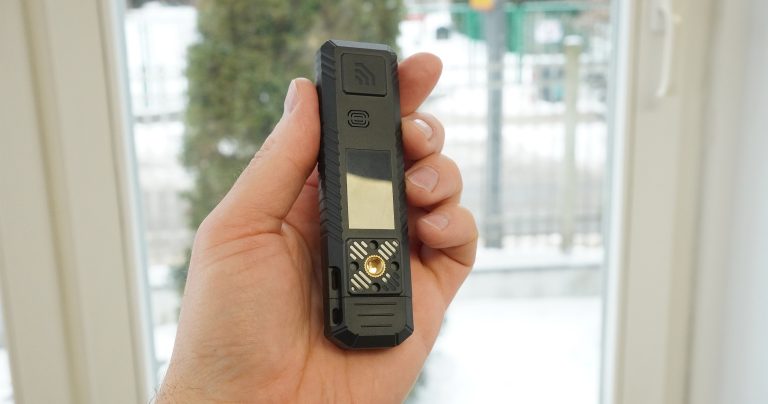
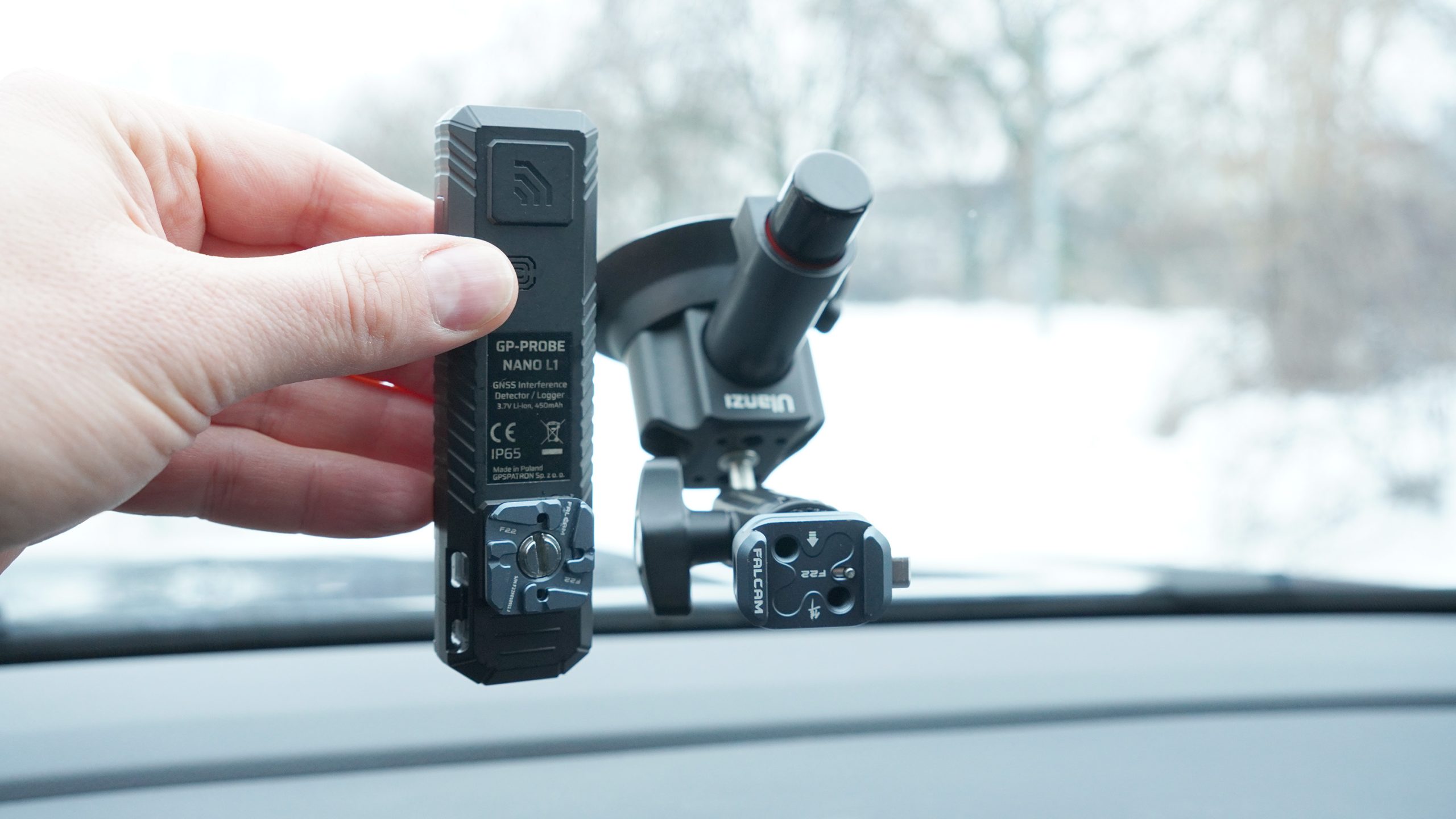
| Mounting Accessories: | ¼” quick release adapter Mounting kit for motorcycle, bicycle Mounting kit for car Nato rail adapter Belt clip |
| Manuals: | Online quick start guide |