

Septentrio GNSS Receivers in Distributed Monitoring Systems
GNSS receivers from Septentrio are increasingly popular due to their combination of high functionality, advanced built-in algorithms for interference mitigation, multi-constellation support, and relatively low cost. They are widely used in:
- GNSS reference stations and CORS networks
- timing and synchronization systems
- critical infrastructure
- and advanced navigation applications
At the same time, even the most advanced GNSS receiver operates as a local device. When interference occurs, operators often face limited long-term data logging, lack of centralized visibility across multiple sites, and difficulties performing post-event analysis or correlating GNSS anomalies with jamming or spoofing activity. Meanwhile, GNSS jamming and spoofing are no longer theoretical threats—they are routinely observed in real environments and directly affect positioning accuracy, timing stability, and system reliability.
To address these challenges, we integrated the Septentrio SBF (binary) protocol into GP-Cloud.
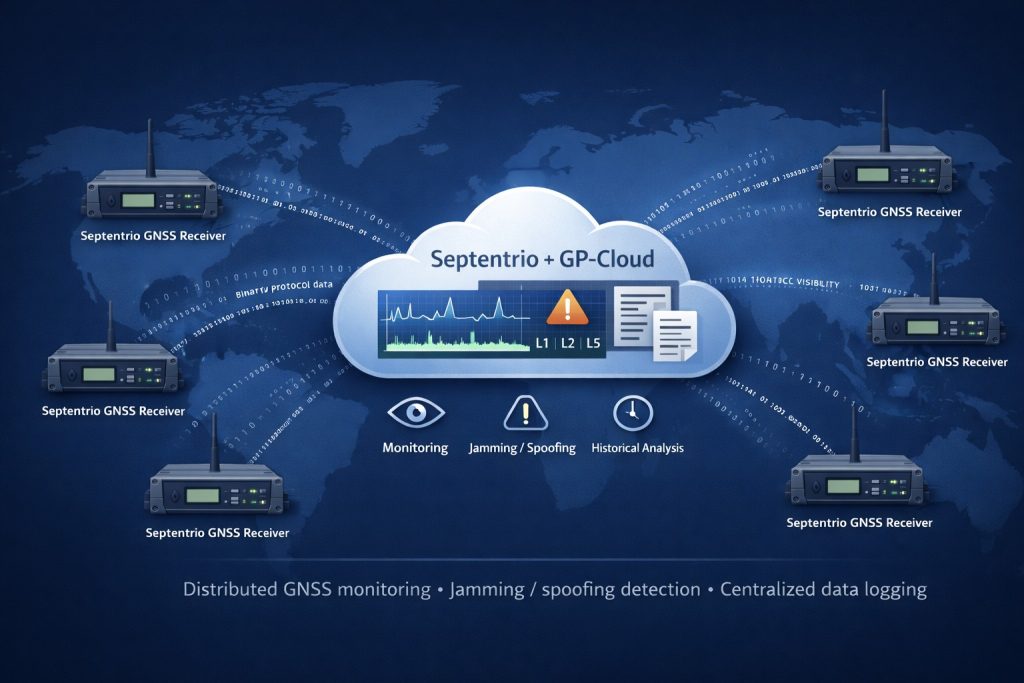
This integration enables cloud-based analysis of both GNSS signal parameters and RF spectral characteristics in the L1, L2, and L5 bands, transforming a standalone receiver into a continuously monitored, auditable, and analyzable system. The result is centralized monitoring, reliable detection of jamming and spoofing events, comprehensive data logging, and effective post-event analysis across single or multiple receivers.
This solution is intended for organizations that already rely on Septentrio receivers and require greater visibility, traceability, and control over GNSS performance—where availability, integrity, and evidence-based analysis are essential rather than optional.
Software-Only Update
Integrating existing Septentrio GNSS receivers with GP-Cloud does not require any additional hardware or firmware modifications. All the required functionality is already built into Septentrio receivers and available out of the box.
The integration process is straightforward:
- Connect each receiver to the network
- Configure streaming of selected SBF (Septentrio Binary Format) messages to GP-Cloud using standard NTRIP outputs
Once the binary data stream is enabled, the receiver immediately becomes part of a real-time cloud monitoring system.
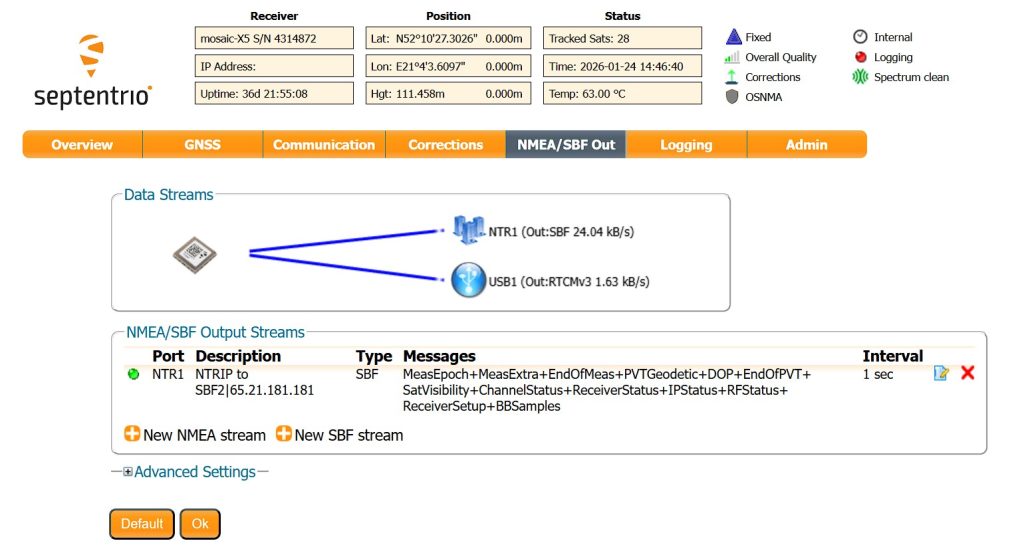

After integration, GP-Cloud provides:
- Real-time detection of GNSS data anomalies
- Spoofing and jamming detection
- Position accuracy and integrity monitoring
- GNSS signal quality analysis
- RF spectrum monitoring across L1, L2, and L5 bands
This approach allows operators to transform existing GNSS infrastructure into a centralized monitoring and analysis system within minutes, without interrupting normal receiver operation.
GP-Cloud can be used either as a subscription-based cloud service or deployed as an on-premises installation on the customer’s own servers, depending on security, data ownership, and operational requirements.
GNSS Spectrum Monitoring
GP-Cloud provides continuous radio spectrum monitoring tightly coupled with GNSS receiver measurements. This approach allows not only detecting the presence of RF interference, but also classifying its real impact on GNSS performance.
Spectrum monitoring is based on a configurable spectral mask combined with real-time analysis of GNSS signal quality indicators.
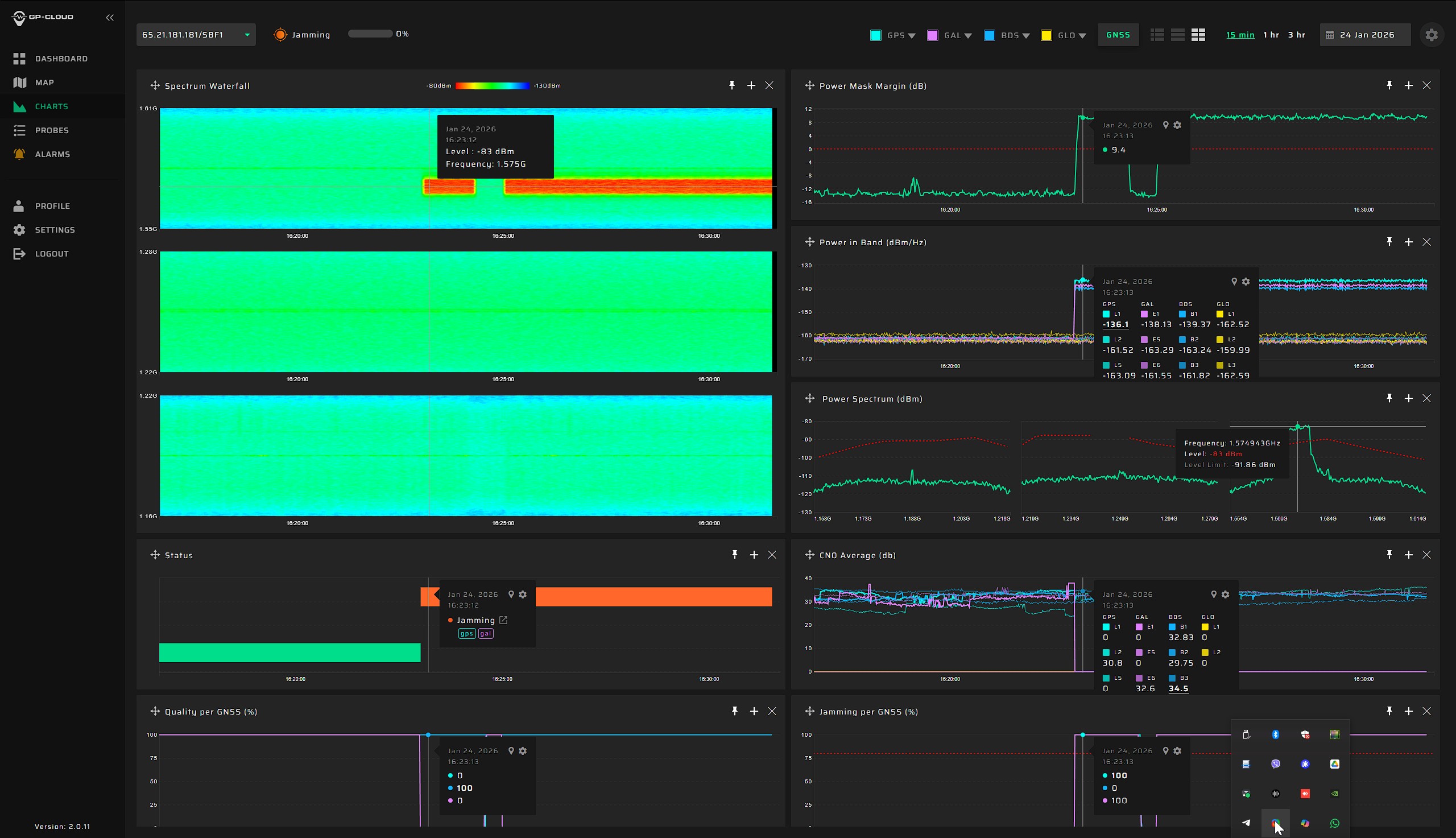
The monitoring dashboard combines multiple spectrum-level charts, giving the operator a complete and synchronized view of the RF environment:
- Spectrum Waterfall
A time–frequency view showing RF activity across GNSS bands. Continuous emissions, bursts, and transient signals are immediately visible. - Power Spectrum (dBm)
Instantaneous RF power versus frequency, used to identify interference shape, bandwidth, and center frequency. - Power in Band (dBm/Hz)
Integrated power levels inside GNSS bands (L1, L2, L5), displayed per constellation. Useful for comparing relative impact across systems. - Power Mask Margin (dB)
Shows how close the measured spectrum is to the configured spectral mask. Crossing the mask threshold triggers interference detection.
Spectral Mask–Based Interference Detection and Classification
GP-Cloud uses a spectral mask–based detection model combined with GNSS receiver signal quality analysis to reliably identify and classify RF interference events.
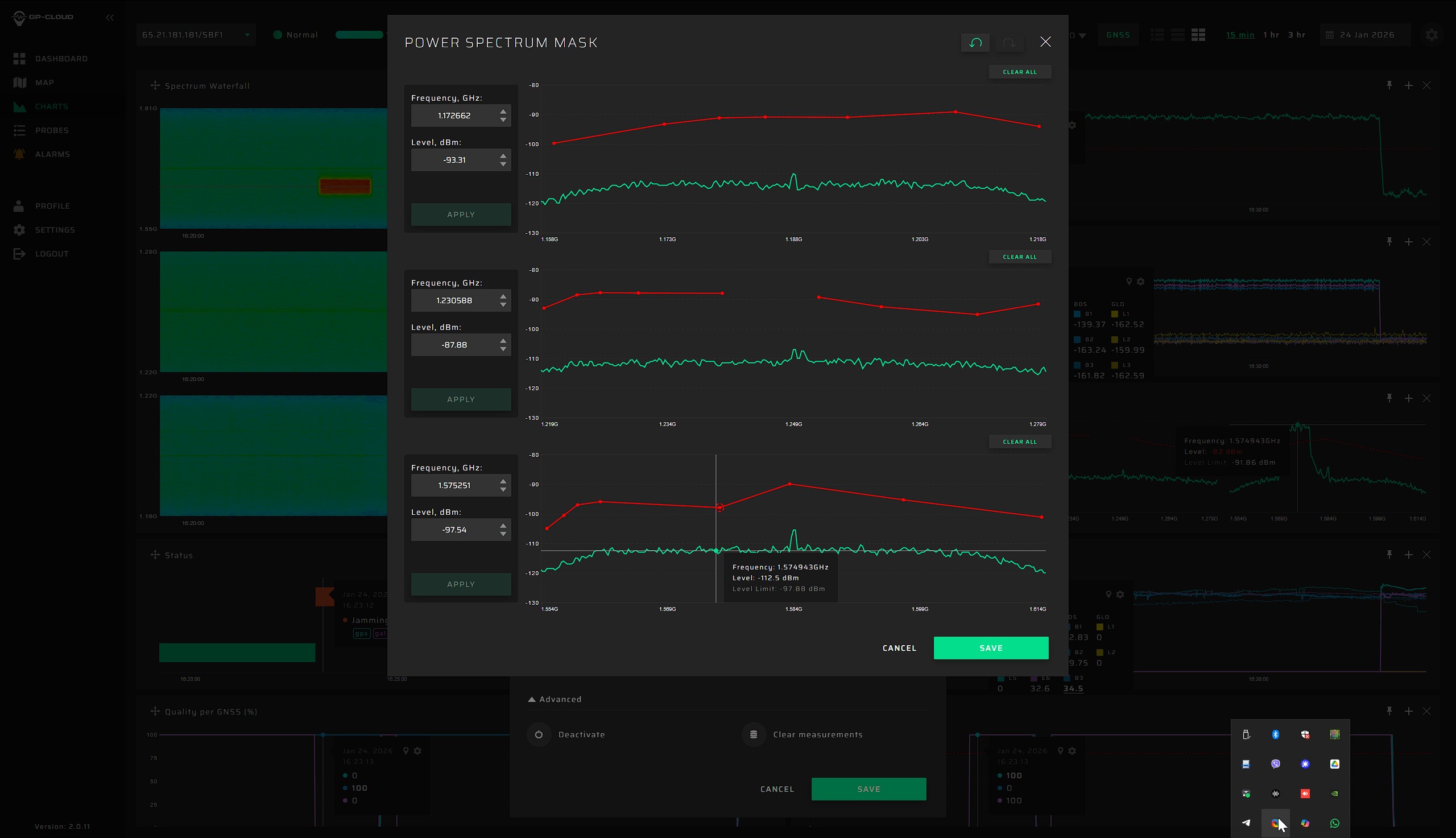
For each monitored GNSS band (L1, L2, and L5), the user defines a spectral mask that represents acceptable RF power levels across the frequency range. The mask is configured as a set of frequency–power points, allowing the user to build arbitrary, band-specific threshold curves.
Once configured, GP-Cloud continuously compares the real-time measured power spectrum against the defined spectral mask. The detection and classification process works as follows:
- The RF spectrum is monitored continuously in all configured GNSS bands.
- If the measured spectrum crosses the spectral mask threshold, the system detects an interference event.
- At the same time, GP-Cloud analyzes GNSS receiver signal quality, primarily the carrier-to-noise ratio (C/N₀).
- If the interference causes a measurable degradation of C/N₀, the event is classified as ‘Jamming’.
- If RF interference is present but GNSS signal quality remains within acceptable bounds, the event is classified as ‘Interference’.
By separating RF presence from GNSS degradation, GP-Cloud provides operators with a clear and operationally meaningful classification:
- Interference — RF energy detected, no significant impact on GNSS signals
- Jamming — RF interference that actively degrades GNSS signal quality
GNSS Signal Quality Analysis
When Septentrio receivers are connected to GP-Cloud, the platform provides detailed GNSS signal quality analysis across all supported frequency bands (L1, L2, and L5) and constellations. This allows operators to continuously assess not only RF interference, but also the actual quality, stability, and integrity of GNSS signals used for positioning and timing.
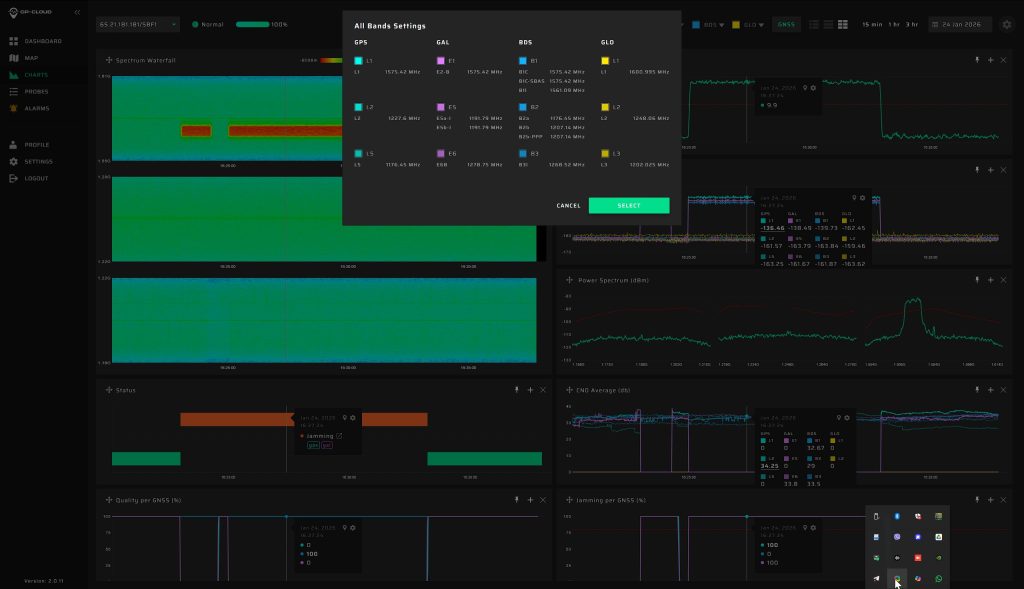
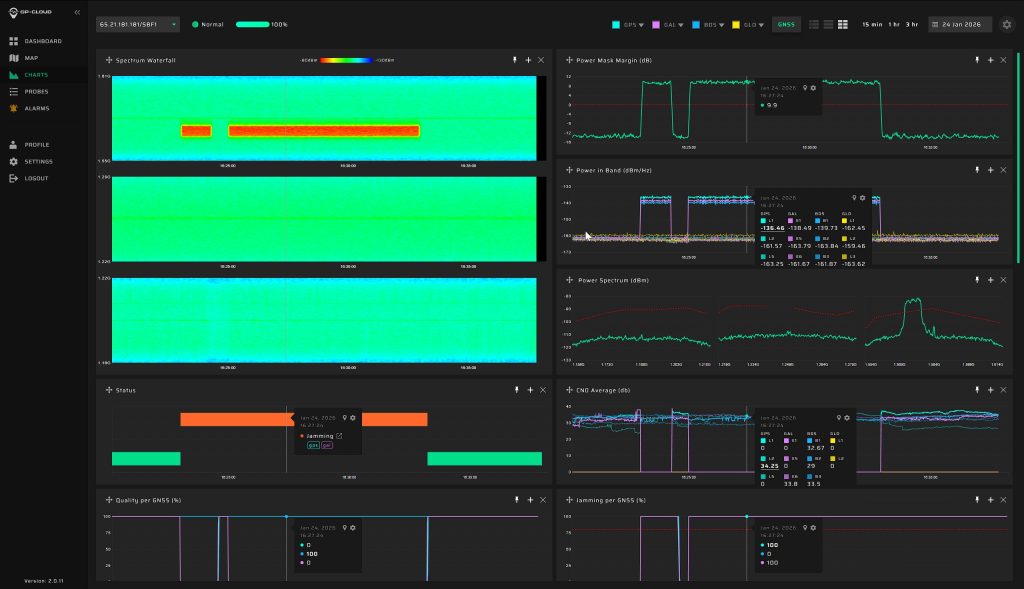
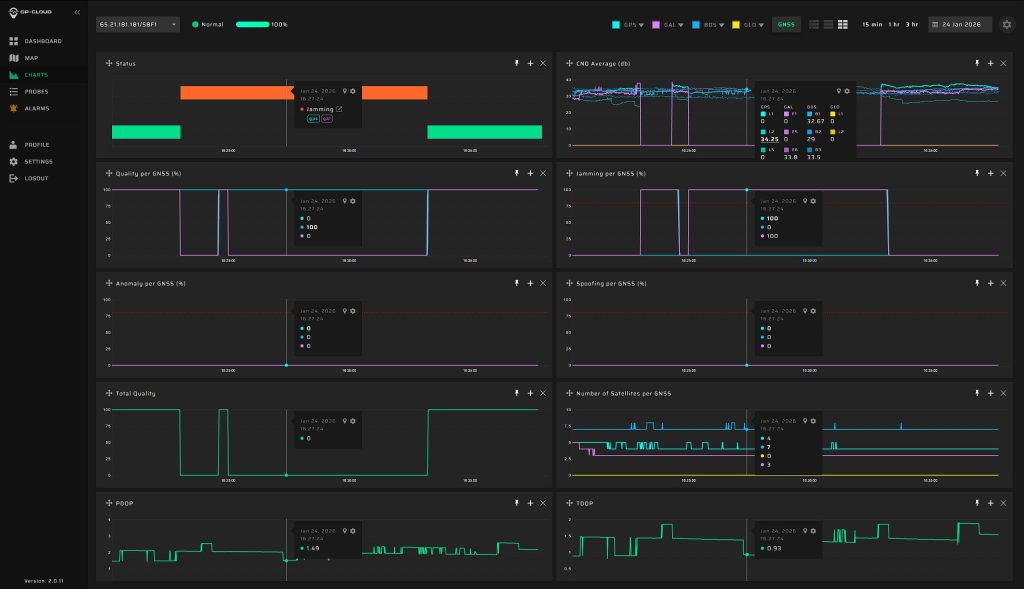
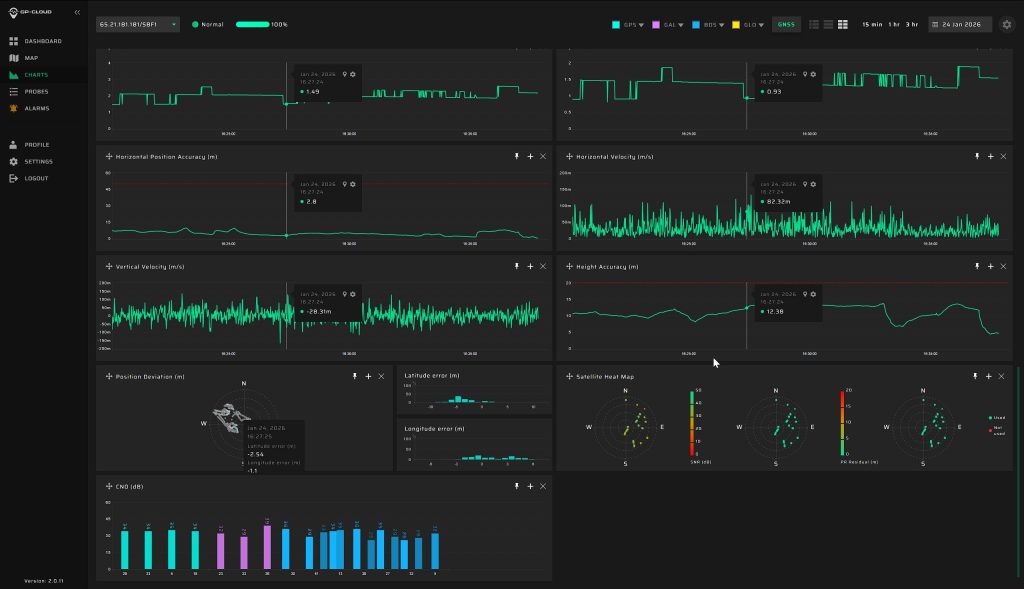
GP-Cloud provides a comprehensive set of charts that allow in-depth analysis of GNSS performance before, during, and after interference events.
Signal Quality and Integrity
- Total Quality (%)
A combined indicator reflecting the overall health of the GNSS solution across all constellations and bands. - Quality per GNSS (%)
Aggregated quality metric showing overall GNSS performance per constellation based on receiver measurements. - Anomaly per GNSS (%)
Shows detected anomalies in GNSS measurements that do not necessarily qualify as spoofing or jamming but indicate abnormal behavior. - Spoofing per GNSS (%)
Displays spoofing detection results per constellation based on receiver-level indicators. - Jamming per GNSS (%)
Indicates the severity of jamming impact per GNSS constellation, correlated with spectrum and C/N₀ degradation. - C/N₀ Average (dB-Hz)
Average carrier-to-noise ratio per constellation and frequency band. This is a primary indicator of signal degradation caused by interference or environmental effects. - Number of Satellites per GNSS
Shows how many satellites are actively tracked per constellation and band.
Positioning and Accuracy Metrics
- Horizontal Position Accuracy (m)
Estimated horizontal positioning accuracy derived from receiver solution data. - Height Accuracy (m)
Vertical positioning accuracy indicator. - Position Deviation (m)
Visual representation of position offsets relative to a reference point, useful for detecting drift or instability.
Kinematic and Dynamic Parameters
- Horizontal Velocity (m/s)
Displays horizontal velocity variations, useful for identifying abnormal dynamics or navigation instability. - Vertical Velocity (m/s)
Vertical motion indicator, often sensitive to GNSS signal degradation and spoofing effects.
Satellite and Geometry Indicators
- Satellite Sky Plot / Heat Map
Visualizes satellite distribution and signal conditions across the sky, including SNR or residual-based coloring. - C/N₀ per Satellite (dB-Hz)
Bar chart showing individual satellite signal strength, allowing identification of constellation- or satellite-specific issues. - PDOP / TDOP
Dilution of precision metrics reflecting satellite geometry quality and its impact on positioning accuracy.
Correlated Analysis with Spectrum Monitoring
All GNSS quality charts are time-aligned with spectrum data and interference events. This allows operators to directly correlate:
- RF interference →
- C/N₀ degradation →
- Positioning accuracy loss →
- Jamming or spoofing classification
As a result, GP-Cloud enables evidence-based GNSS performance analysis, rather than relying on isolated indicators.
Ready to Extend Your Septentrio GNSS Infrastructure?
If you already operate Septentrio receivers, you already have a strong foundation.
GP-Cloud allows you to extend that foundation into a centralized monitoring and analysis system—without additional hardware and without disrupting existing operations.
By connecting your receivers to GP-Cloud, you gain:
- Centralized GNSS and RF spectrum monitoring
- Reliable detection and classification of jamming and spoofing
- Long-term data logging and post-event analysis
- Full visibility across distributed sites and infrastructures
Whether you manage a small reference network or a large, distributed GNSS infrastructure, GP-Cloud helps you turn raw receiver data into actionable operational insight.
👉 Get in touch to discuss your setup, request a live demo, or evaluate GP-Cloud in your environment—either as a managed cloud service or as an on-premises deployment.


