

We are pleased to announce the release of firmware version 2.1.0 for GP-Probe TGE2.
This update introduces major improvements in measurement capabilities, RF spectrum analysis, system stability, and connectivity diagnostics. In this article, we highlight only the most visible and user-facing changes. In reality, firmware 2.1.0 includes several dozen additional fixes, refinements, and internal improvements that are not listed here.
For this reason, we strongly recommend updating all GP-Probe TGE2 devices to the latest firmware version to ensure optimal performance, improved detection accuracy, and overall system reliability.
What’s New and Improved in Firmware 2.1.0
New Features & Enhancements
- New Measurements tab in the built-in web interface
- Real-time Spectrum Waterfall, Spectrogram, and Power Spectrum views
- New Interference status in GP-Cloud, separating non-impacting RF interference from actual GNSS jamming
- New charts in GP-Cloud for spectrum analysis
- Power spectrum normalization for cleaner RF analysis
- Peak power measurements added
- Spectrogram frequency resolution increased from 128 to 256 frequency bins
- Ability to ping external servers directly from the Status page:
- Google (8.8.8.8)
- GP-Cloud server
Fixes & Stability Improvements
- Fixed GNSS time validation and authentication issues
- Fixed relay / output control behavior
- Improved performance and stability of the embedded web interface
- Numerous additional fixes, refinements, and internal optimizations
Standalone Measurements Without GP-Cloud
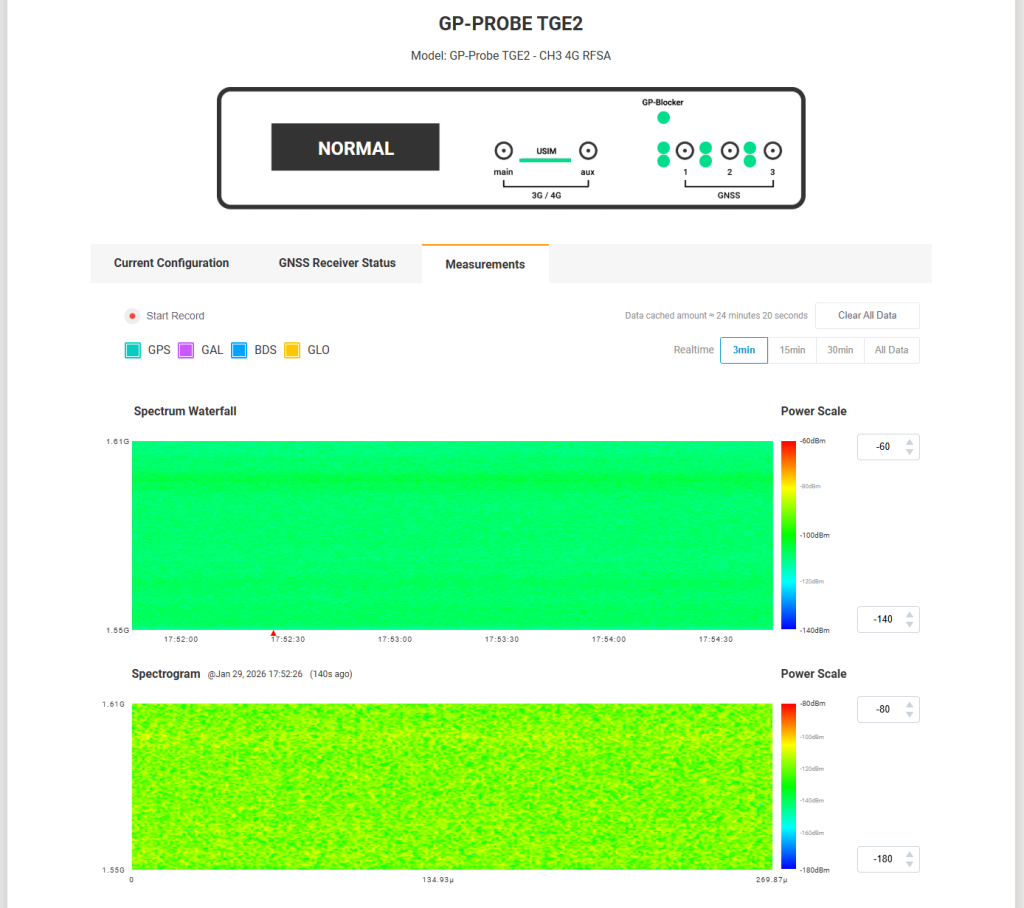
Firmware 2.1.0 introduces a Measurements tab in the built-in web interface, providing real-time RF and GNSS signal analysis locally on the device.
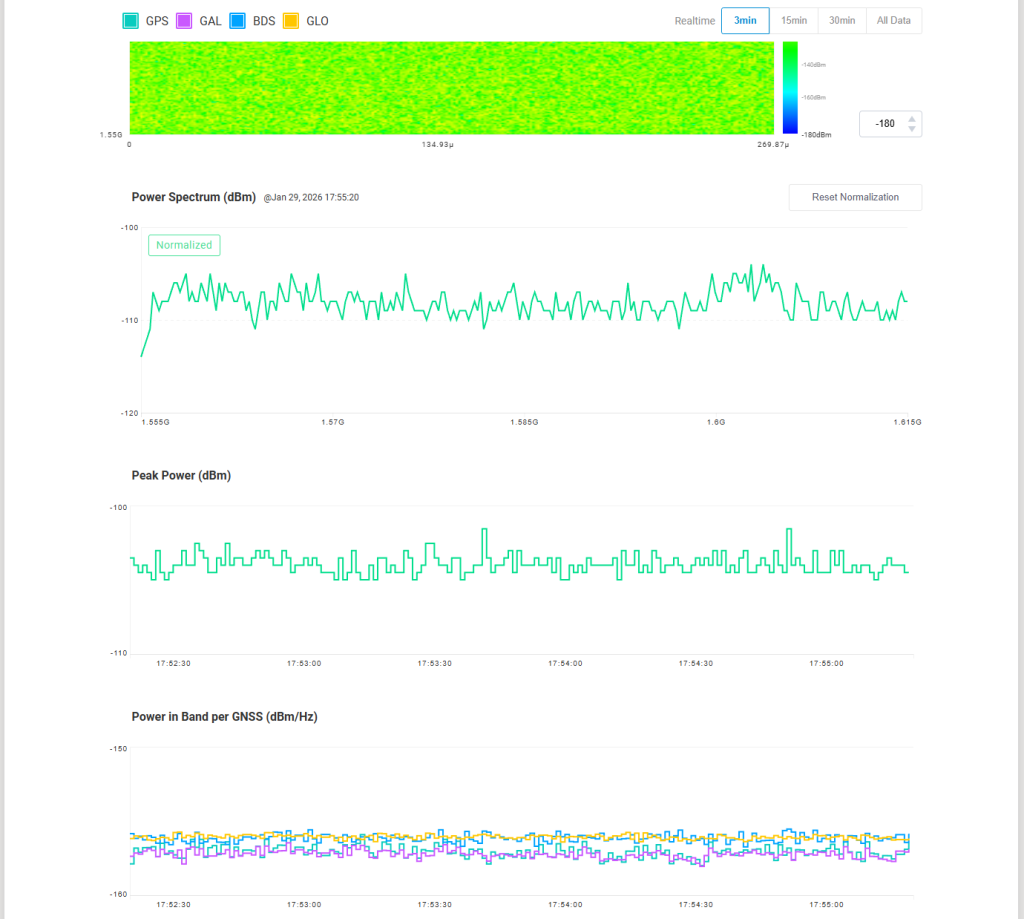
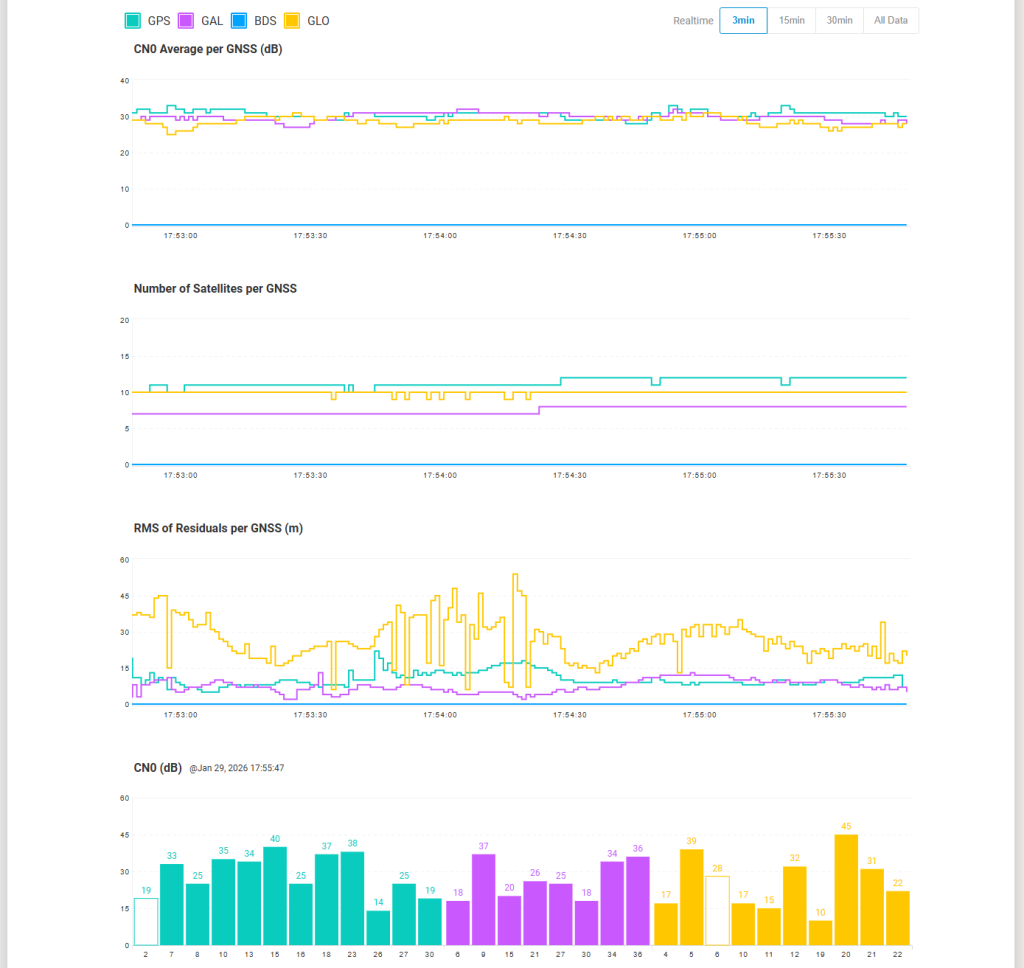
All measurements are available without Internet access and without connecting to GP-Cloud. The Measurements interface provides:
- Spectrum Waterfall (time–frequency view)
- High-resolution Spectrogram (256 frequency bins)
- Instantaneous Power Spectrum
- Peak power tracking
- GNSS quality indicators for GPS, Galileo, BeiDou, and GLONASS
New Interference Status in GP-Cloud and Spectrum Analysis Charts
With firmware 2.1.0 for GP-Probe TGE2, GP-Cloud has been extended to process additional RF data provided by the probe.
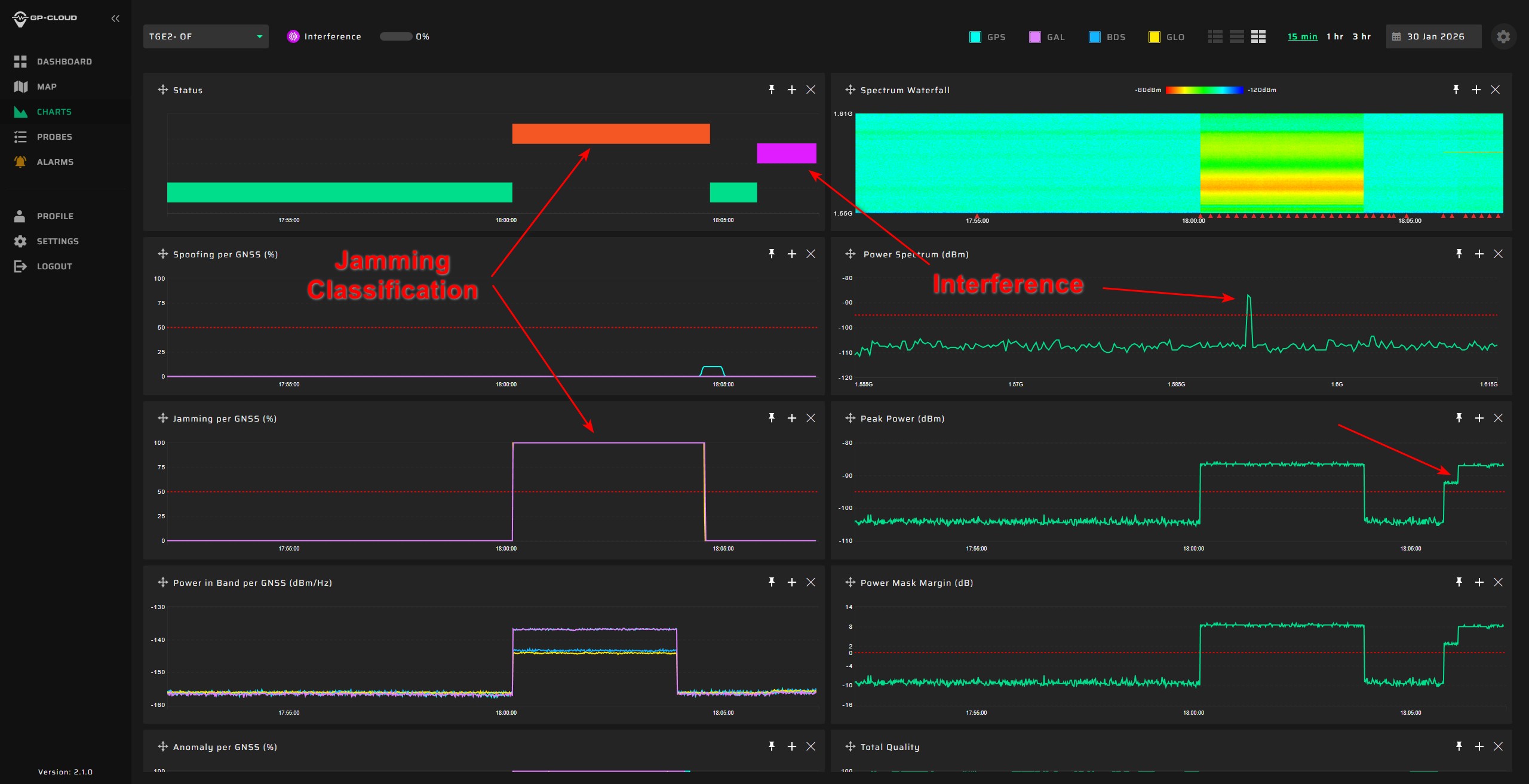
A new Interference status has been introduced:
- Interference is set when an RF signal is visible in the spectrum and exceeds the configured peak power threshold, but does not degrade GNSS reception quality.
- Jamming is set only when the signal causes measurable degradation of GNSS signal quality, indicating actual suppression of satellite navigation signals.
This logic separates the presence of RF emissions from their real impact on GNSS performance and reduces false jamming alarms.
To support this classification, new real-time charts are available in GP-Cloud:
- Power Spectrum — real-time view of the RF spectrum shape.
- Peak Power (dBm) — peak signal level with a user-defined detection threshold.
- Power Mask Margin (dB) — difference between the threshold and actual signal level.
Together, these additions provide a clearer and more accurate view of GNSS interference and jamming events.
Power Spectrum Normalization
One of the key technical enhancements in this firmware is power spectrum normalization, introduced to simplify peak power–based interference detection.
In GP-Cloud, interference detection uses a single peak power threshold that applies across the entire frequency range. In real installations, GNSS antennas with integrated LNAs introduce frequency-dependent gain, making the raw spectrum uneven. In such conditions, a single threshold becomes unreliable unless complex spectral masks are used.
Spectrum normalization compensates for antenna and RF chain response, flattening the noise floor and allowing one peak power threshold to be applied consistently across all frequencies. This simplifies configuration and improves detection accuracy.
⚠️ After updating the firmware, please:
- perform spectrum normalization on each device;
- recalibrate peak power thresholds and detection logic in GP-Cloud.
This ensures correct interference and jamming classification.
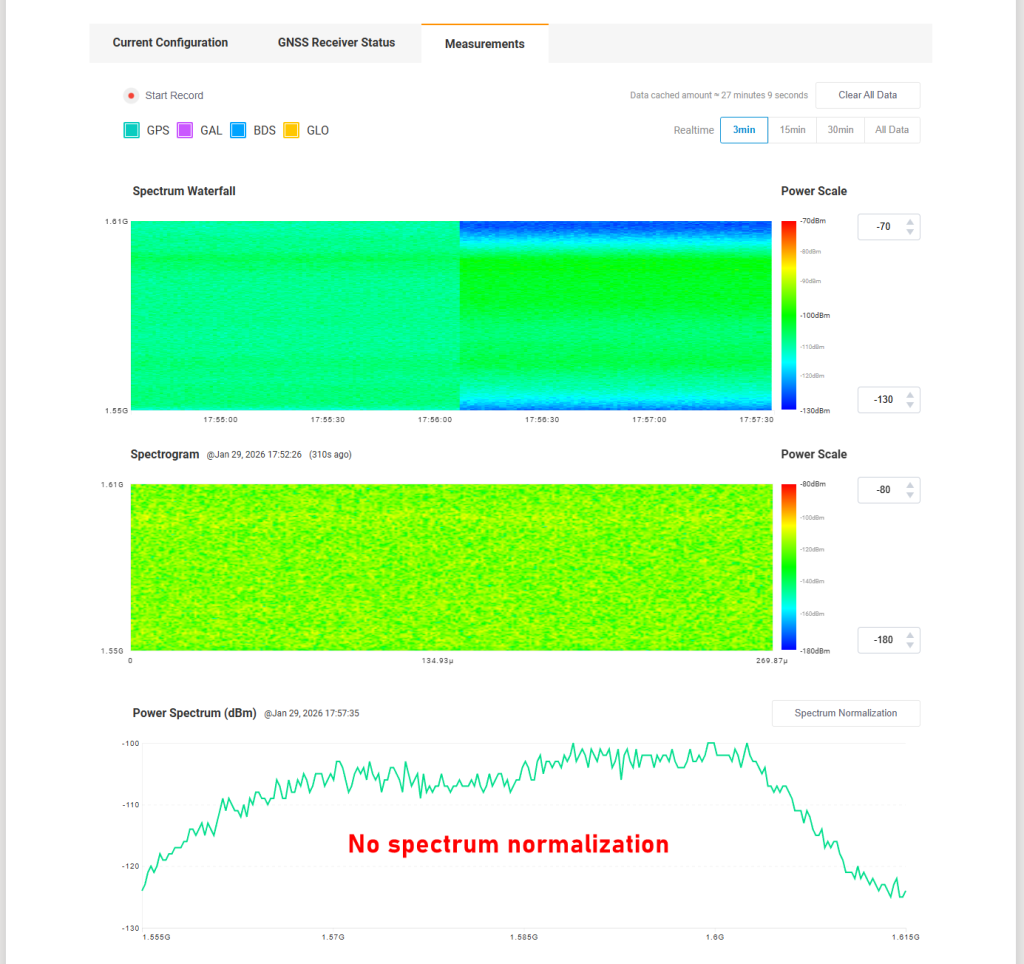
When spectrum normalization is enabled, the noise floor becomes flat and uniform, effectively compensating for antenna and LNA characteristics:
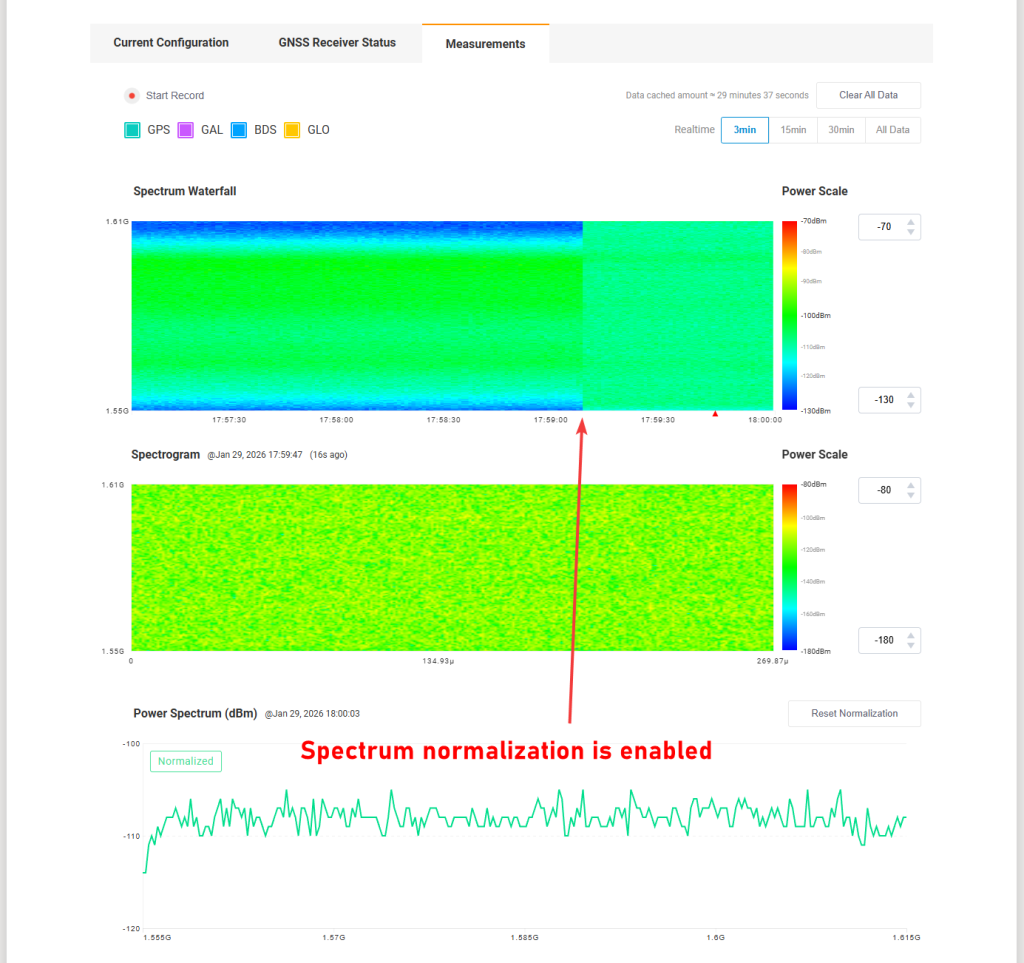
This significantly improves the sensitivity of interference detection algorithms, particularly those based on peak power analysis.
Spectrum normalization can be enabled or reset directly from the Measurements interface.
Network Connectivity Diagnostics (Ping)
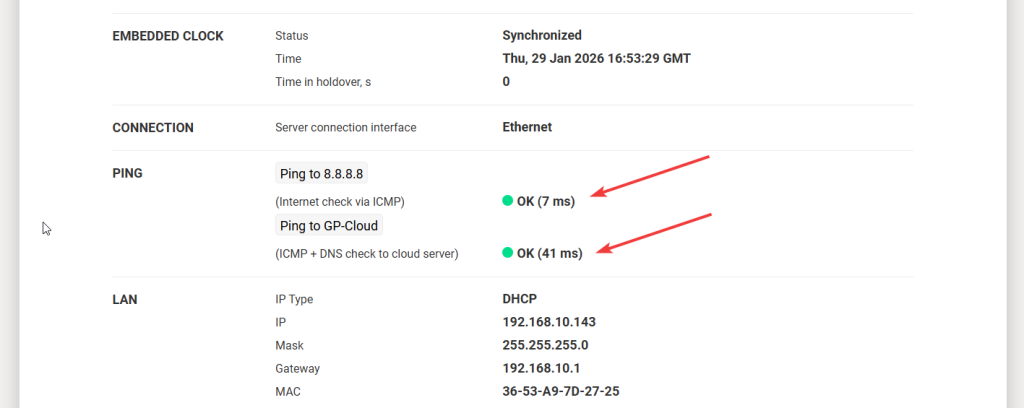
Firmware 2.1.0 adds built-in network connectivity testing directly to the Status page of the web interface.
Available tests:
- Ping to Google (8.8.8.8) — verifies general Internet connectivity via ICMP
- Ping to GP-Cloud — verifies ICMP and DNS connectivity to the GP-Cloud server
Each test displays latency and status, making it easy to:
- confirm Ethernet or cellular connectivity,
- diagnose DNS or routing issues.
Update the Firmware
Firmware version 2.1.0 for GP-Probe TGE2 is now available for download.
We recommend updating all GP-Probe TGE2 devices to benefit from the latest measurement capabilities, improved RF spectrum analysis, enhanced connectivity diagnostics, and overall system stability improvements.
🔽 Download the latest firmware here:
👉 https://firmware.gp-cloud.io/


