Before a physical attack on a convoy or a protected individual, attackers typically activate RF jammers. These devices block GPS tracking and cellular communications, isolating the target from any help. For VIP protection services, this means losing situational awareness at the worst possible moment. What most protection teams do not realize is that this jamming can actually be detected. Because jammers are activated seconds or minutes before the assault begins, GPS jamming detection provides an early warning signal that gives the team time to react.
How Jammers Blind and Isolate a Target: Understanding What Can Interfere with GPS Signal
GPS signals arrive at ground level at roughly -130 dBm, about one ten-billionth of a watt. A cheap jammer broadcasting at just 10 dBm can overpower these signals across a radius of 100 meters or more. The result: every GPS-based tracker vehicle security system in the area stops reporting. Navigation fails. The operations center sees nothing.
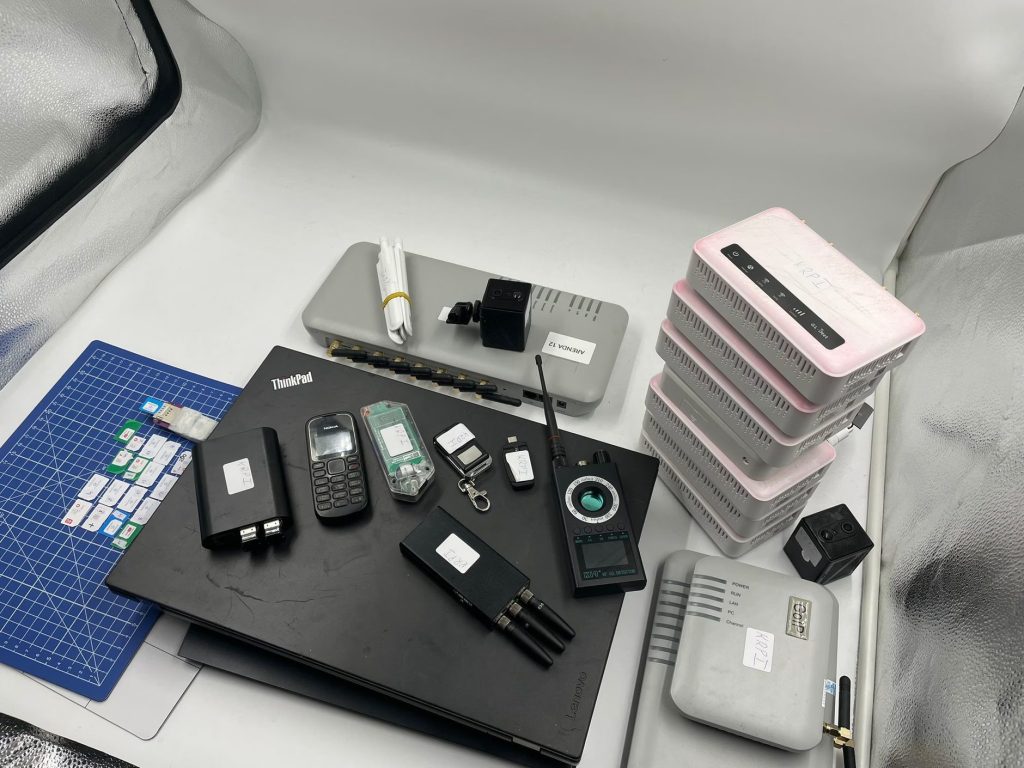
Attackers rarely use GPS-only jammers. In practice, organized groups deploy broadband devices that simultaneously block GPS, cellular networks, WiFi, Bluetooth, and even police radio frequencies. A UK Government Office for Science report documented multi-band “briefcase jammers” with 8 channels designed to achieve total RF isolation of a target. No tracking. No phone calls. No radio. No calling for help.
These devices are small, widely available online, and cheap. A basic car GPS signal interference blocker sells for as little as $3. Multi-band models capable of blocking all communication channels cost $300 to $1,700. They are illegal in virtually every jurisdiction, but openly sold on more than 100 websites.
The key point for protection teams: jammer activation is typically the first technical action taken by attackers. It happens seconds or minutes before the physical assault. If you can detect it, you have a warning.
Real Cases: Jammers Before the Attack
The pattern of jammer-first, attack-second is well documented in vehicle theft, cargo hijacking, and armed robbery operations worldwide.
In Mexico, GPS jammers are used in 85% of cargo truck hijackings. A truck robbery occurs approximately every five minutes in the country. Jamming the vehicle’s tracking system is the standard first step before the physical assault.
In the UK, organized crime groups routinely use jammers to steal high-value vehicles. In one case documented by Tracker UK, thieves used a GPS jammer to steal a Mercedes-Benz G63 AMG. The vehicle was only recovered because it had VHF-based tracking that jammers could not affect. In another UK case, four separate GPS jamming devices were found on a single stolen vehicle. Professor David Last of the University of Bangor, a leading expert on GPS crime, told NBC News that organized criminals consider jammers a standard part of their operations.
In South Africa, cash-in-transit robberies follow the same pattern. Armed gangs use jammers to neutralize GPS tracking and panic alarms on armored vehicles before attacking with explosives and automatic weapons. KwaZulu-Natal province alone recorded 10 cash-in-transit heists in the last quarter of 2024.
The same playbook applies when attackers target a protected individual or convoy. The priority for the attacker is not to defeat GPS tracking specifically, but to cut off all communications so the team cannot call for backup or raise the alarm. Broadband jammers achieve this by blocking radio, cellular, and GNSS frequencies in a single action.
How to Detect GPS Jamming
As explained earlier, attackers typically jam all communication and navigation systems before an assault: cellular, radio, and GPS. However, the most reliable way to detect this jamming activity is to monitor the GPS band specifically.
GNSS frequency bands (such as GPS L1 at 1575.42 MHz) are protected by international regulation: no ground-based transmitter is permitted to broadcast on these frequencies. Only satellites are allowed. This means any signal detected in the GPS band at ground level is, by definition, illegal interference. There is no ambiguity, and no need to distinguish legitimate signals from jamming. A detector in the GPS band can identify interference from a very long distance, often much further than the jammer’s effective operational radius.
By contrast, monitoring cellular or radio bands is far more complex. These bands are filled with legitimate signals from phones, radio stations, and authorized transmitters. A jammer’s signal would have to be distinguished from all this normal traffic, which is technically difficult and produces false alarms. The GPS band has no such problem.
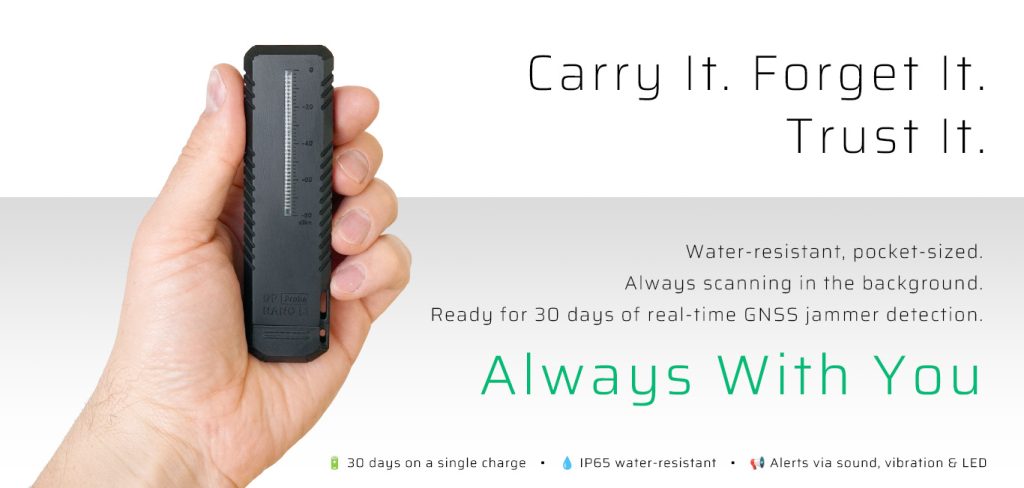
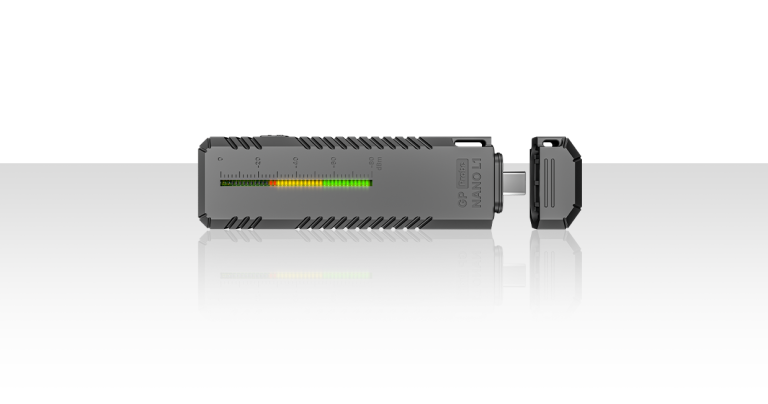
GPSPATRON’s GP-Probe Nano L1 is a pocket-sized detector built on this principle. It continuously monitors the GNSS L1 band and alerts the user via vibration, sound, and a 36-LED power scale when interference is detected. The device measures 113 x 31 x 15 mm, weighs approximately 50 grams, and runs for 30 days in detector mode without charging. It does not block or counter the jammer. It detects it and alerts the operator.
A typical USB-style jammer broadcasting at 5 dBm can be detected at up to 200 meters. More powerful multi-band jammers can be detected from even further away. The vibration alert allows covert operation: the device can sit in a pocket and alert the officer without any visible indication.
Real-Time GNSS Interference Detection
Compact wearable detector monitoring L1 band activity and triggering instant alerts on jamming events, enabling immediate operational response.
What GPS Jamming Detection Brings to a Protection Team
The GP-Probe Nano L1 does not stop an attack. It gives the protection team something they currently do not have: warning time. When a jammer activates nearby, the device vibrates. That alert means something is happening in the RF environment that should not be there. The team can react before the physical threat materializes.
In practical terms, this means the team can switch to alternate routes, shift to non-GPS navigation, alert the operations center by radio or voice, and move to a heightened security posture. These seconds matter. Without a detector, the first sign of trouble is the attack itself.
For VIP protection, the Nano L1 is used in detector mode, where it alerts the operator in real time via vibration, sound, and LED. This mode is the relevant one for close protection operations, where the value of the device comes from the immediate alert, not from historical data. For organizations operating multiple units across fixed sites (residences, offices), the GP-Cloud platform provides centralized event correlation across all deployed detectors.
The 30-day battery life eliminates daily charging. The 50-gram weight means zero operational burden. No setup, no training in RF engineering, no visible equipment. The device simply monitors and alerts. For any team responsible for protecting people or high-value assets in transit, the GP-Probe Nano L1 adds an early warning layer that currently does not exist in most protection operations.