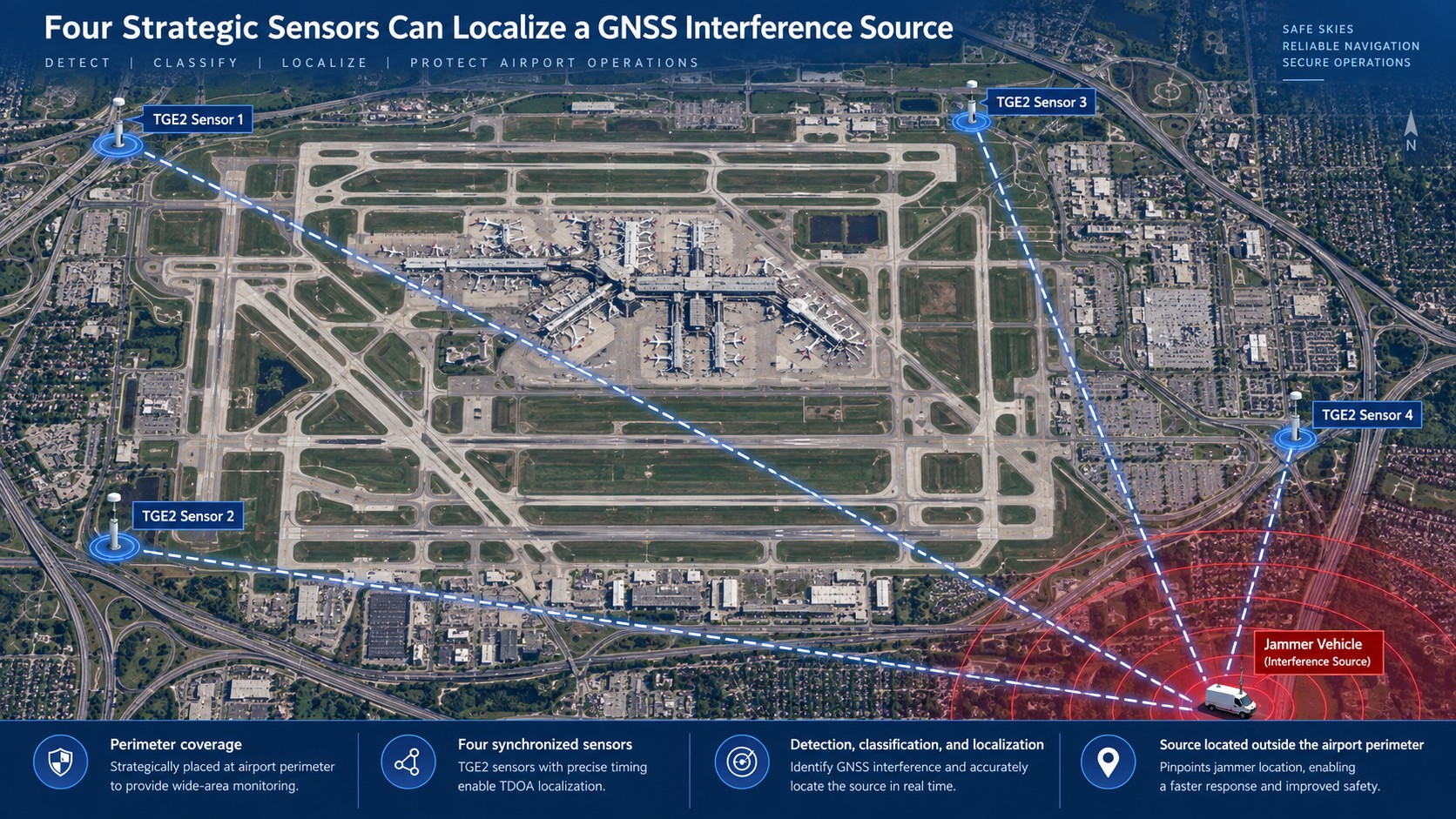
For years, the aviation industry has been reporting increasing levels of GNSS jamming and spoofing. The discussion has largely focused on conflict zones, pilot reports, NOTAMs and contingency procedures.
But two recent cases — one in New Mexico and another in Sofia — illustrate why GNSS interference should no longer be treated simply as an external navigation problem.
The real issue is broader: aviation safety is built in layers. GNSS is one of those layers. Removing it may not immediately cause an accident, but it reduces the safety margin available when something else goes wrong.
New Mexico: Military GPS Jamming Was Active Before a Fatal Crash
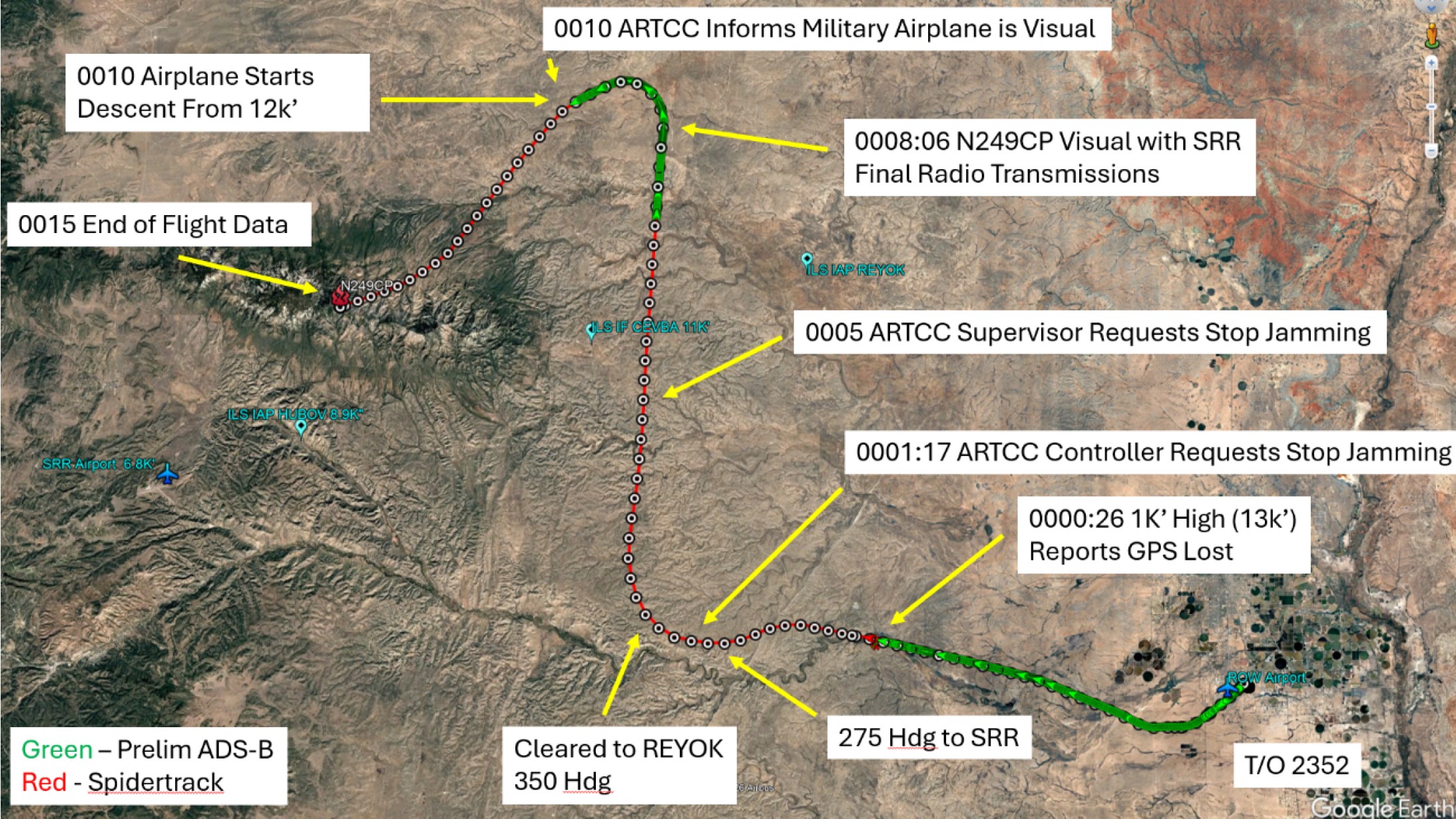
On May 14, 2026, a Beech C90 operating an air-ambulance mission crashed into mountainous terrain near Ruidoso, New Mexico, killing four people.
The NTSB preliminary report confirms that U.S. military GPS jamming was active in the area. The crew reported losing GPS capability, and three other aircraft reported GPS problems during the same period. Air traffic control requested that the military stop the jamming, and GPS-related surveillance data subsequently improved. Later, after the crew reported that they had Ruidoso visually and accepted a visual approach, the military was informed that jamming could resume. The aircraft struck mountainous terrain several minutes later.
This distinction is critical: the NTSB has not concluded that GPS jamming caused the crash. The final cause remains under investigation.
And that is exactly the point.
Aviation safety should never depend on a single system. Pilots have alternative navigation methods. ATC can provide vectors. Airports may have ILS and conventional navigation aids. Crews have visual references when conditions allow.
But redundancy does not mean that deliberately removing one layer has no consequence.
In this case, the flight was operating at night, over difficult mountainous terrain, on an aeromedical mission. The loss of GPS introduced an additional problem that the crew and ATC had to manage. Even if the eventual investigation determines that another factor caused the crash, the event demonstrates something fundamental:
a safety layer that is unavailable cannot protect you from the next error, failure or unexpected condition.
This is why the argument that “aircraft can fly without GPS” misses the point. Of course they can. Aviation safety is not about proving that operations remain theoretically possible after removing one defence. It is about preserving as many independent defences as possible.
Sofia: When a Local Jammer Reaches an International Airport
A very different case emerged in Sofia in August 2026.
Bulgarian authorities reported detecting powerful GPS interference originating from the Dragalevtsi area. According to the State Agency for National Security and subsequent statements from the Interior Ministry, the interference affected GPS frequencies across parts of Sofia, including Sofia Airport and aircraft flying over the city. Authorities also seized an SUV equipped with components associated with a professional signal-jamming system. The Interior Minister later stated that the investigation concerned two jammer systems rather than one.
This raises an important question:
How can equipment operating from one vehicle or private facility interfere with GNSS reception at an international airport without the airport immediately having an independent picture of what is happening?


The Next Problem May Come From Our Own Protection Systems
Electronic warfare capabilities have developed extraordinarily quickly following the war in Ukraine. At the same time, counter-UAS systems are being deployed around military facilities, government buildings and critical infrastructure.
Many counter-drone concepts rely on RF interference against command links, telemetry or satellite navigation. This creates an uncomfortable possibility: a system deployed to protect one piece of critical infrastructure can unintentionally degrade another.
Europe is already recognising the coordination problem. EASA and IATA have called for real-time GNSS monitoring, tighter controls on jamming equipment, backup navigation infrastructure and improved civil-military coordination. In March 2026, EASA and EUROCONTROL published a dedicated European action plan built around monitoring, data sharing, operational procedures and coordinated response to GNSS interference.
The Airport Blind Spot Is Not Only in the Air
The aviation discussion naturally concentrates on aircraft approach and landing. But airports themselves are becoming increasingly dependent on GNSS.
A-SMGCS, airport vehicles, aircraft towing and pushback operations, ADS-B-derived positioning, aircraft position initialization and GNSS-disciplined timing systems can all depend directly or indirectly on satellite navigation.
This becomes particularly important during Low Visibility Procedures.
In fog, pilots, vehicle drivers and controllers lose the most intuitive safety mechanism available to humans: seeing what is around them. Positioning and surveillance systems therefore become more important precisely when visual confirmation becomes less available.
And a jammer does not need to disable an entire airport.
A low-power source in a nearby parking area may affect only a few hundred metres — perhaps one taxiway, one apron, one service road or one towing route. At cruising altitude such a source may be practically invisible. From the perspective of airport surface operations, however, those few hundred metres may be exactly where GNSS is needed most.
That is why high-altitude interference maps and pilot reports alone cannot provide an airport with sufficient situational awareness.

Monitoring Should Become Another Safety Layer
Aviation works because independent safety layers protect each other. GNSS monitoring should become one of those layers.
An airport should know when GNSS interference starts, where it is strongest, whether it is jamming, spoofing or another anomaly, whether the source is stationary or moving, and which operational areas may be affected.
Waiting for several pilots to complain is not monitoring. Discovering an interference source only after an operational incident is not resilience.
The technology to detect, classify, log and localize these events already exists. What remains is to deploy it before GNSS interference becomes a contributing factor in incidents where several other safety layers happen to fail at the same time.
Read more about GPSPATRON’s multi-layer architecture for airport GNSS interference monitoring: Airport GNSS Interference Monitoring: Multi-Layer Detection Architecture