
Reach out to us for an assessment of your project and to receive a personalized quote tailored to your needs.
GP-Simulator 2
Software-defined GPS Signal Simulator for GNSS Receiver Testing
Precisely simulate spoofing, jamming, and dynamic scenarios in the lab – no outdoor tests needed
Contact Us for Project Evaluation
Reseller Directory
Choose from our trusted distributors to enjoy personalized service, expert advice, and compliance with regional standards for a seamless buying experience.
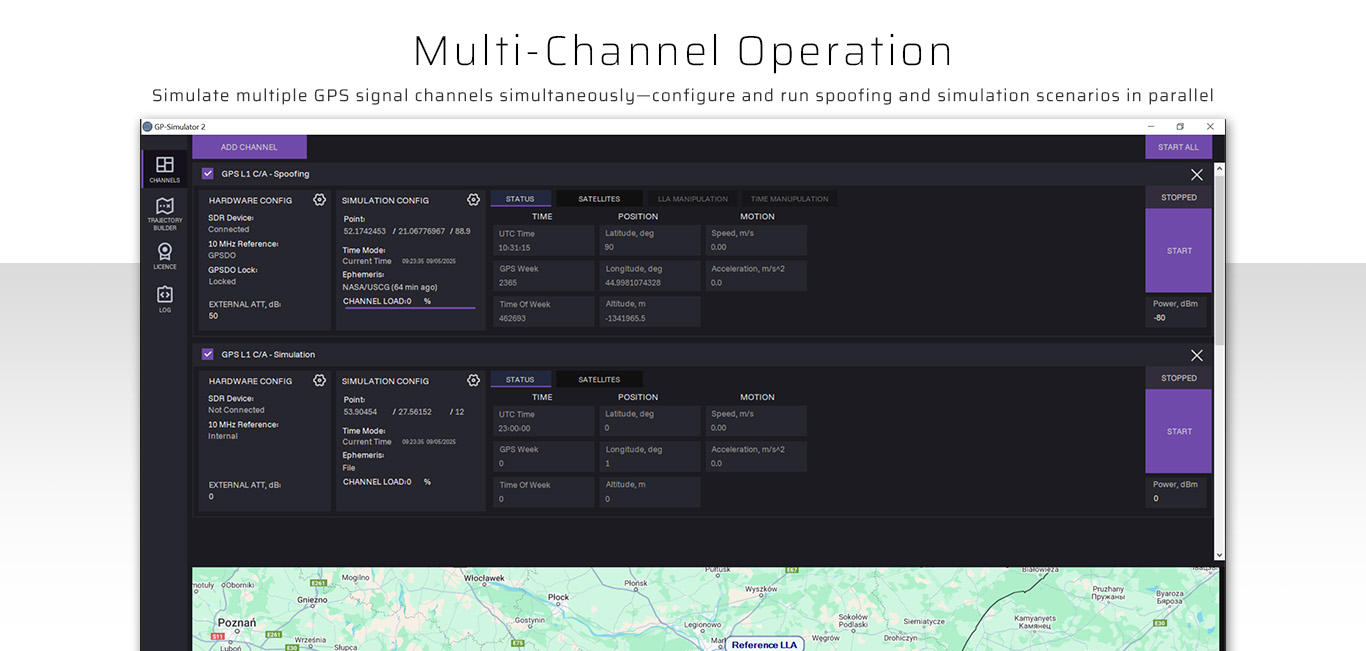
GPS Signal Simulation Features
GP-Simulator 2 combines advanced spoofing research with routine GNSS validation. It runs on SDR hardware, making it ideal for lab R&D or automated production tests. Engineers control every aspect of the signal for repeatable results.
Watch: GP-Simulator 2 Overview
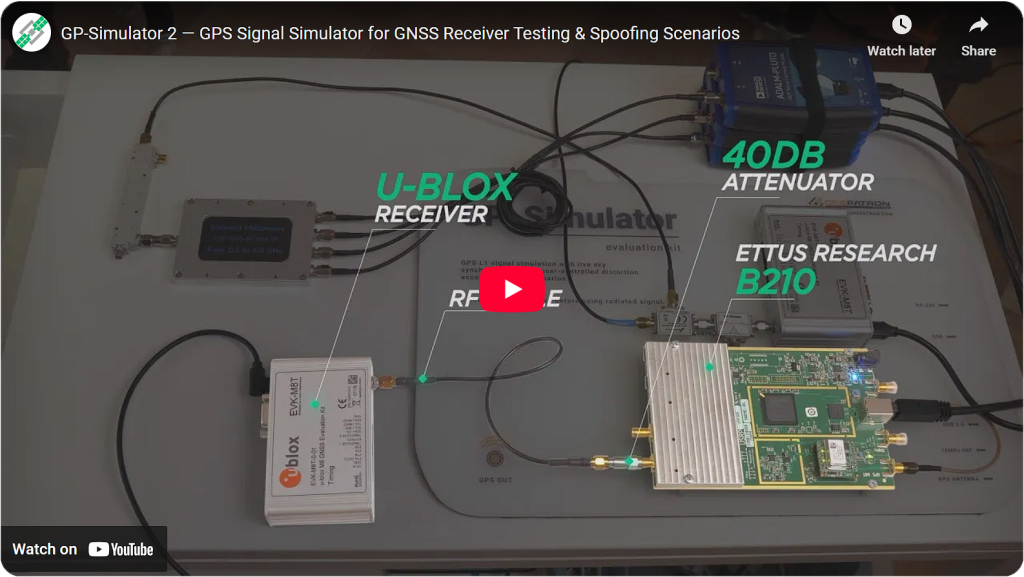
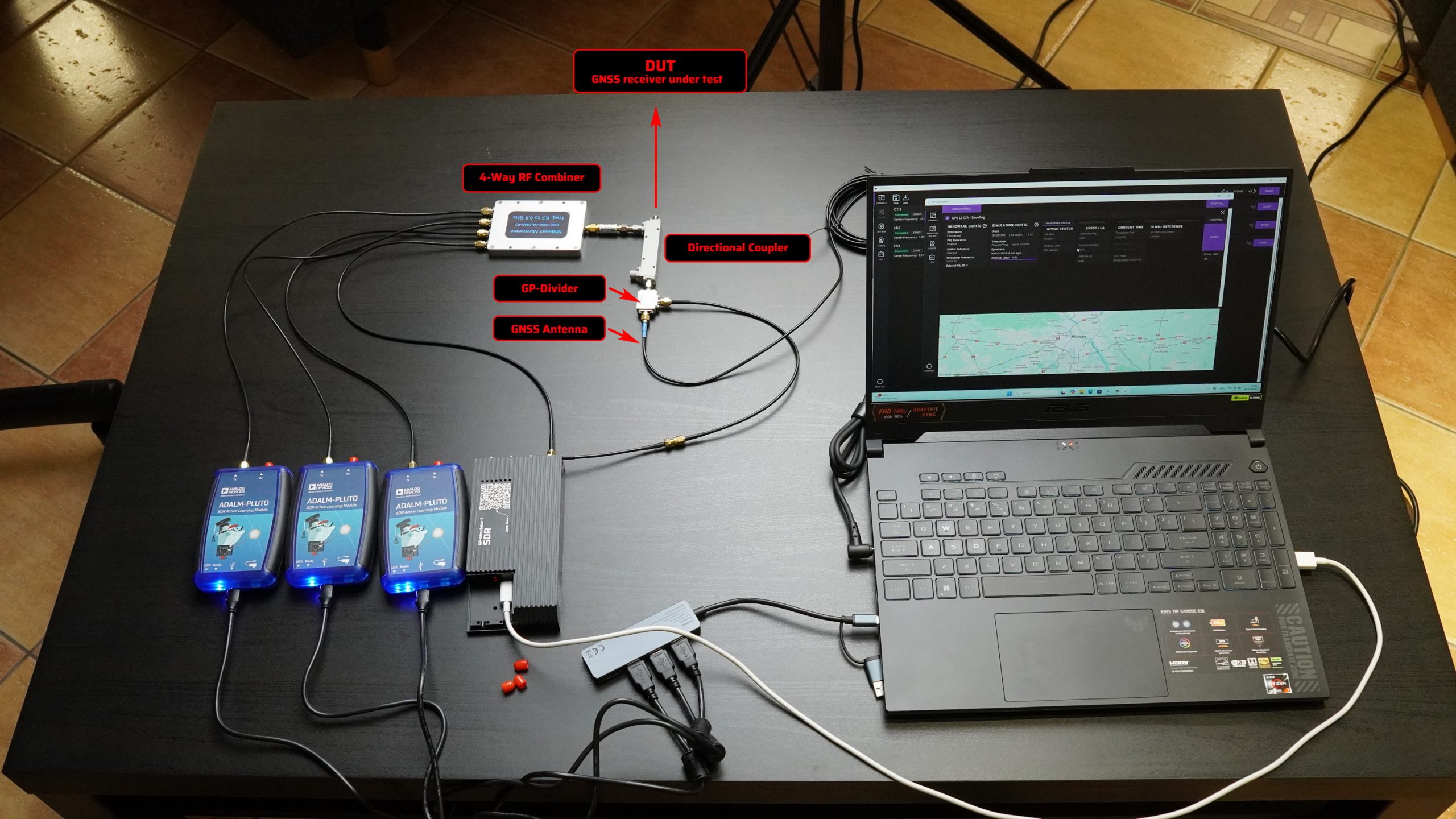
See GP-Simulator 2 in action: this demo walks through the setup and controlled laboratory testing of a GNSS receiver under simulated spoofing conditions. Learn how to configure the software, generate repeatable test scenarios, and analyze receiver behavior. Check our YouTube channel for more use-case demos.
Use Cases & Applications
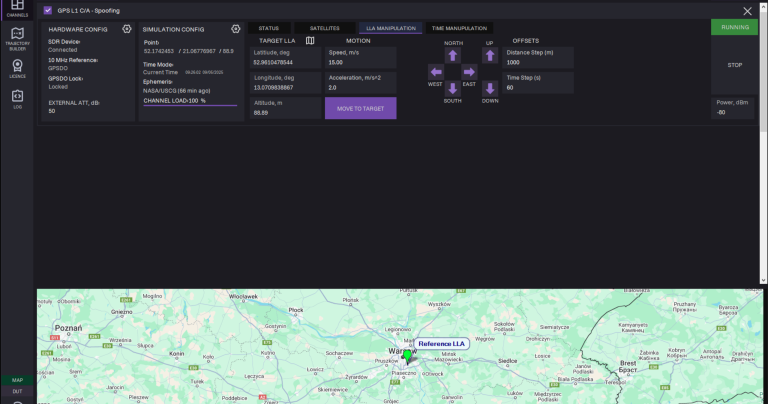
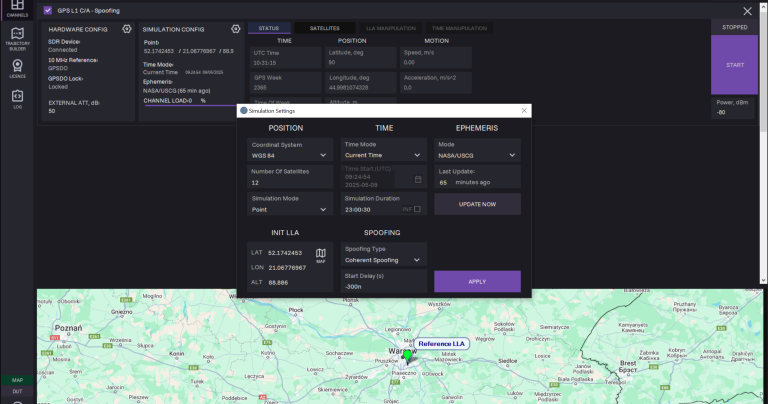
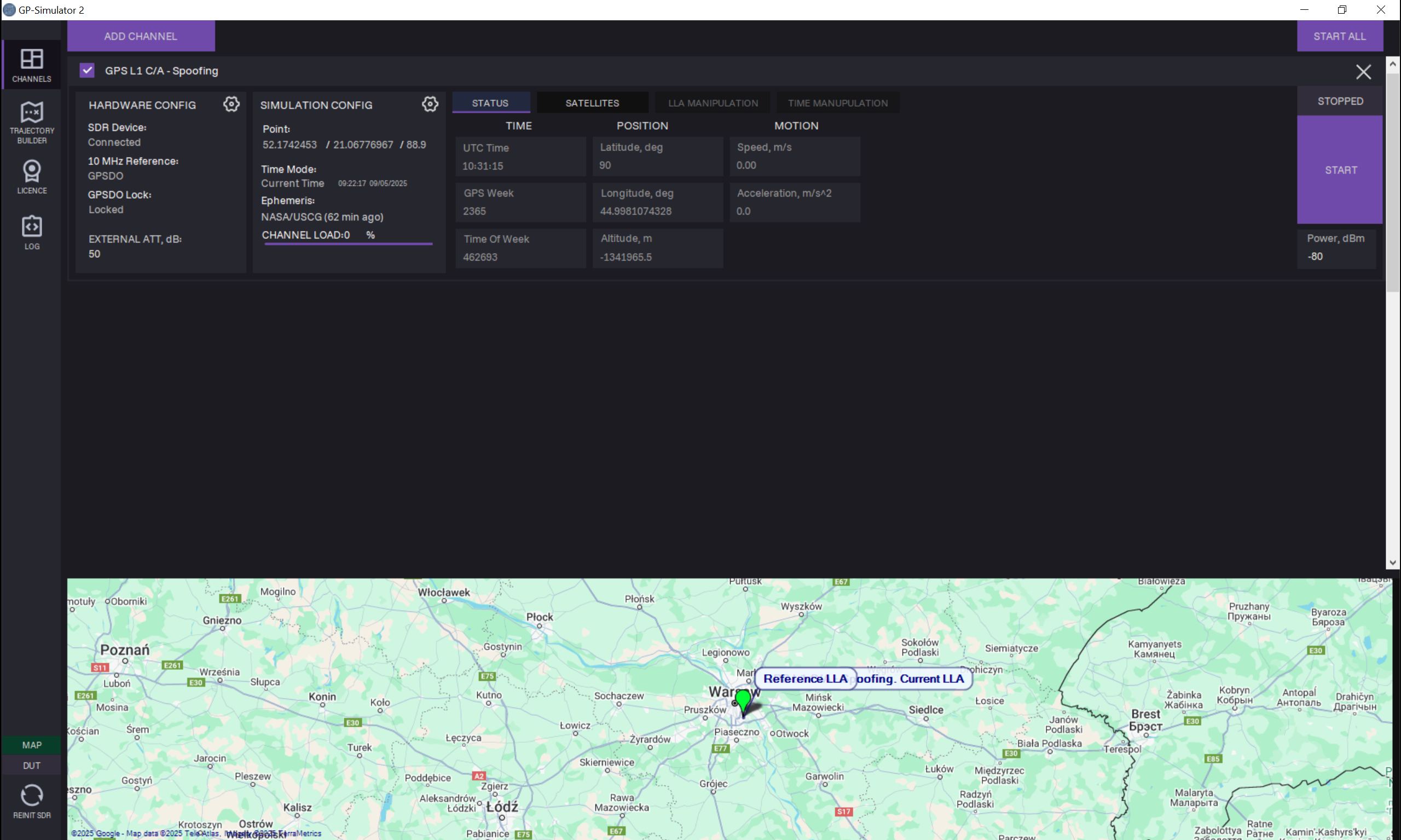
GP-Simulator 2 is a GPS/GNSS signal simulation platform for production testing, R&D, receiver validation, and resilience assessment. It is designed for controlled laboratory and manufacturing environments where repeatable GNSS scenarios are required to verify receiver behavior, timing performance, navigation robustness, and product quality.
🛡️ GNSS Receiver Resilience Testing
Application:
GNSS receivers used for timing, navigation, asset tracking, and other critical applications must maintain predictable behavior under abnormal or degraded signal conditions. GP-Simulator 2 allows engineers to reproduce controlled GNSS test scenarios in a repeatable laboratory environment.
How GP-Simulator 2 helps:
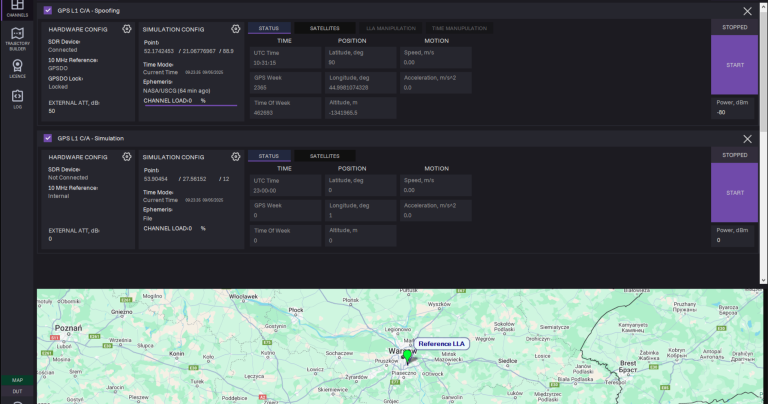
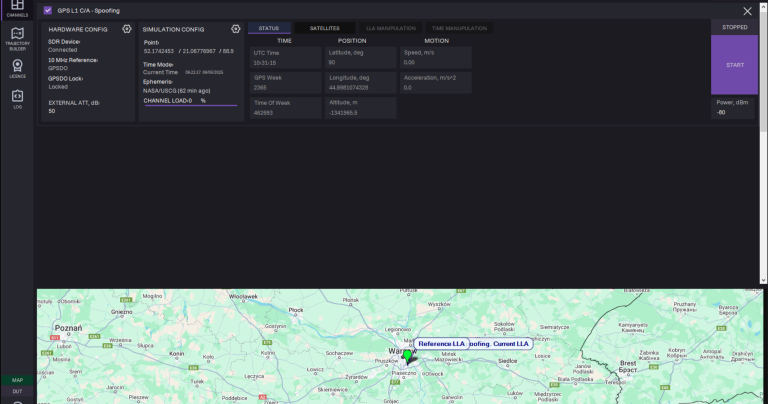
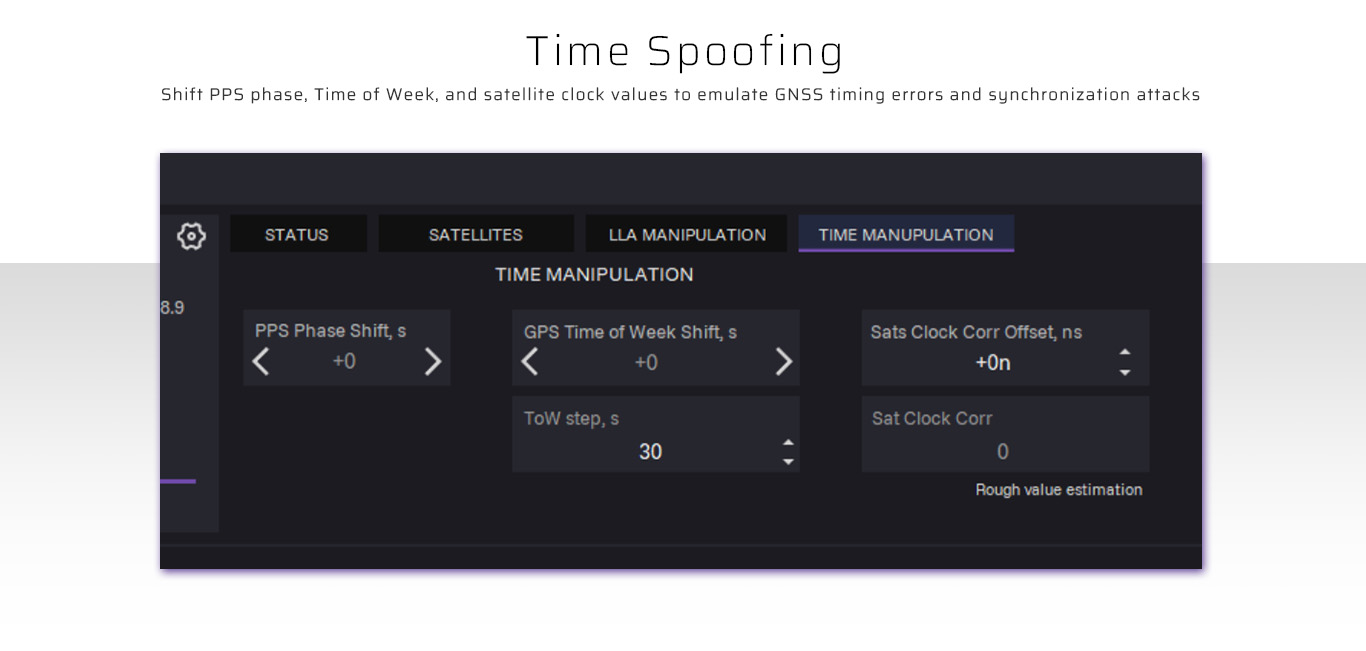
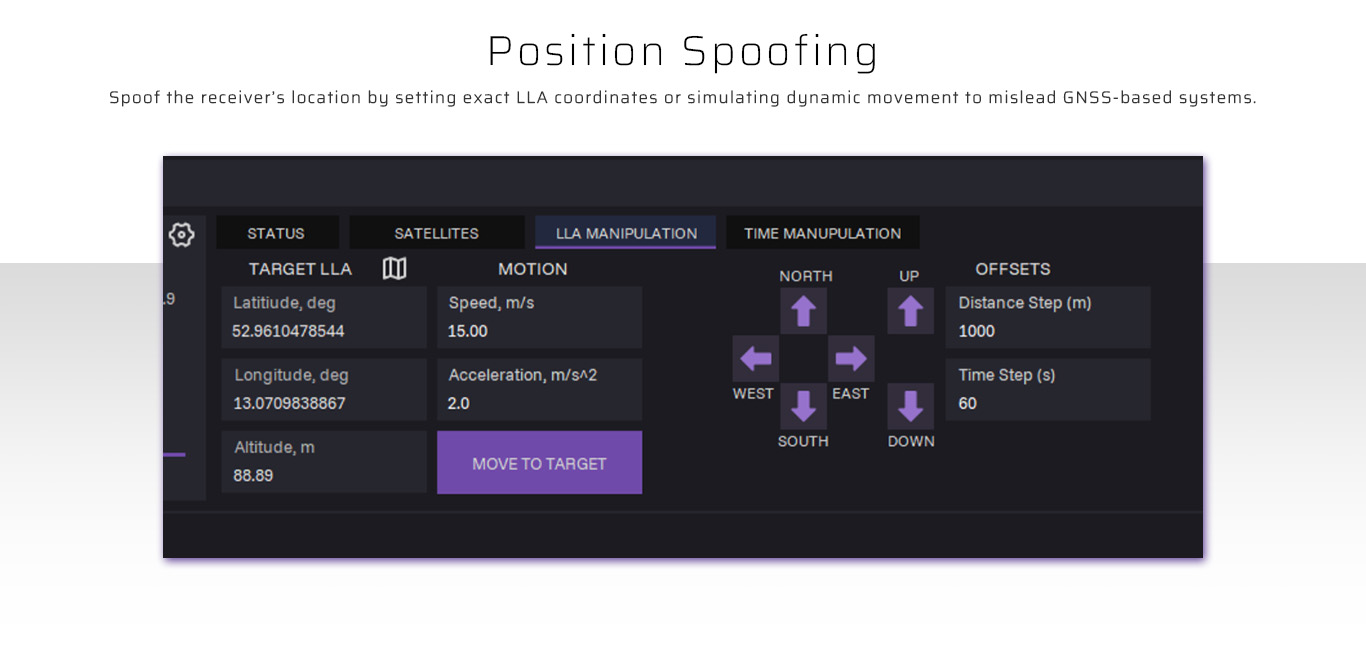
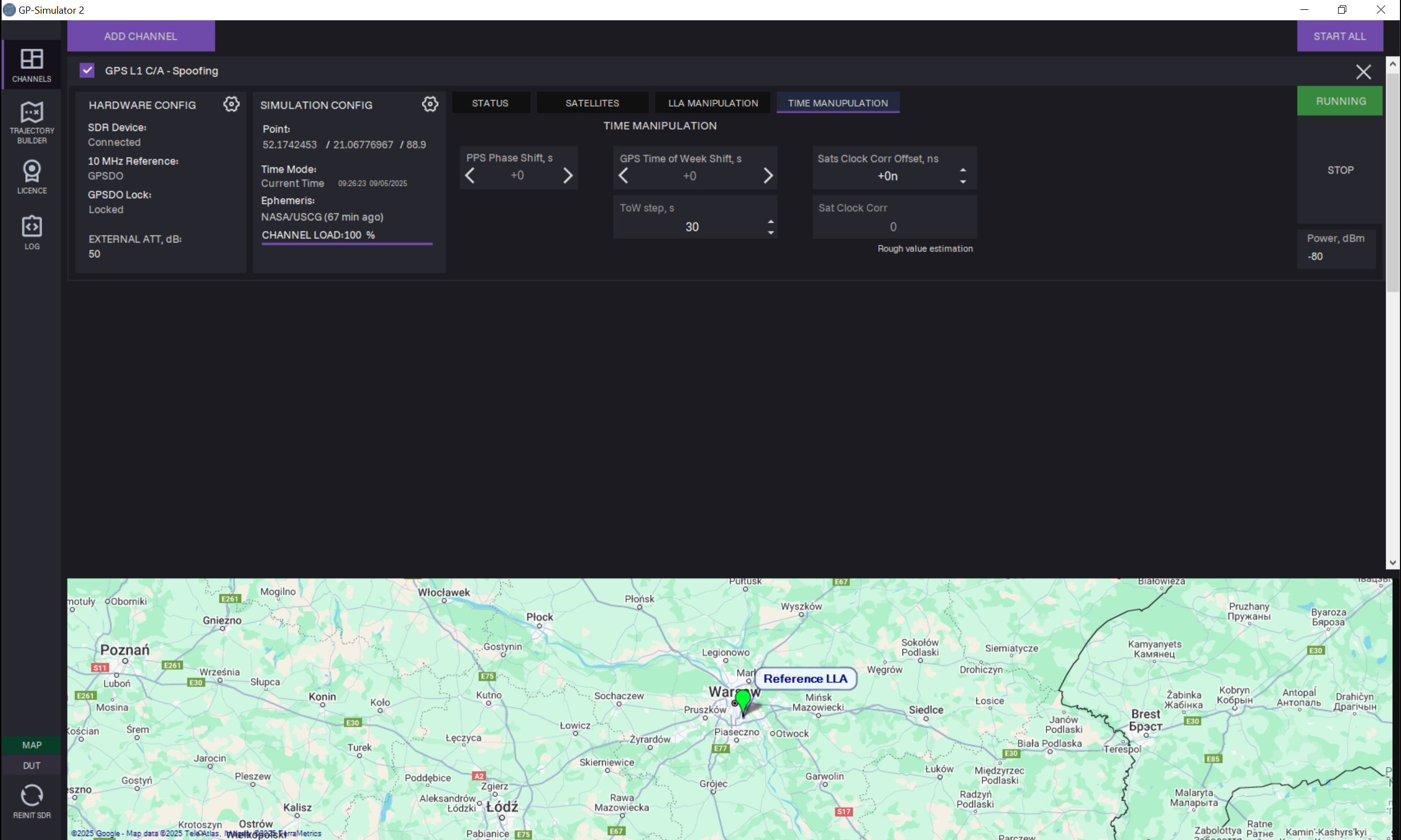
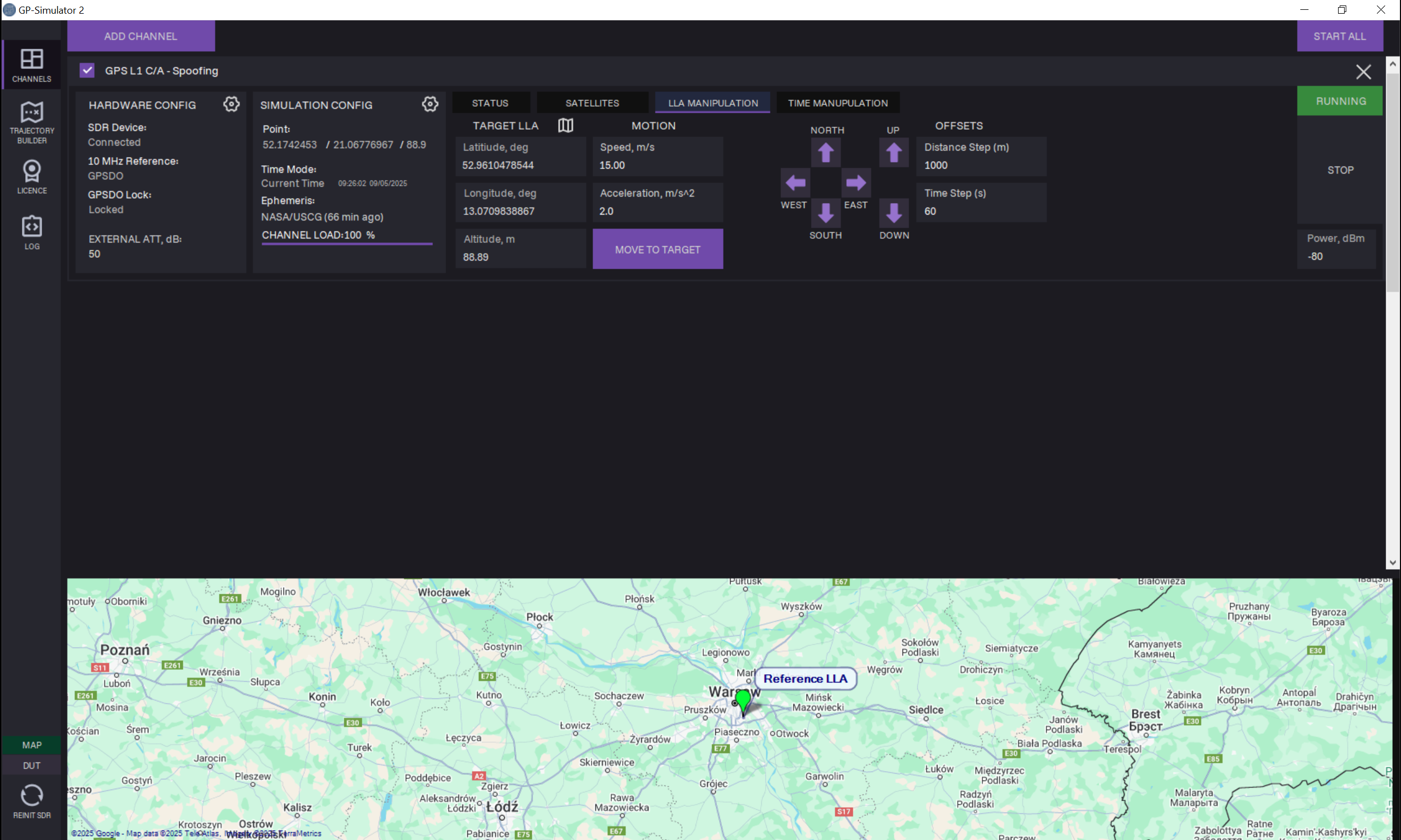
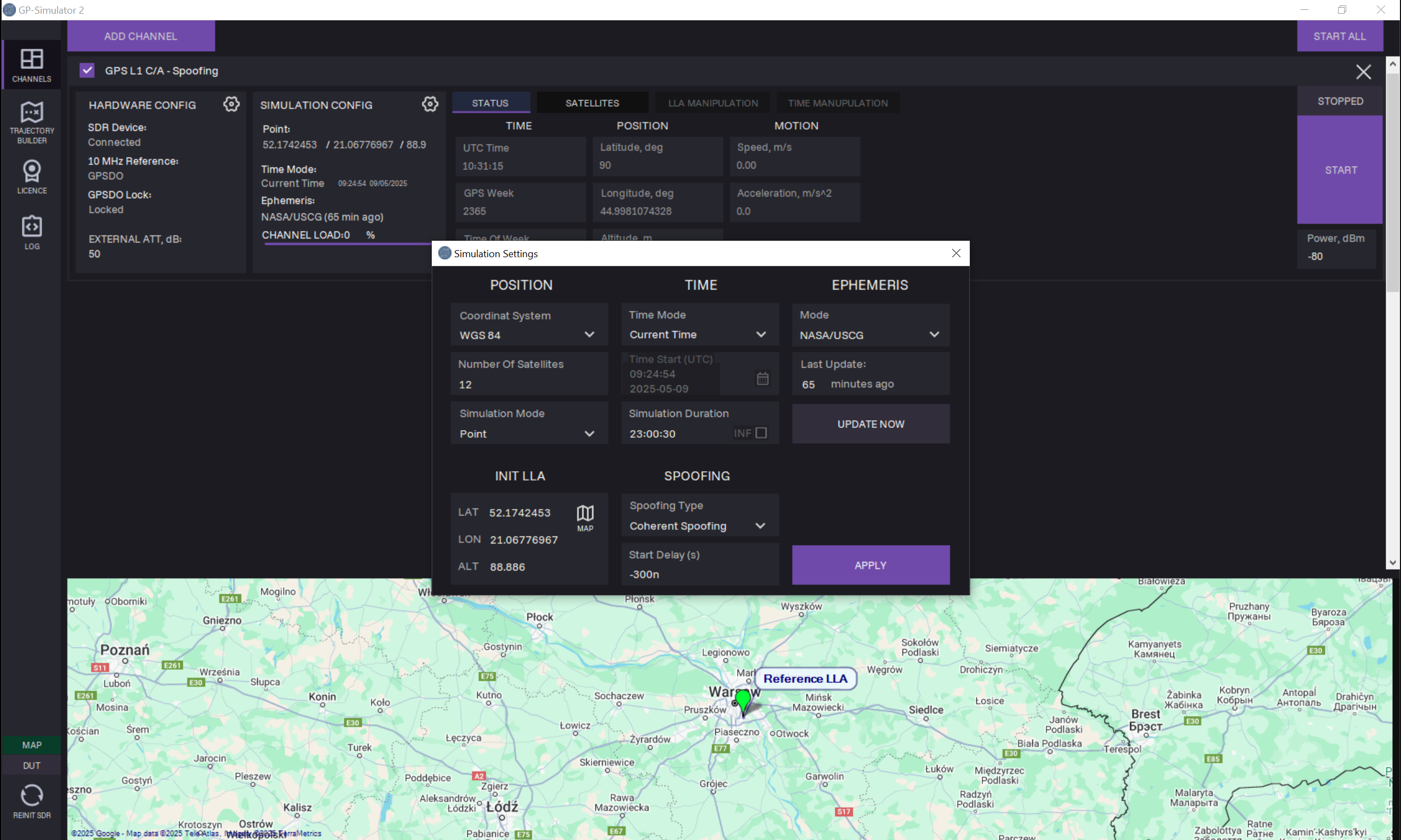
GP-Simulator 2 supports precise GPS L1 signal simulation, including coherent and non-coherent spoofing test scenarios for receiver resilience evaluation. Engineers can configure simulated coordinates, time, PPS phase, satellite parameters, and signal transitions to evaluate how a receiver responds to abnormal GNSS conditions.
For broader RF susceptibility testing, GP-Simulator 2 can be used together with GP-Jammer in controlled laboratory environments. This enables combined testing with configurable RF interference waveforms and repeatable GNSS scenarios.
Together, GP-Simulator 2 and GP-Jammer provide a laboratory test platform for evaluating GNSS receiver robustness, identifying weaknesses, validating mitigation mechanisms, and measuring recovery behavior.
✅ What Problems Does It Solve?
- Verifies GNSS receiver behavior under abnormal signal conditions
- Evaluates resilience to simulated position and timing anomalies
- Tests receiver fallback and mitigation mechanisms
- Measures recovery and reacquisition performance
- Supports repeatable validation and certification testing
📏 What Can You Measure?
- Receiver response to simulated position and time offsets
- PPS phase stability and synchronization behavior
- Recovery and reacquisition time
- Positioning performance under controlled RF interference
- Alarm and fallback behavior
- Satellite lock retention
🎯 Benefits of Using This Setup
- Controlled and repeatable laboratory scenarios
- Supports automated testing through API
- Configurable multi-channel RF test environments
- Precise GNSS signal parameter control
- Suitable for R&D, production, and validation laboratories
👥 Who Should Use It?
- GNSS receiver and module manufacturers
- Timing and navigation system integrators
- Telecom, energy, and transport operators
- R&D and validation laboratories
- Certification and compliance teams
⏱ Testing Time Servers and Critical Infrastructure for GNSS Resilience
Application:
GNSS-disciplined time servers are widely used in telecommunications, data centers, power grids, financial systems, and transportation networks. Reliable timing depends on predictable receiver behavior under abnormal or degraded GNSS conditions.
How GP-Simulator 2 helps:
GP-Simulator 2 enables controlled laboratory simulation of GPS timing anomalies, including configurable time offsets, PPS phase variations, and satellite parameter changes. This allows engineers to evaluate how precisely time servers respond to abnormal GNSS inputs and whether internal protection and holdover mechanisms operate as expected.
For broader RF susceptibility testing, GP-Jammer can be used in a controlled laboratory environment to introduce configurable interference waveforms alongside simulated GNSS scenarios.
✅ What Problems Does It Solve?
- Evaluates resilience of GNSS-disciplined time servers under abnormal signal conditions
- Identifies susceptibility to time offsets, PPS phase variations, and TOW anomalies
- Helps identify synchronization errors under degraded GNSS conditions
- Validates fallback behavior and transition to holdover mode
- Supports timing robustness and compliance testing
📏 What Can You Measure?
- PPS phase offset and jitter under simulated conditions
- Time-server response to abnormal GNSS inputs
- Time-to-failover and time-to-recovery metrics
- Accuracy degradation under controlled RF interference
- Timing-network behavior during GNSS loss or drift
🎯 Benefits of Using This Setup
- Controlled and repeatable laboratory scenarios
- Reproducible testing for R&D and validation
- No outdoor RF transmission required
- Supports applicable timing-resilience and compliance testing
- Suitable for R&D, production, and validation laboratories
👥 Who Should Use It?
- Telecom, power, transport, and data-center operators
- Time-server manufacturers and integrators
- GNSS resilience and certification laboratories
- Timing-system engineering teams
- Infrastructure compliance organizations
🔬 Testing and Debugging GNSS Hardware During Product Development
Application:
Electronics developers integrating GNSS modules into their designs (e.g., trackers, IoT devices, automotive electronics, and industrial systems) often need to verify performance and eliminate signal quality issues caused by PCB layout, interference, or component selection.
How GP-Simulator 2 helps:
By generating controlled, repeatable GPS signals directly in the lab, engineers can test GNSS functionality without relying on outdoor conditions or real satellites. This enables fast, precise debugging during schematic and layout development.
✅ Tasks it helps solve:
- Evaluate receiver sensitivity under known signal levels
- Detect impact of on-board EMI from DC/DC converters, microcontrollers, RF circuits
- Test performance with real-time position changes or trajectories
- Verify cold start time and positioning accuracy
- Assess PPS signal precision and stability under varying signal conditions
📏 What you can measure:
- Minimum signal level for stable satellite tracking
- Time-to-first-fix (TTFF) under different scenarios
- Positioning accuracy (static and dynamic)
- Phase offset and jitter of PPS output
- Reaction to simulated signal degradation or distortion
🎯 Key benefits:
- Debug GNSS issues at the engineer’s desk — no outdoor testing required
- Reduce development cycles and avoid costly post-production fixes
- Ensure consistent GNSS performance across prototypes
- Gain confidence in product quality before mass production
👥 Typical users:
- R&D teams at hardware startups and OEMs
- Developers of GNSS-enabled IoT devices
- Engineers working on automotive electronics, industrial devices, and asset-tracking systems
📦 Batch Testing of GPS Modules Before Assembly
Application:
Electronics manufacturers who purchase GNSS modules from third-party suppliers need to ensure that every module meets performance and reliability standards before soldering it onto the main PCB. Quality issues such as counterfeit, ESD damage, or degraded sensitivity are common — and costly if detected too late.
How GP-Simulator 2 helps:
By simulating stable GPS signals in a controlled lab setup, GP-Simulator 2 allows manufacturers to quickly test large batches of GNSS modules under identical, repeatable conditions. This can be done either manually or as part of an automated test station using the API module.
✅ Tasks it helps solve:
- Validate module functionality before PCB mounting
- Measure signal acquisition time and sensitivity
- Identify defective, underperforming, or fake GNSS modules
- Compare modules from different suppliers
- Automate quality checks as part of incoming inspection or pre-assembly stage
📏 What you can measure:
- Cold start performance
- Number of satellites acquired and average SNR
- Time-to-first-fix under controlled signal levels
- Module PPS output presence and stability
- Stability of coordinates in static mode
🎯 Key benefits:
- Prevent defective GNSS modules from entering your production line
- Reduce rework, scrapping, and warranty claims
- Gain traceability and performance statistics for each module or supplier
- Save time by running high-volume, fast GNSS verification indoors
- Improve overall product quality and reduce manufacturing risk
👥 Typical users:
- EMS (Electronics Manufacturing Services) companies
- OEMs assembling GNSS-based products
- QA departments responsible for inbound component validation
✅ Final Testing of Assembled Devices with Integrated GNSS Modules
Application:
After assembling GNSS-enabled products — such as vehicle trackers, telematics units, wearable devices, IoT sensors, or navigation systems — manufacturers need to confirm that the built-in GNSS module functions correctly in its final hardware and firmware configuration.
How GP-Simulator 2 helps:
GP-Simulator 2 allows production teams to simulate stable, repeatable GPS signals in a controlled indoor environment. Devices under test (DUTs) can be evaluated for GNSS performance without needing sky access or test driving. The same test scenario can be replayed across thousands of units with consistent results.
✅ Tasks it helps solve:
- Verify GNSS module integration and firmware configuration
- Ensure correct PPS output behavior
- Confirm fix acquisition and coordinate accuracy
- Perform trajectory-based testing for mobile use cases
- Detect intermittent faults that may not show up in static bench tests
📏 What you can measure:
- Time-to-first-fix (cold and hot starts)
- Accuracy of reported coordinates in static or dynamic simulation
- PPS signal timing and stability
- Sensitivity and signal lock robustness under marginal conditions
- Functional validation of antenna, RF front-end, and GNSS stack
🎯 Key benefits:
- Eliminate dependency on GPS antennas or open-sky testing
- Perform GNSS validation inside test chambers or assembly lines
- Standardize GNSS testing across production batches
- Catch firmware bugs or hardware integration issues before shipment
- Enable pass/fail logic and logging for QA automation
👥 Typical users:
- Manufacturers of GPS-enabled devices
- Automotive electronics providers
- IoT hardware developers
- QA and end-of-line testing teams
Licensing & Bundles
Explore available software licenses, hardware kits, and ready-to-use bundles tailored for GNSS simulation and spoofing.
🔑 Licenses
Permanent software licenses that activate core simulation functionality.
GP-Simulator 2 – Core | GPS Simulation
SKU: GPS2/CORE/PER
Permanent software license for GNSS signal simulation. Ideal for testing GPS receivers in laboratory or production environments. Supports simulation of up to 12 GPS L1 satellites.
🧩 Software Options (Add-ons)
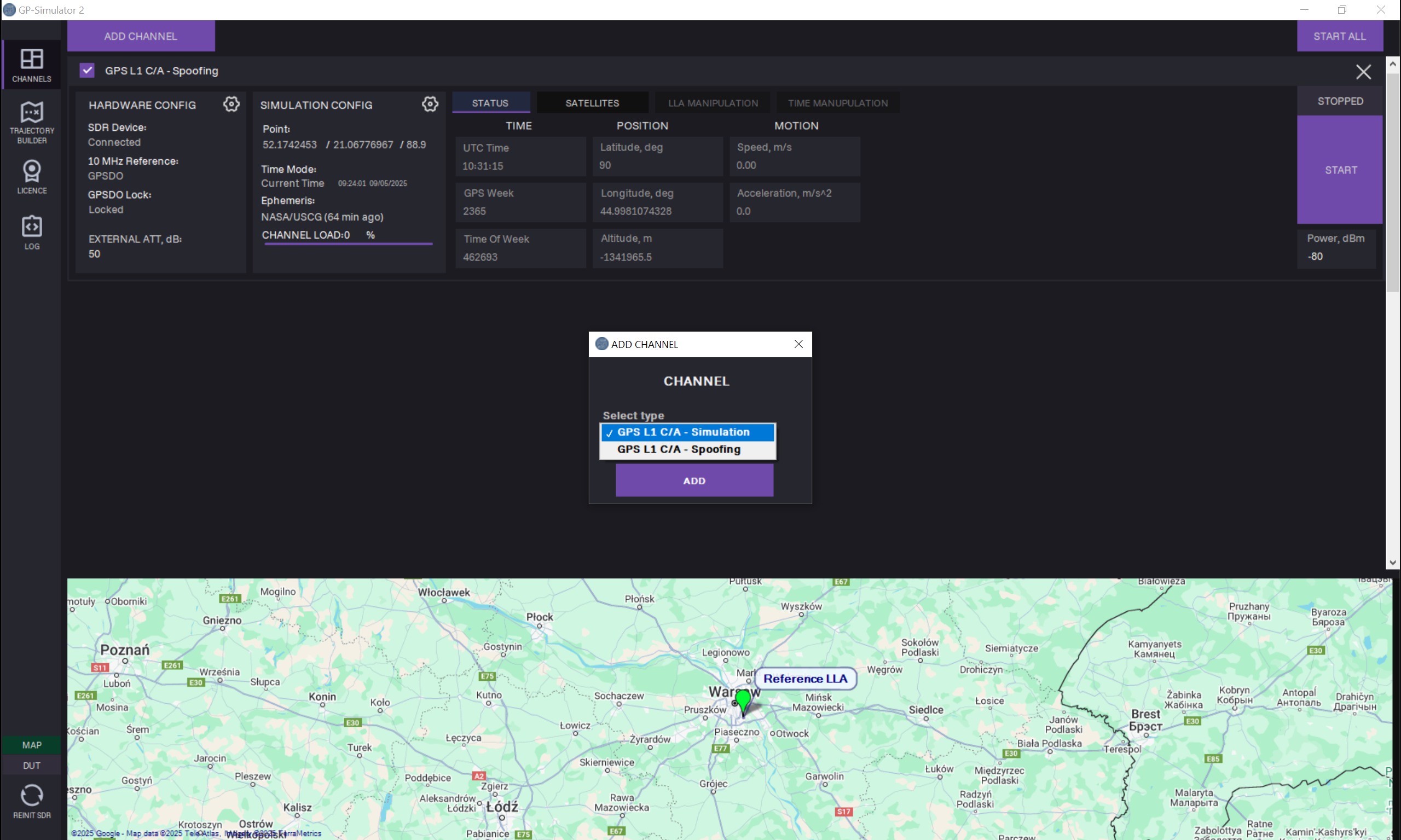
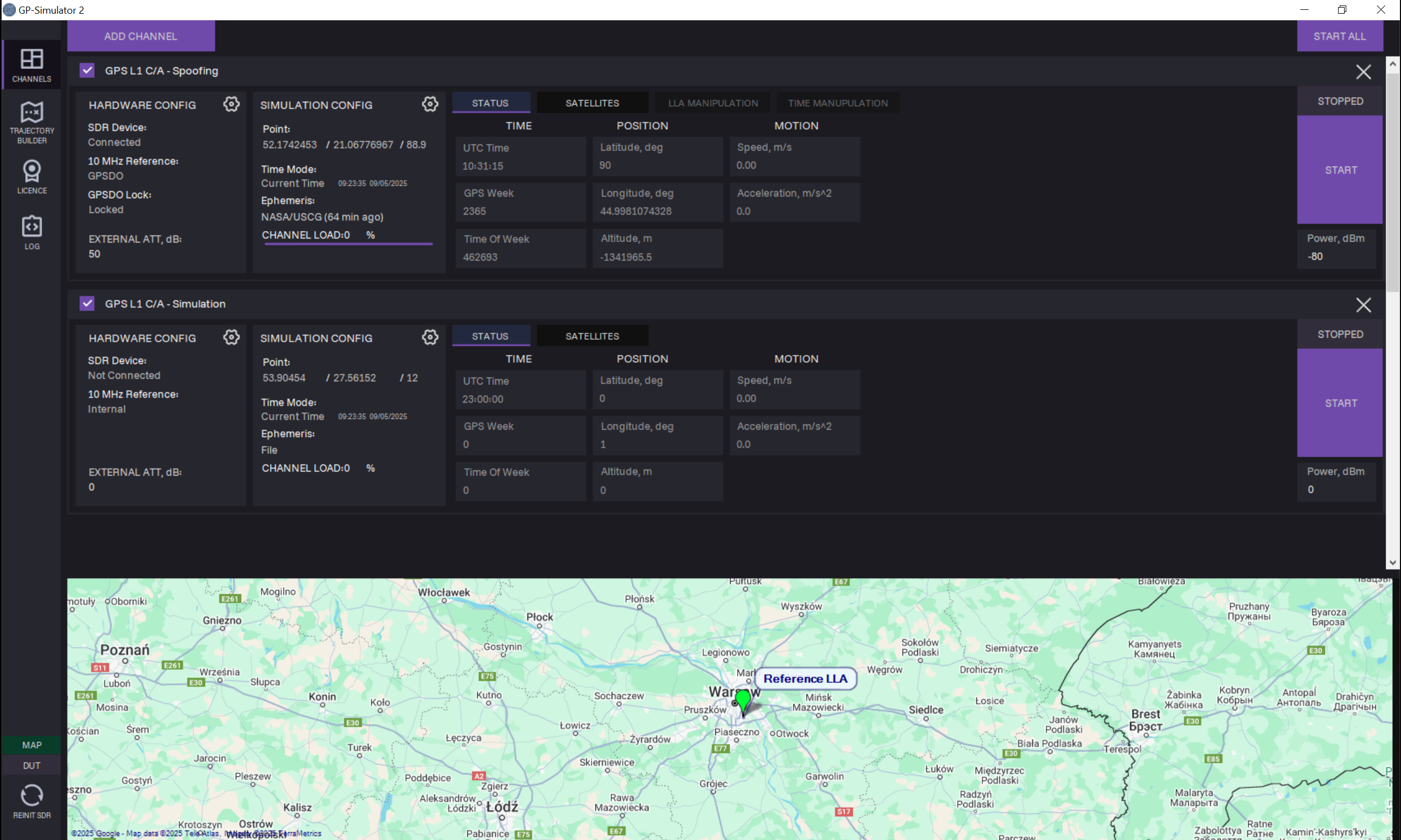
Optional modules that extend functionality with spoofing, dual-channel operation, or automation capabilities.
GP-Simulator 2 opt.: GPS Spoofing
SKU: GPS2/Opt/SPOOF/PER
Adds spoofing functionality to the core software. Enables coherent spoofing and real-time manipulation of position and time during signal generation. Recommended for cybersecurity, research, and spoofing resilience testing.
GP-Simulator 2 opt.: API Control
SKU: GPS2/Opt/API/PER
Enables API access for automation and integration. Ideal for automated test environments, scripting, and integration into CI systems or external platforms.
🛠️ Hardware Kits
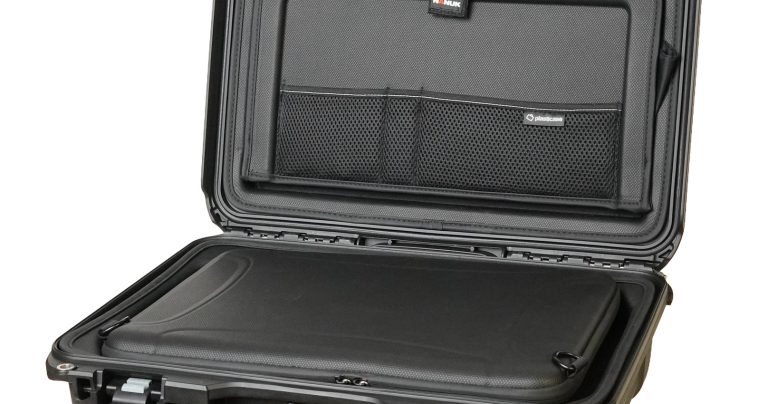
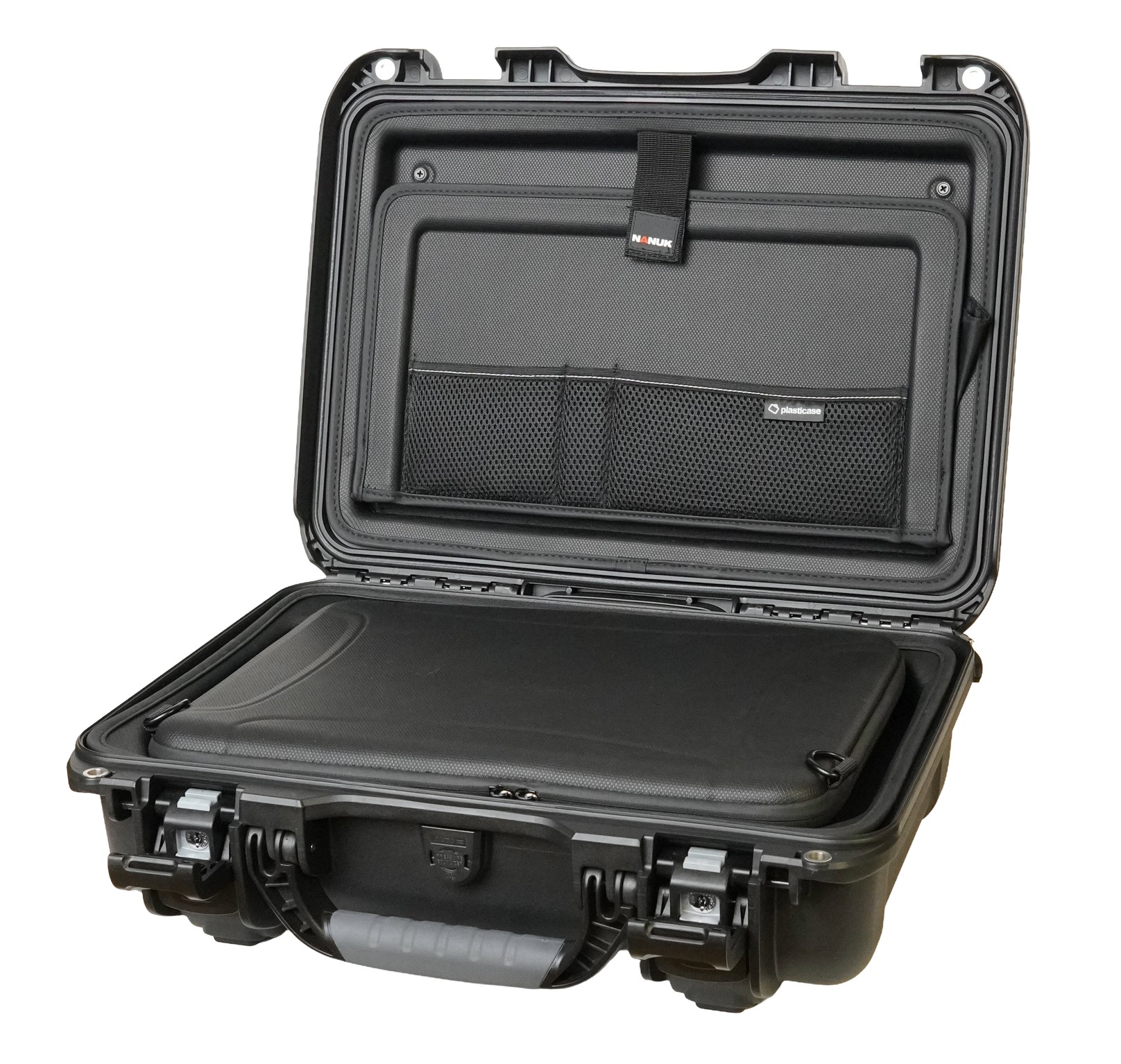
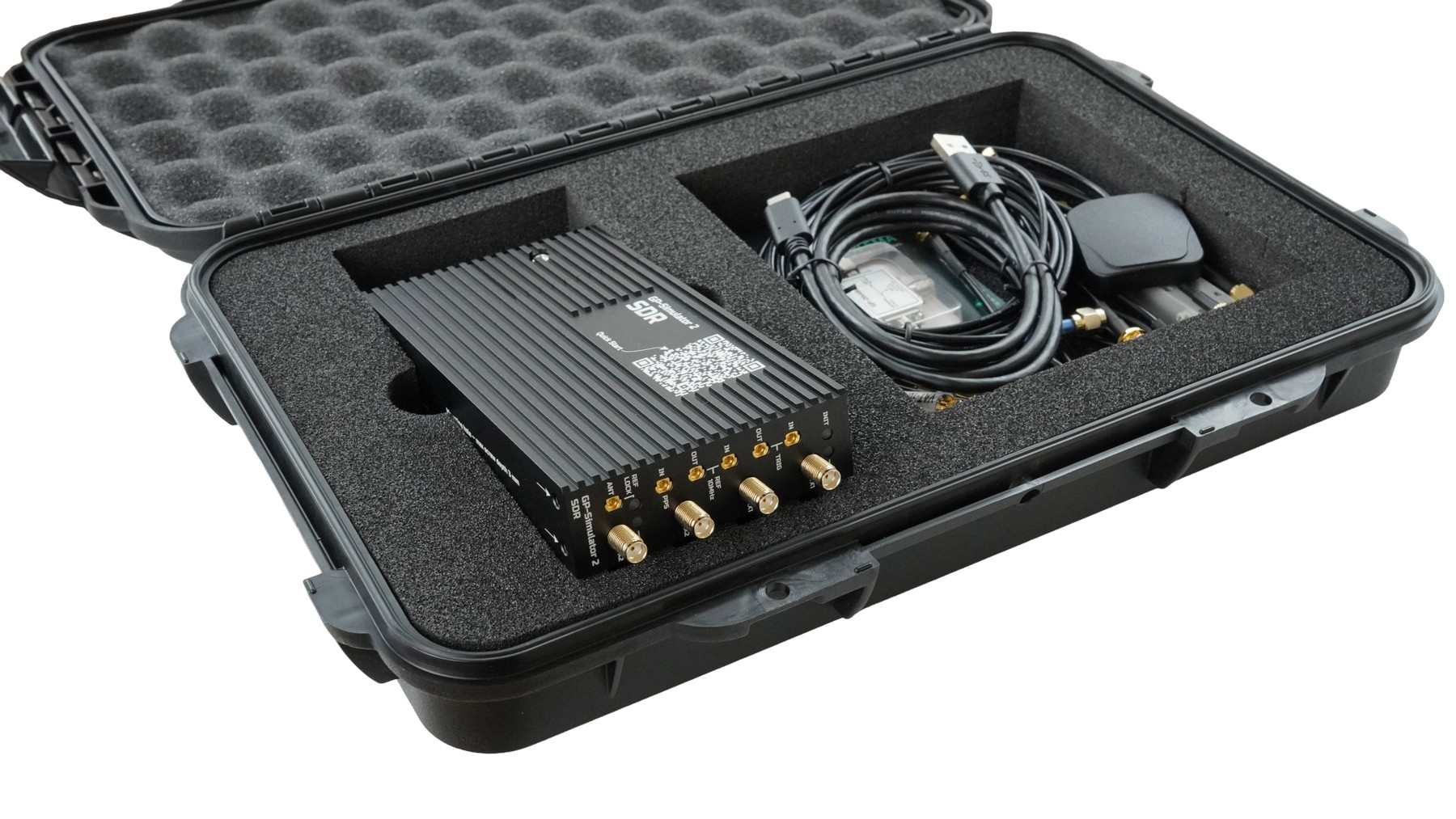
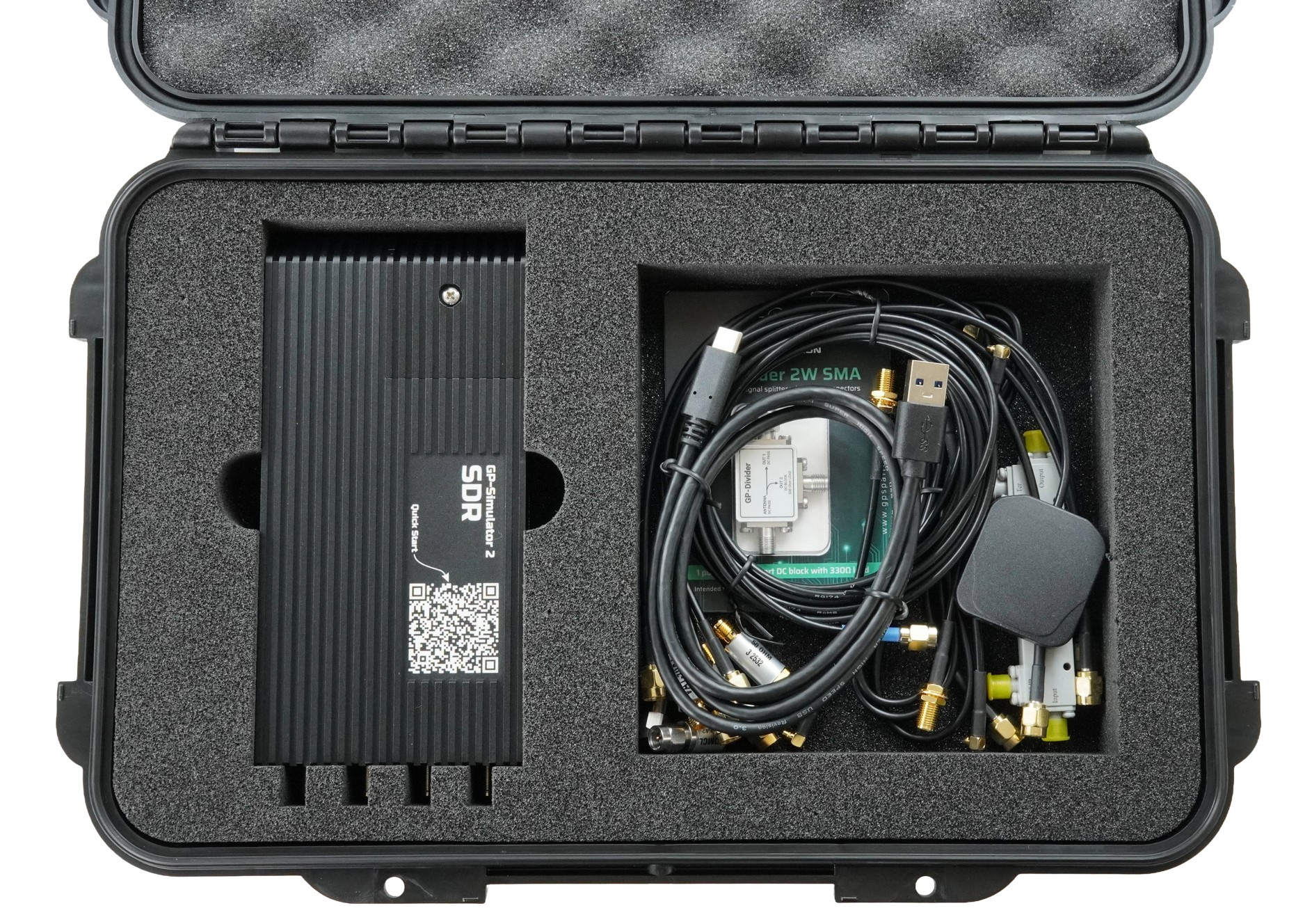
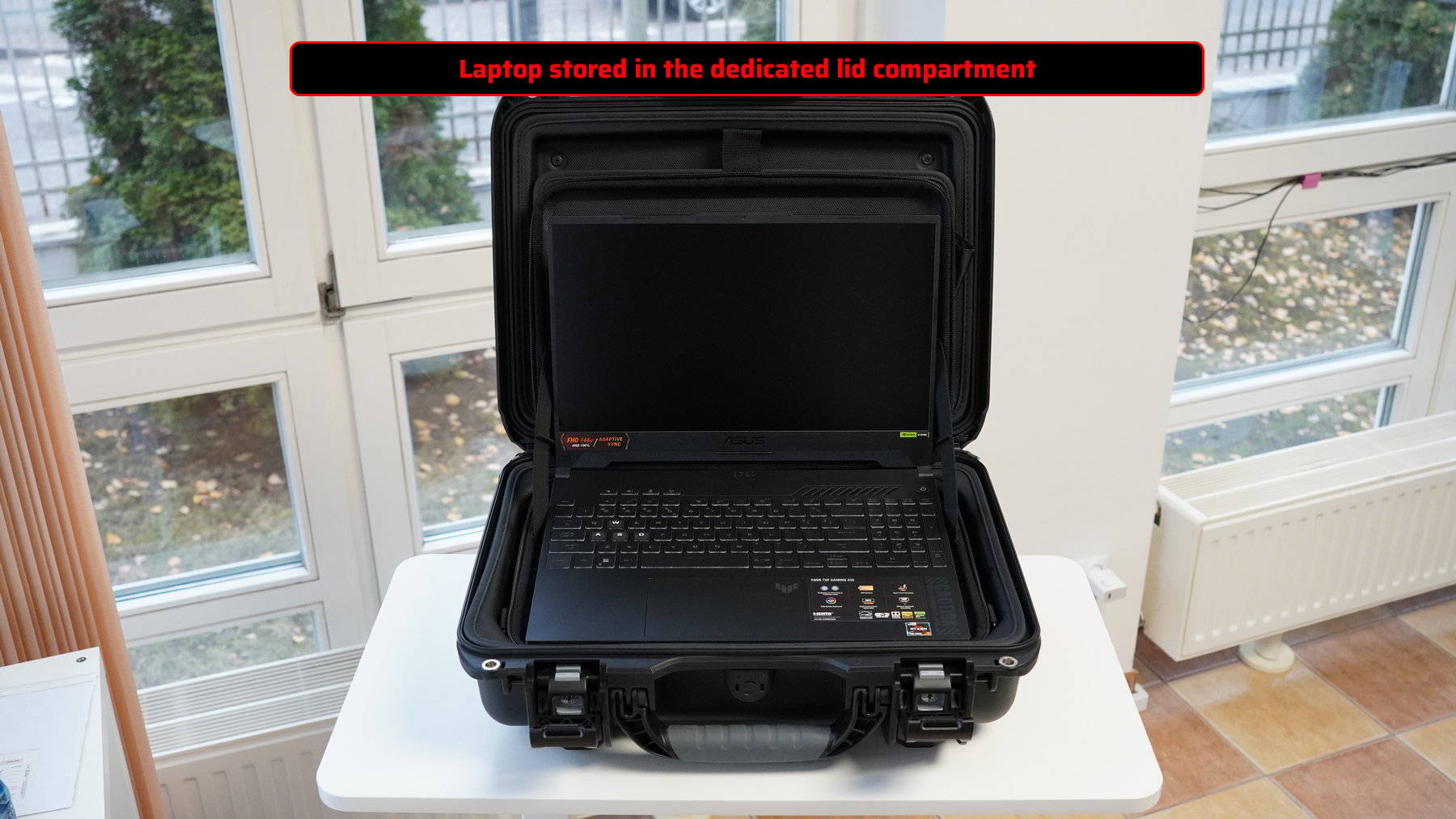
High-performance SDR kits bundled with essential RF accessories in a rugged case — ready for lab or field use.
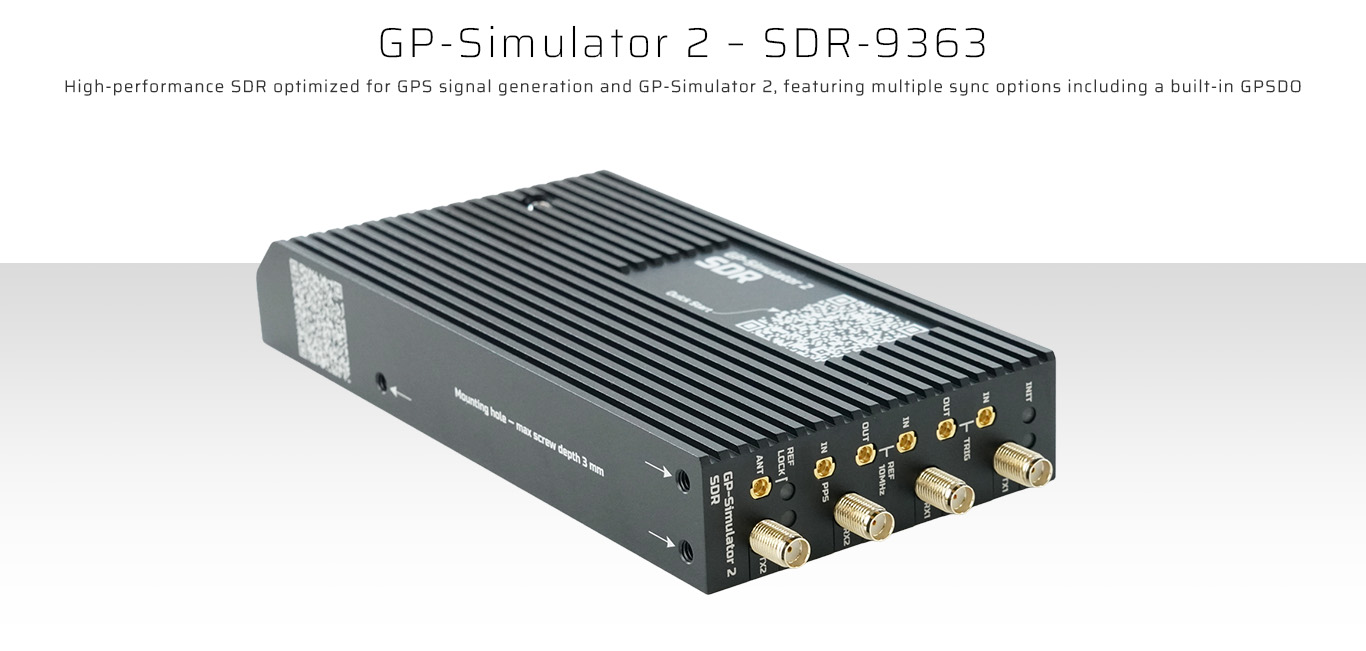
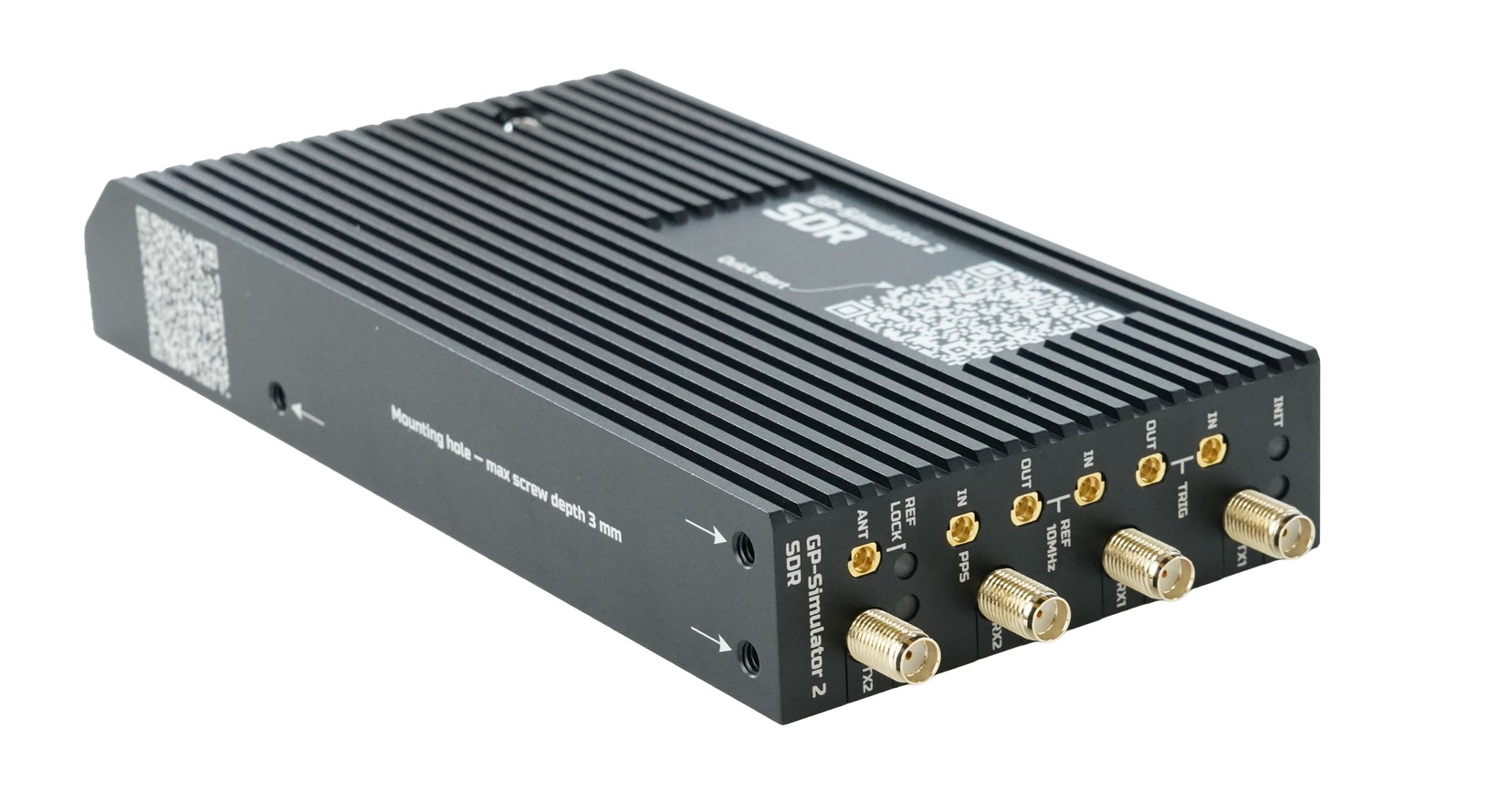
GP-Simulator 2 – SDR Kit
SKU: GPS2/SDR/KIT
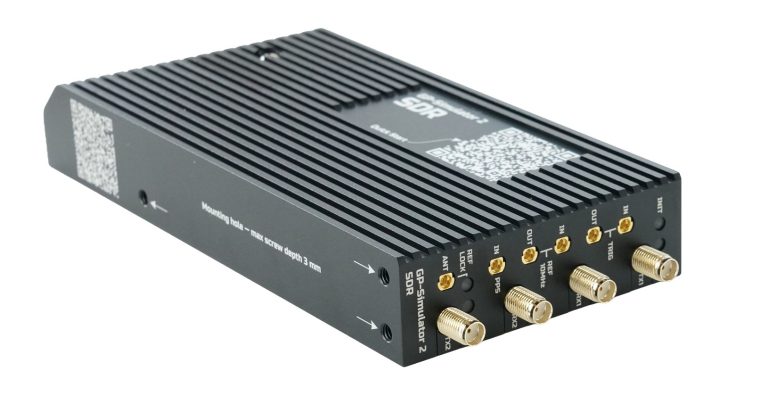
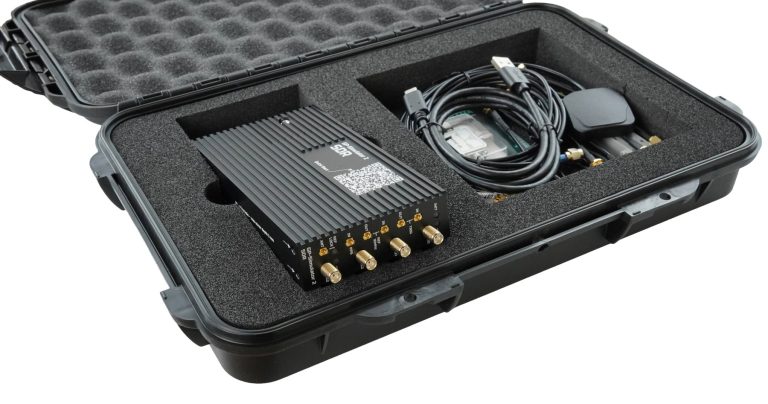
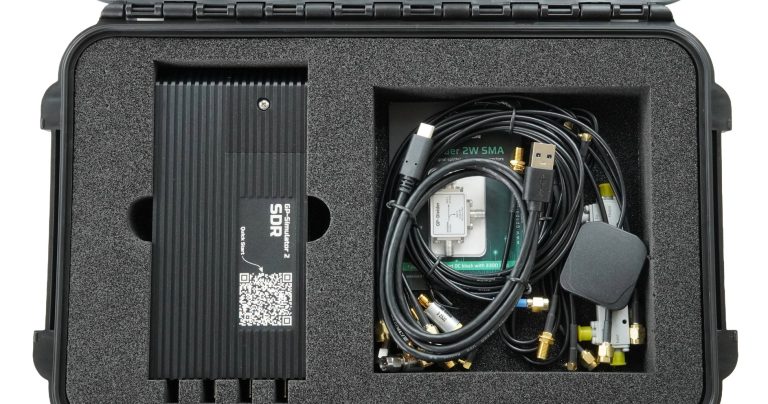
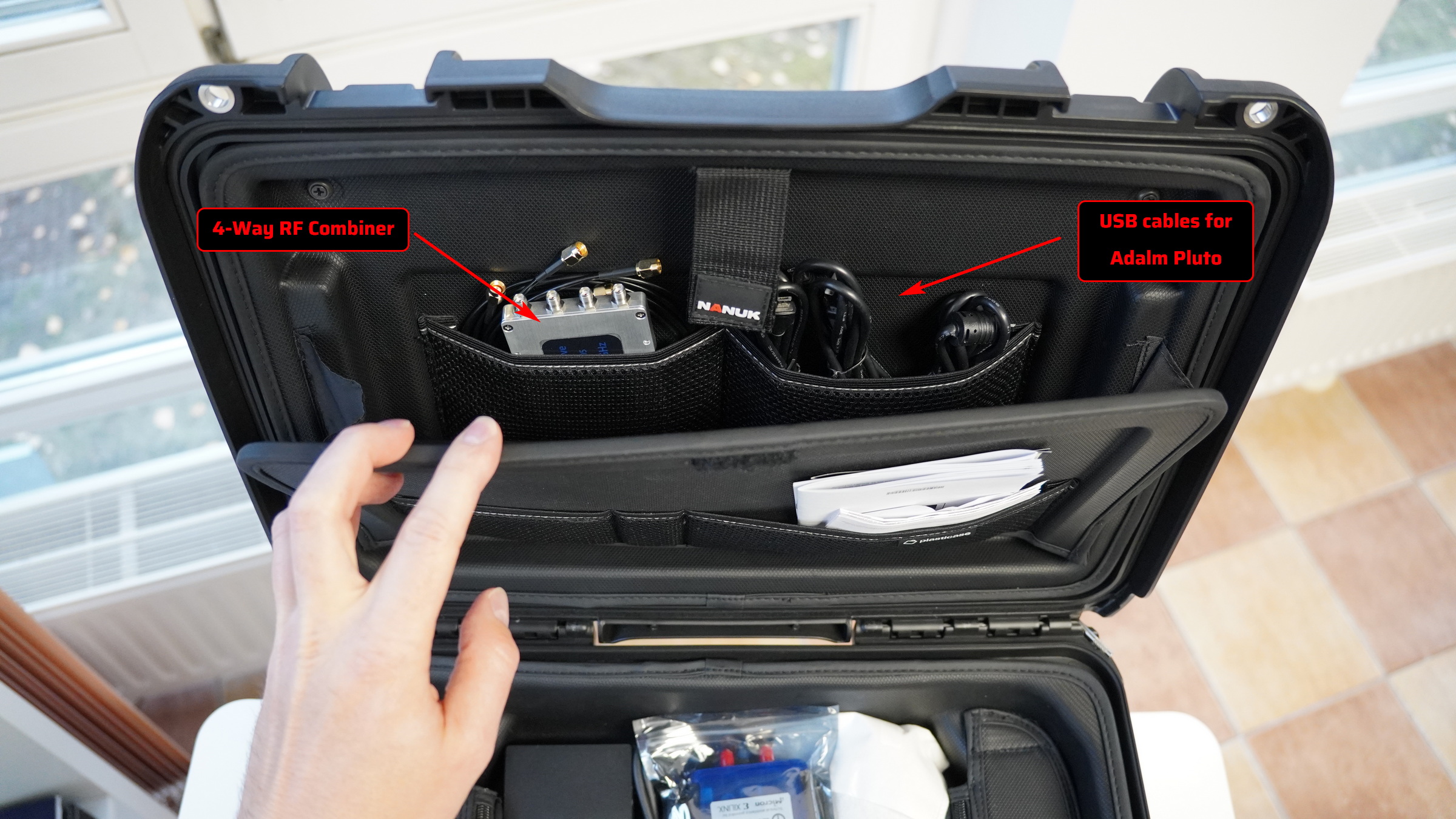
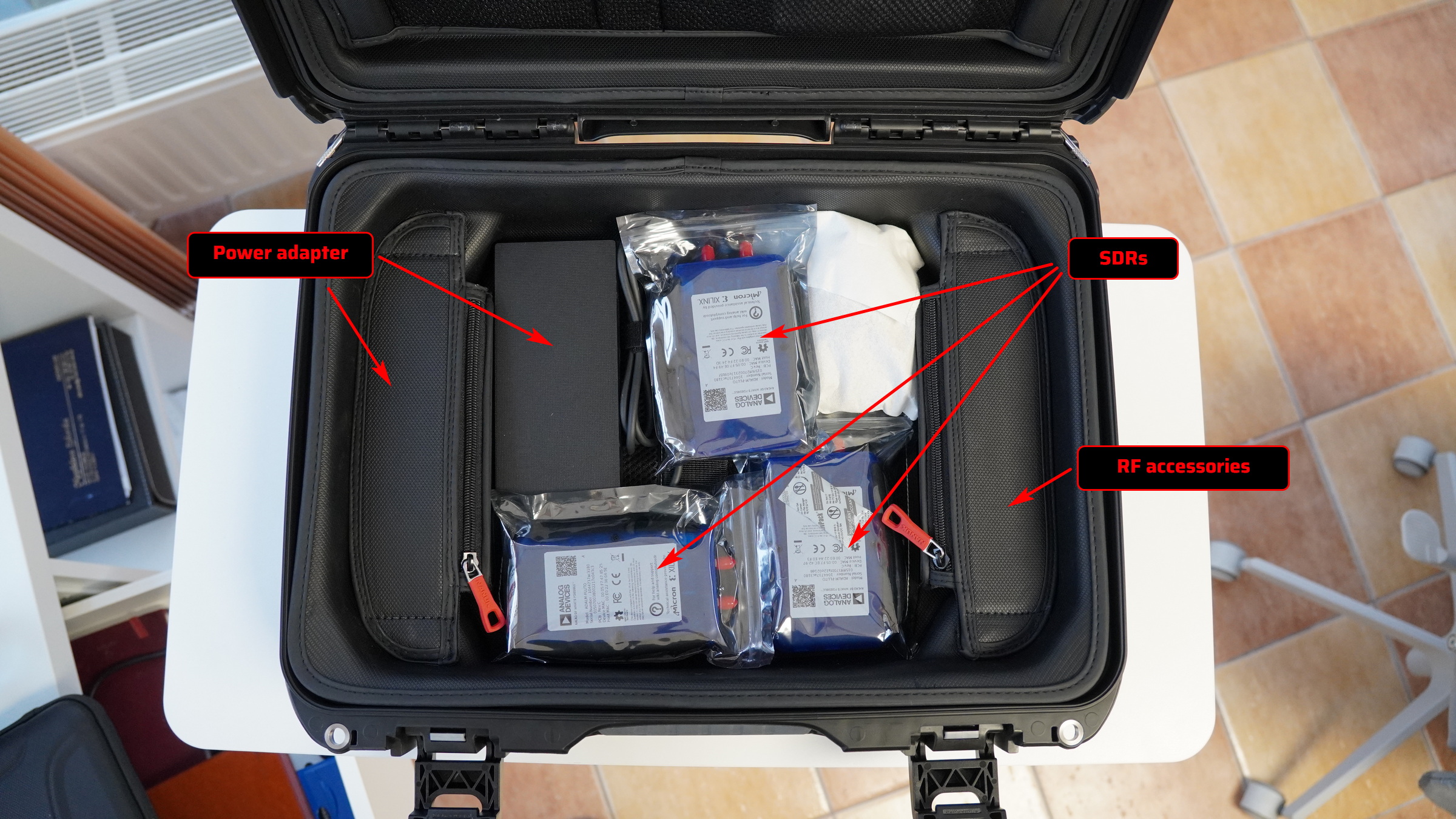
High-performance SDR unit optimized for use with GP-Simulator 2. Supplied in a rugged case with all essential RF accessories (cables, attenuators, DC blockers, adapters, etc.) for quick setup in laboratory and controlled test environments.
📦 Pre-Configured Bundles
Save with ready-to-use combinations of software and hardware — ideal for simulation, spoofing, or GNSS threat emulation.
GP-Simulator 2 – Basic Simulation Bundle
SKU: GPS2/BUNDLE/BASE
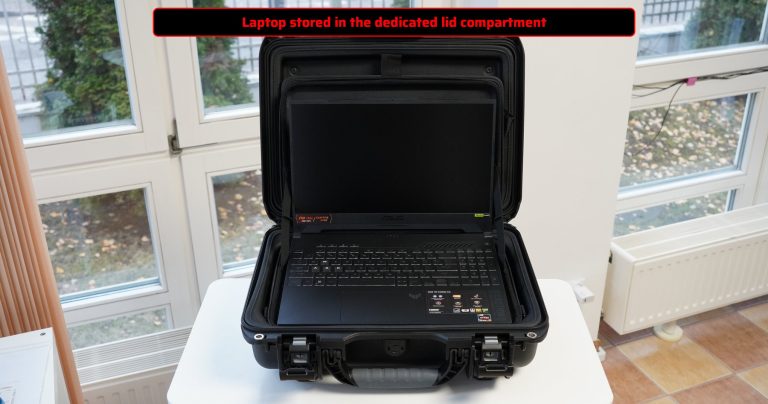
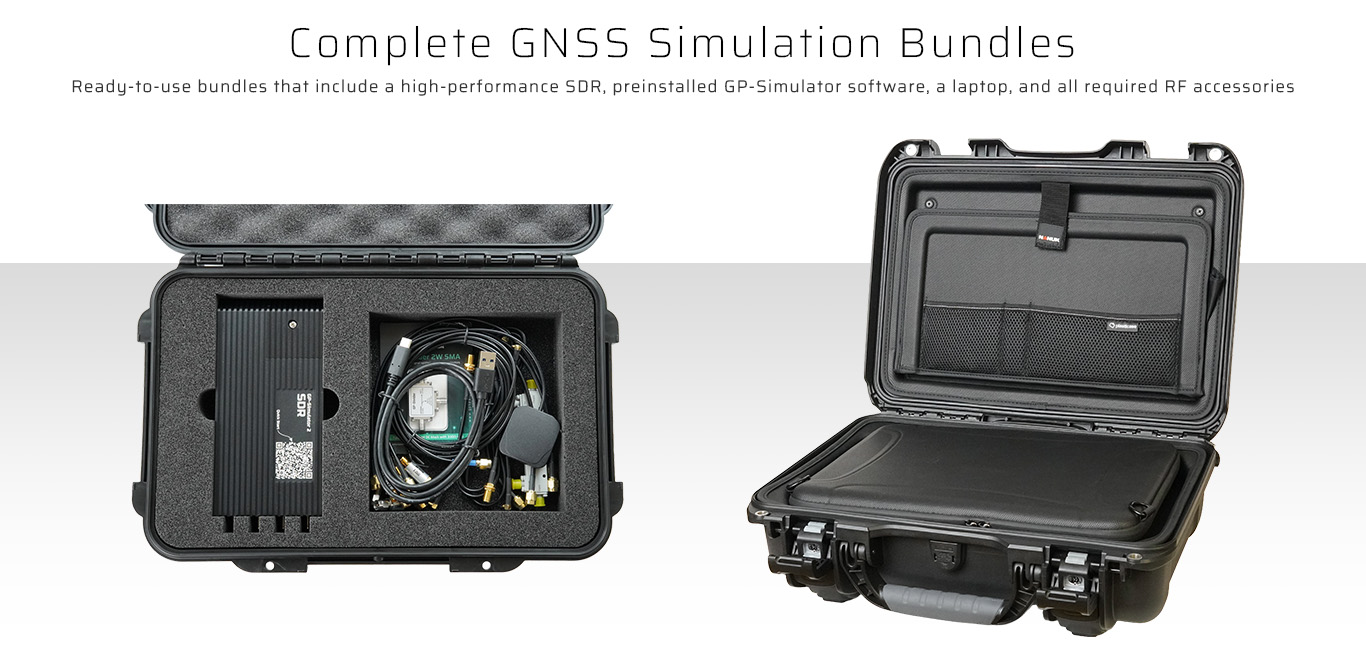
A complete starter kit for GPS signal simulation. Ideal for receiver validation, QA, or integration testing. Includes software, SDR, laptop, and RF accessories — all packaged in a rugged portable case.
Includes:
- GP-Simulator 2 – Core License
- GP-Simulator 2 – SDR Kit with RF accessories required for quick and trouble-free setup
- High-performance laptop (Win11 Home, Ryzen 7, 32 GB RAM, RTX 4060)
- Rugged case – NANUK 923 Laptop, Black
GP-Simulator 2 – Spoofing Bundle
SKU: GPS2/BUNDLE/SPOOF
A complete GNSS resilience test kit including the core simulator, spoofing simulation extension, and SDR hardware. Designed for controlled laboratory evaluation of receiver behavior under simulated spoofing conditions.
Includes:
- GP-Simulator 2 – Core License
- GP-Simulator 2 opt.: GPS Spoofing
- GP-Simulator 2 – SDR Kit with RF accessories required for quick and trouble-free setup
- High-performance laptop (Win11 Home, Ryzen 7, 32 GB RAM, RTX 4060)
- Rugged case – NANUK 923 Laptop, Black
GP-Simulator 2 – Advanced GNSS Resilience Test Bundle
SKU: GPS2/BUNDLE/THREAT
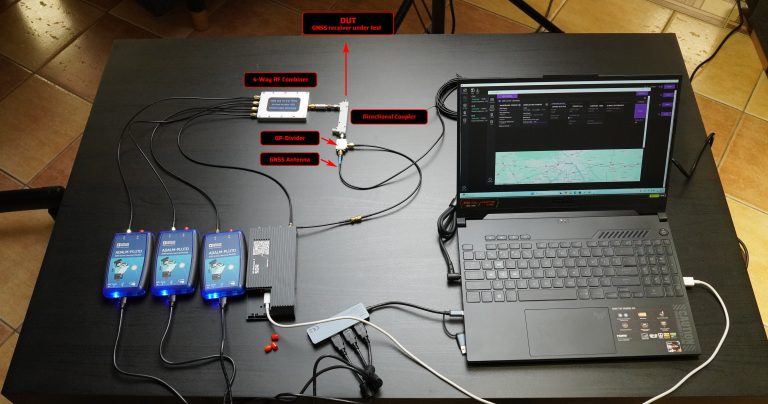
A comprehensive laboratory kit for advanced GNSS spoofing and jamming testing. Combines GP-Simulator and GP-Jammer platforms with all required hardware for evaluating GNSS vulnerabilities of time servers, drones, and critical infrastructure. Includes software, SDRs, high-performance laptop, and RF accessories in a rugged portable case.
Includes:
- GP-Simulator 2 – Core License
- GP-Simulator 2 opt.: GPS Spoofing
- GP-Simulator 2 – SDR Kit with RF accessories required for quick and trouble-free setup
- GP-Jammer 3-Channel License
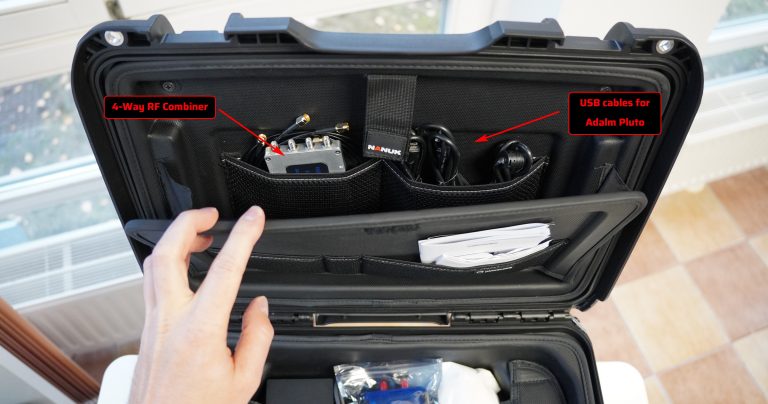
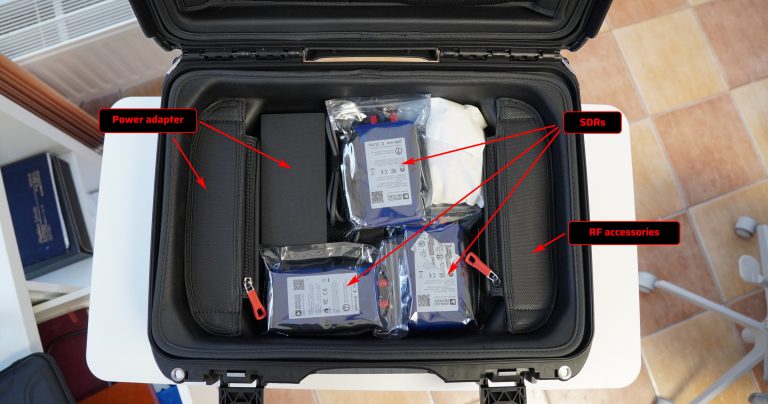
- 3× Adalm Pluto SDR
- Additional set of RF accessories for ADALM-Pluto connectivity
- High-performance laptop (Win11 Home, Ryzen 7, 32 GB RAM, RTX 4060)
- Rugged case – NANUK 923 Laptop, Black
Application Specification
Supported Signals
- GPS L1 C/A
- Galileo E1B/C is coming soon
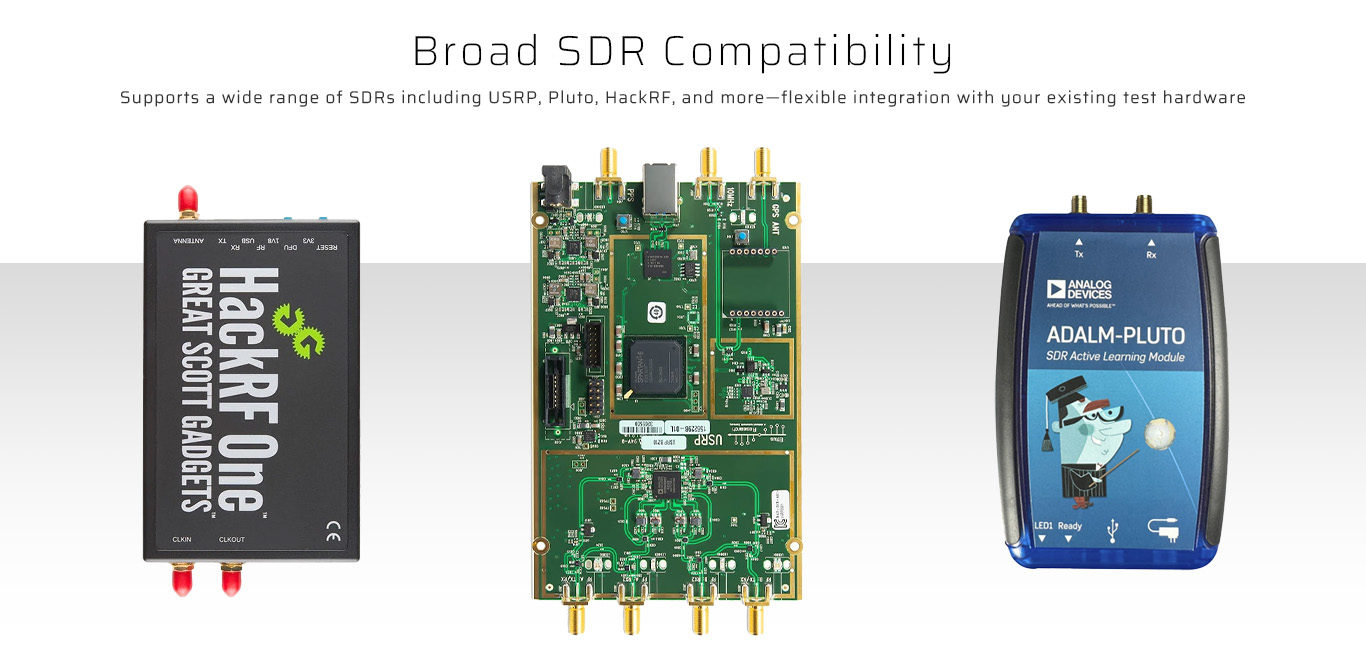
Supported SDR Devices
- Ettus USRP
Full support via UHD drivers. Compatible with B200, B210, X310, and other models. Synchronization via GPSDO.
Supports coherent spoofing simulation scenarios. - GP-Simulator SDR – Proprietary high-performance SDR with low phase noise, enhanced frequency stability, and precise timing synchronization. Offers improved spoofing fidelity and signal clarity. Supports coherent spoofing simulation scenarios.
Supported Operating Systems
- Windows 11 (64-bit)
- Windows 10 (64-bit)
- Windows 8 (64-bit)
Minimum System Requirements
- Intel® Core™ i3 Processors
- RAM 8 GB
- Free hard drive space 1-GB
- One port USB 3.0
- Internet (optional)
Simulation Modes
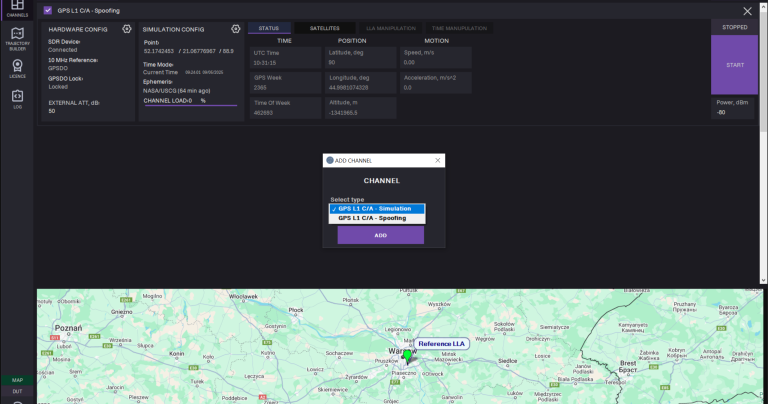
- Signal Simulation
Standard GPS signal simulation for receiver testing. Set a static point, time, or dynamic trajectory, control output power, and adjust per-satellite signal strength during runtime. - Spoofing Simulation
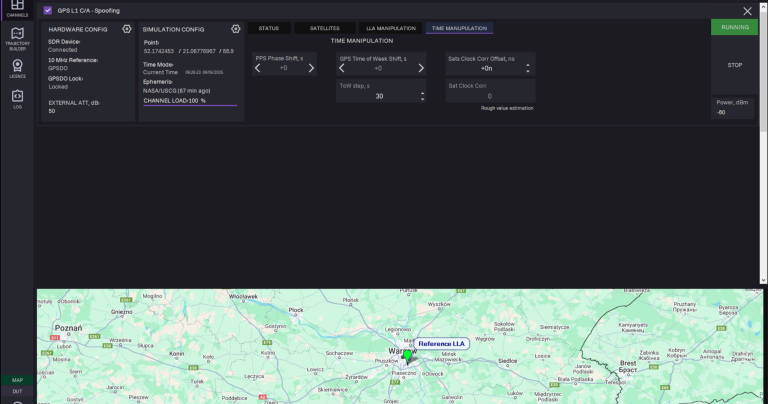
Enables coherent and non-coherent spoofing. During signal generation, allows real-time manipulation of time and position to test spoofing resilience.
Position Simulation Modes
- Fixed Location
Manually specify static latitude, longitude, and altitude. - Trajectory Simulation
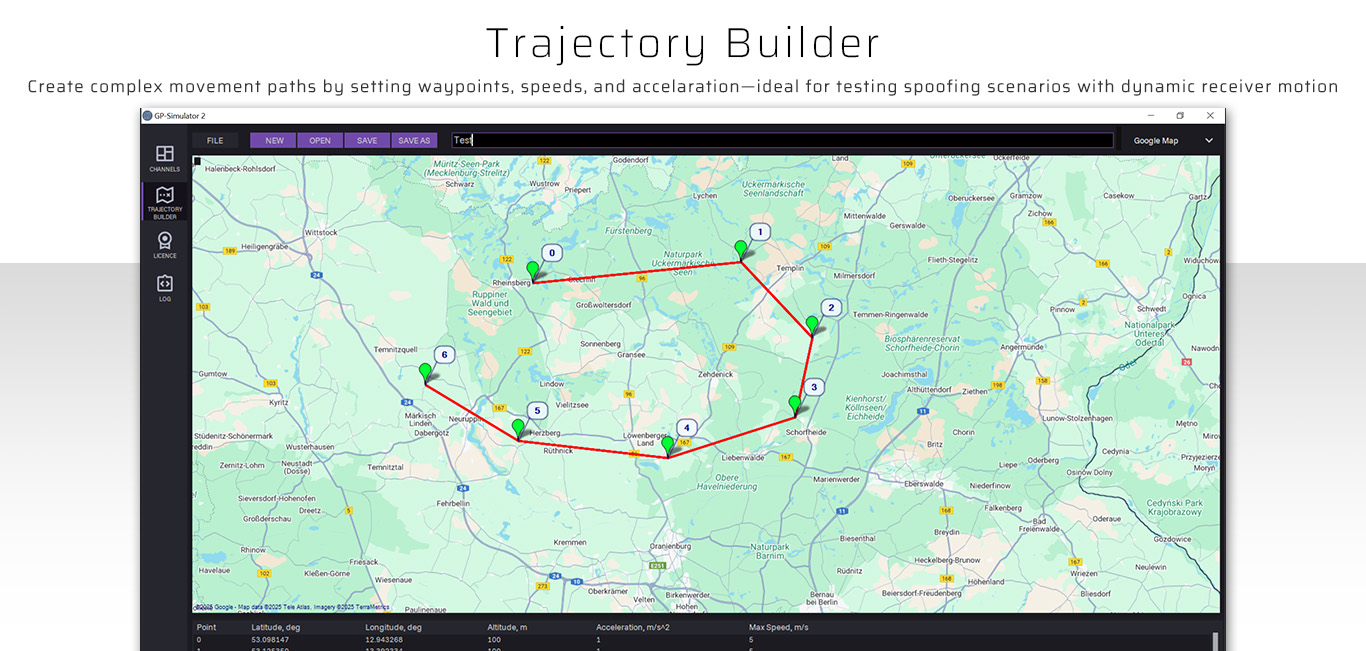
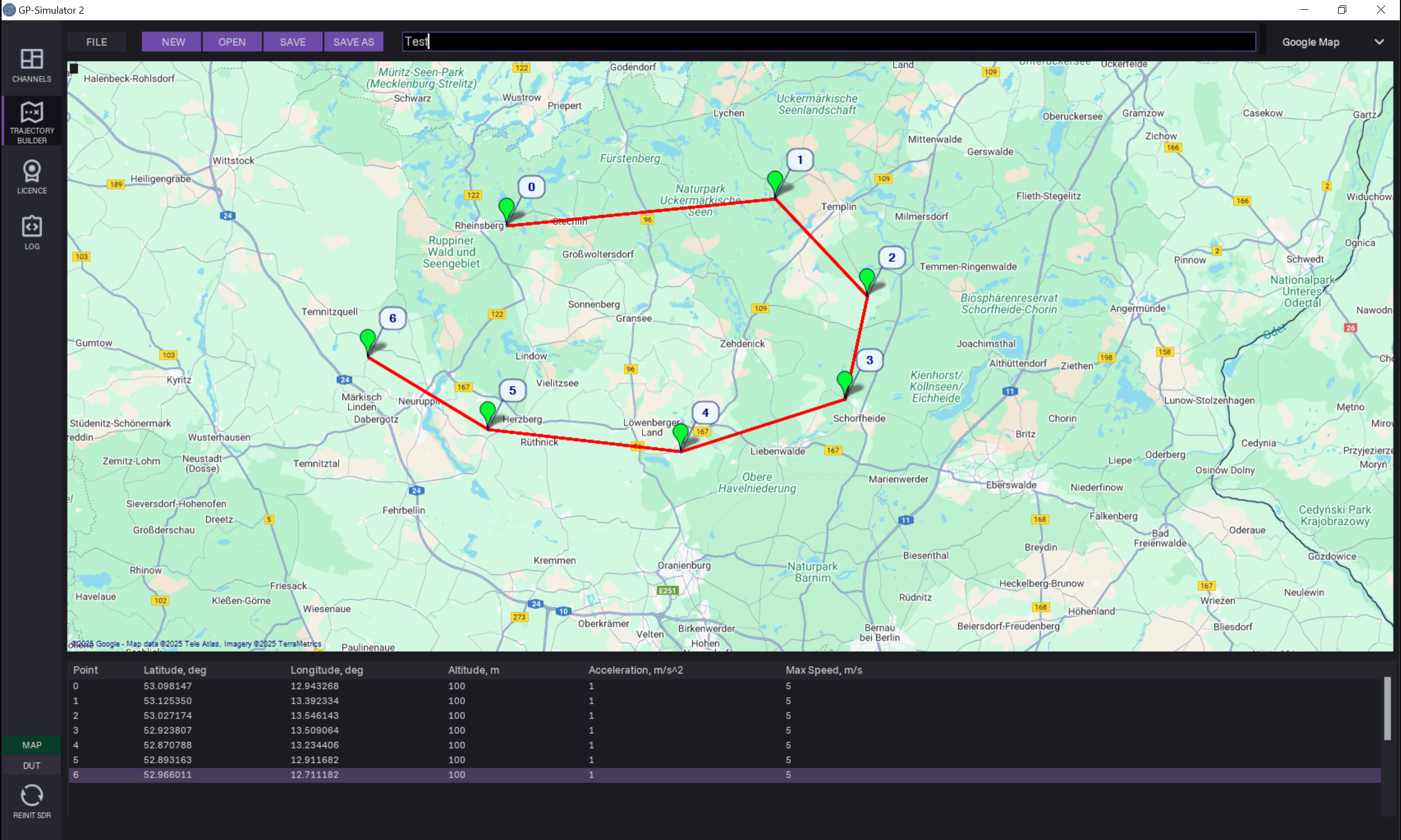
Move the simulated receiver dynamically along a user-defined path
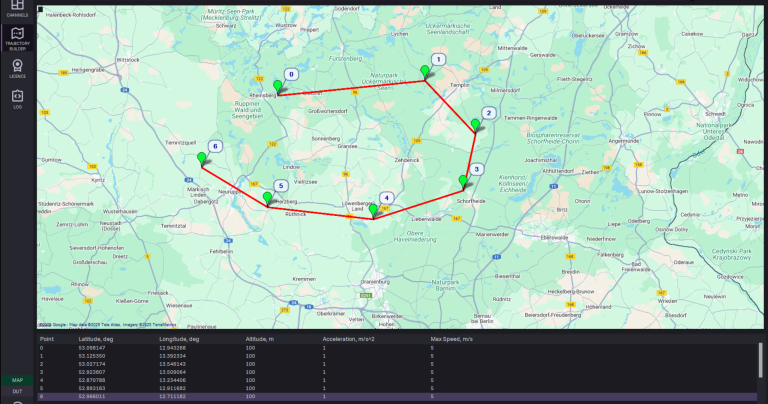
Trajectory Builder
Built-in graphical editor for creating and editing movement paths. Supports:
- Waypoint-based vector format
- Speed and Acceleration assignment per segment
Time Simulation Modes
- Current Time
Simulate GNSS signals based on real-time system clock. - Past Time
Reproduce historical satellite configurations and timing conditions. - Future Time
Predict and simulate GNSS signals for a future date with synthetic ephemeris.
Almanac and Ephemeris Sources
- Local Files
Load RINEX almanac and ephemeris files from disk. - Synthetic Data
Use generated orbital parameters for testing without real data. - Automatic Download
Fetch authentic NASA data (via CDDIS or USCG) for the selected simulation time range.
Almanac source: www.navcen.uscg.gov
Ephemeris source: ftp://cddis.nasa.gov
Timing & Synchronization
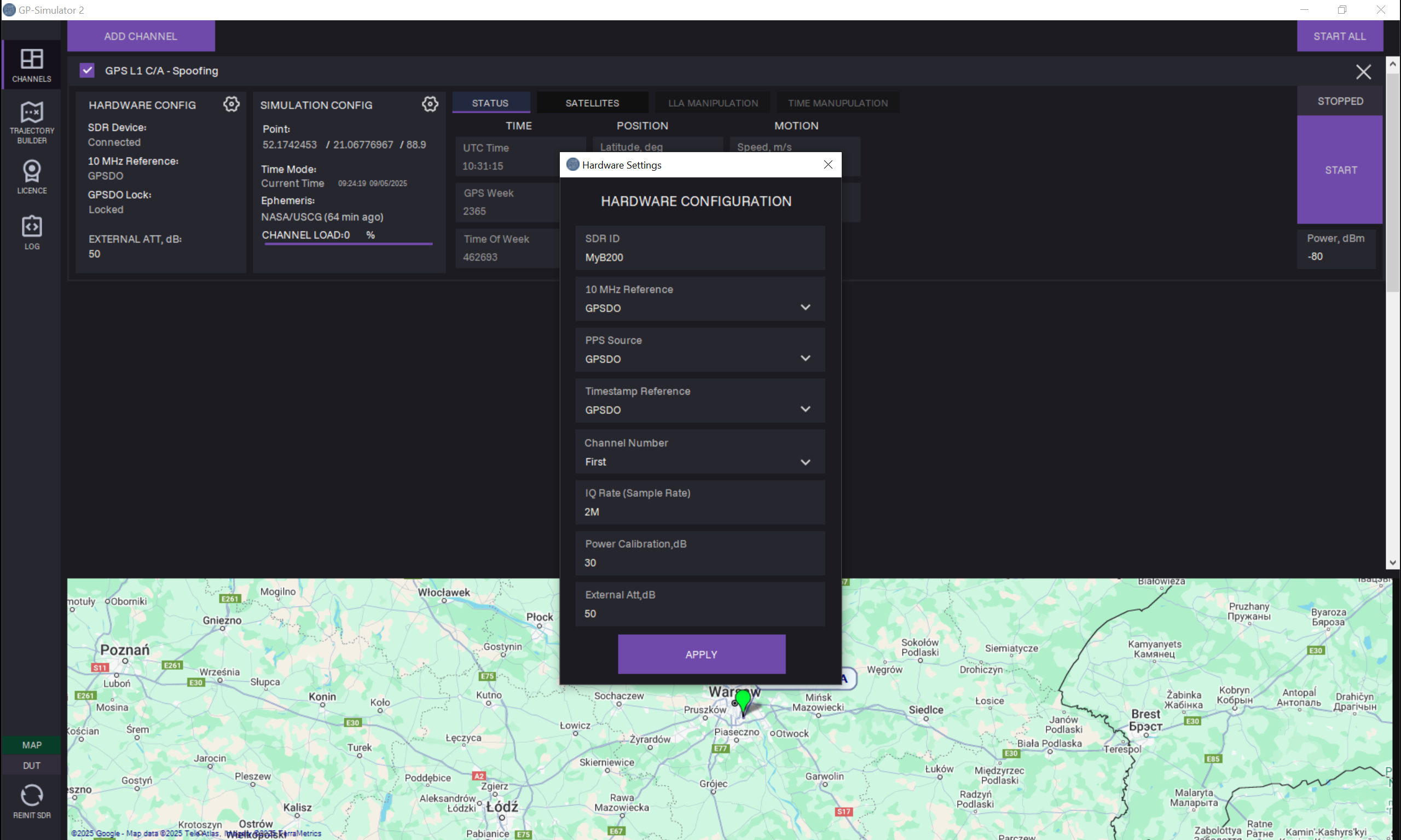
Enables precise alignment of simulated GPS signals through configurable timing sources.
Includes the following options:
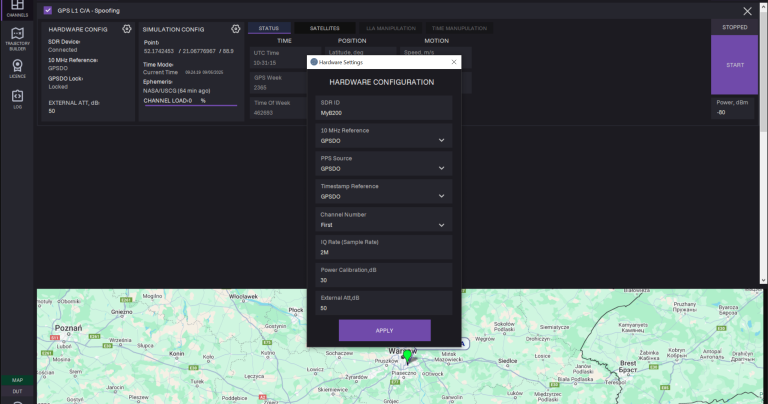
- 10 MHz Reference – Select clock source:
- Internal oscillator
- External 10 MHz reference
- GPS-disciplined oscillator (GPSDO)
- PPS Source – Select pulse-per-second synchronization input:
- Internal (free-run)
- External (trigger)
- GPSDO
- Timestamp Reference – Select timebase for GPS data alignment:
- Local system clock (PC)
- NTP Server
- GPSDO
Power Control
- Power control during signal generation.
- SDR output power calibration.
- Compensation for external RF signal path losses.
Spoofing Simulation
| Spoofing Type: |
|
| Time Manipulation: |
|
| Position Manipulation: |
|
Support
| Support: | 1 year of complimentary technical support |
| Manuals: | Online quick start guide |
GP-Simulator 2 – SDR-9363 Specification
RF Front-End
AD9363, 2×2 MIMO
Frequency Range
325 MHz – 3.8 GHz
RF Bandwidth
up to 20 MHz
ADC / DAC
12-bit, 61.44 MS/s
Max TX Power
- Up to 10 dBm CW (frequency dependent)
- Up to 0 dBm for GPS signal
Power Control Dynamic Range
80 dB
Power Regulation Step
0.5 dB
Baseband Chipset
Xilinx Artix-7 XC7A100T, 512 MB DDR3 RAM
Connectivity
USB 3.0 Type-C
Timing & Synchronization
- Embedded GPSDO
- Embedded 50 ppb TCXO
- 10 MHz Reference input/output
- Trigger/PPS Reference input
GPSDO Performance
- Live sky synchronization time accuracy: ± 250 ns to UTC RMS (2-Sigma)
- GPSDO 10 MHz Accuracy: 1 ppb
Data Stream Bandwidth
Up to 56 MSPS real-time (USB 3.0 host)
Mechanical
| Enclosure: | Anodized aluminum |
| Size: | 170 × 78 × 25 mm |
| Weight: | ~500 g |
Environmental
| Operational Temperature: | 0°C to +50°C |
| Storage Temperature: | -20°C ~ +80°C |
| Humidity: | 0% – 90% RH non-condensing @ 40°C |
Regulatory Compliance
Complies with the requirements: CE | ROHS
| EMC: | EN 55032 FCC Part 15B |
| Safety: | EN 62368-1 |
Warranty & Support
| Warranty: | 1 year Extended warranty is available |
| Support: | 1 year of complimentary technical support |